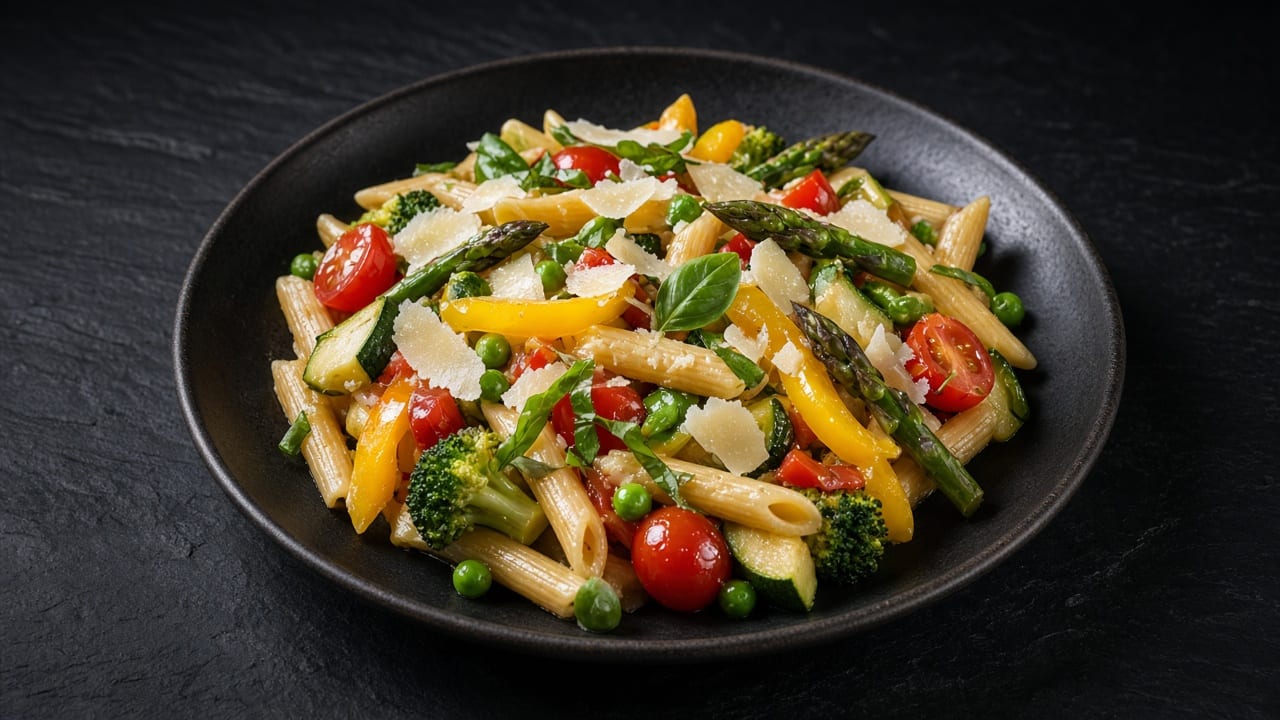
Penne Primavera with Spring Vegetables, Lemon and Parmesan
Inspired by techniques from Serious Eats, NYT Cooking and America's Test Kitchen.
Penne tossed with stir-fried spring vegetables, peas, butter, lemon and Parmesan for a light, bright pasta dish.
Always check the labels of the products you use.
Method
- 1
Boil the water. Bring 4 litres of water to the boil with the 32 g salt, ready for the pasta.
- 2
Stir-fry the vegetables. Heat 2 tbsp of the oil in a very large frying pan over medium-high heat, add the broccoli and pepper and stir-fry for 3 minutes, then add the asparagus and courgette and cook for 3-4 minutes more, until everything looks bright and just tender with a little colour at the edges. Cooking the vegetables in stages like this, rather than all at once, is what keeps each one crisp-tender instead of stewed and soft.
- 3
Add garlic and tomatoes. Stir in the remaining oil, garlic and cherry tomatoes and cook for 1-2 minutes, just until the tomatoes begin to soften. Season, then take the pan off the heat.
- 4
Cook the pasta and peas. Cook the penne in the boiling water for 1 minute less than the packet time, adding the peas for the final 2 minutes. Reserve 240 ml of the cooking water, then drain.
- 5
Combine and toss. Add the pasta, peas, butter, lemon zest and 120 ml of the reserved water to the vegetables, and toss over medium heat for 1-2 minutes, until a light, glossy coating forms around everything. The starchy pasta water and melting butter are what bind the sauce together rather than leaving it watery.
- 6
Finish off the heat. Take the pan off the heat and stir in the Parmesan and the lemon juice, tossing again until smooth. Adding the cheese and lemon juice only once the heat is off keeps the sauce silky instead of letting the cheese seize into clumps.
- 7
Serve. Scatter the torn basil over the top and serve straightaway, while the vegetables are still vivid and the pasta glossy.
Storage
Best eaten fresh, as the vegetables soften on standing, but leftovers keep in the fridge for up to 2 days. Reheat gently in a pan with a splash of water until piping hot, rather than in the microwave, to avoid the vegetables turning mushy. Cool leftovers in a shallow container and refrigerate within 2 hours (within 1 hour on a day above 32°C).
EU nutrition claims
- Source of protein: 3.7 g protein per 100 kcal, about 15% of energy (needs ≥ 12%)
- Low sugars: 3.1 g sugars per 100 g (limit ≤ 5 g)
Per 100 g of the finished dish, worked out from the nutrition per serving and the lowest likely cooked weight (about 342 g a serving), so the true values are, if anything, lower. Thresholds from the Annex to EU Regulation (EC) No 1924/2006. How we decide
Free sugars
0.1 g per serving
0.2 % of the 50 g daily maximum · 0.4 % of the ideal 25 g
Free sugars under 50 g a day, ideally about 25 g, based on WHO free-sugar guidance (not endorsed by WHO). The share shown is the share of one serving. WHO
Equipment
- very large frying pan or sauté pan (32 cm) or a wide casserole
- large pot (at least 5 litres)
- colander or tongs
- heatproof mug for pasta water
Nutrition per serving (estimated values)
| Per serving | Amount |
|---|---|
| Energy | 635 kcal |
| Protein | 23.6 g |
| Carbohydrate | 92.5 g |
| of which sugars | 10.5 g |
| of which free sugars | 0.1 g |
| Fat | 19.7 g |
| of which saturates | 6.5 g |
| Fibre | 9.3 g |
| Salt | 2.25 g |
Protein per 100 kcal
3.7 g High Protein needs ≥ 5 g (20% of energy)
Calculated from USDA FoodData Central ingredient values