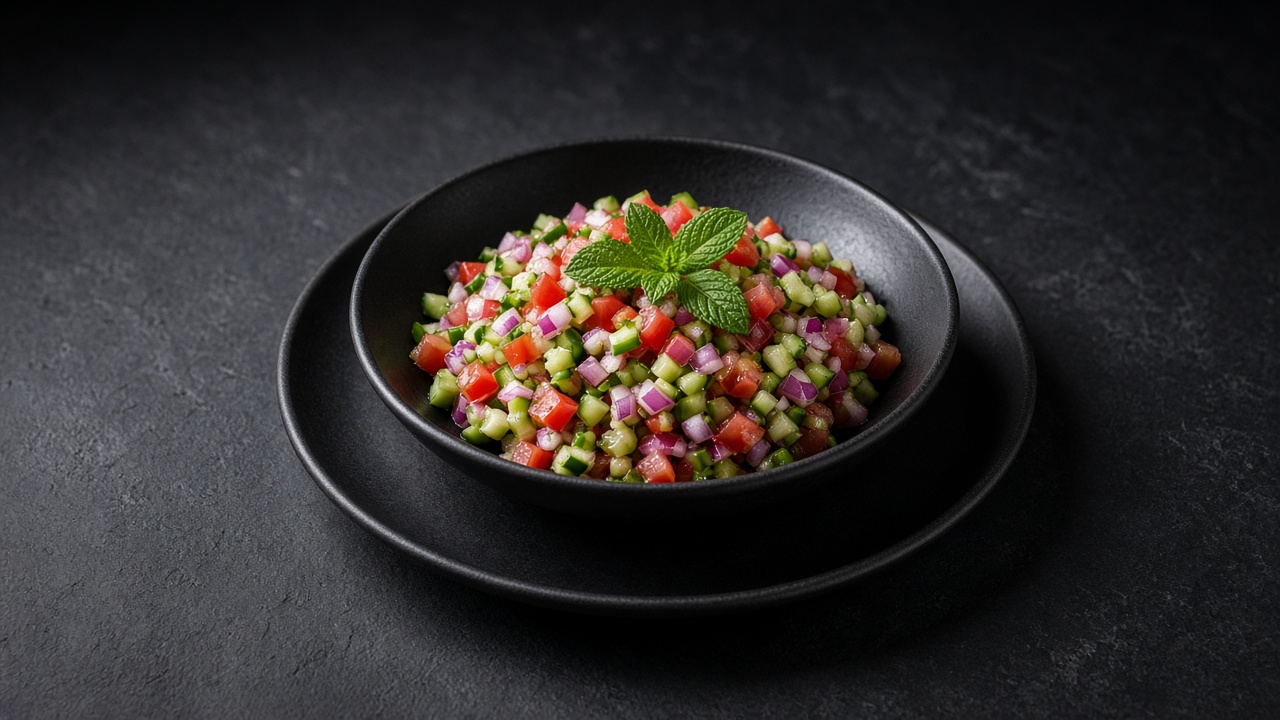
Persian Cucumber and Tomato Salad (Salad-e Shirazi)
Inspired by techniques from Serious Eats and NYT Cooking.
A refreshing Persian diced salad of cucumber, tomato and onion in a tangy lime and dried mint dressing, finished with sumac for a fruity sharpness. A short rest after dressing is all it needs to come together.
Based on the listed ingredients, none of the 14 major EU allergens. Always check product labels.
Method
- 1
Dice the vegetables. Cut the cucumber, tomato and onion into small, even dice of about 5 mm, with the onion slightly smaller than the rest. Keeping the pieces uniform means every spoonful gets a balanced mix of all three rather than one dominating. Tip them into the large bowl with the chopped parsley.
- 2
Whisk the dressing. Whisk the lime juice, olive oil, dried mint, salt and pepper together in the small bowl. Crumble the dried mint between your fingers as you add it, since this releases its aroma far more than simply sprinkling it in whole.
- 3
Dress and rest. Pour the dressing over the diced vegetables, toss well, and leave for 15 minutes. During this rest the salt draws juice out of the tomato and cucumber, which mingles with the lime and oil to flavour everything evenly.
- 4
Finish and garnish. Toss the salad again and taste, adding a touch more lime juice if you'd like it sharper. Sprinkle with the sumac and top with the mint sprigs just before serving, so its colour and citrusy tang stay bright rather than fading into the dressing.
Storage
Cover and refrigerate within 2 hours and eat within 2 days; the vegetables will soften gradually as they sit. This salad isn't suitable for freezing.
EU nutrition claims
- Low saturated fat: 0.6 g saturated fat per 100 g, 9.9% of energy (limits ≤ 1.5 g and ≤ 10%)
- Low sugars: 2.4 g sugars per 100 g (limit ≤ 5 g)
- Source of fibre: 1.8 g fibre per 100 kcal (needs ≥ 1.5 g)
Per 100 g of the finished dish, worked out from the nutrition per serving and the lowest likely cooked weight (about 233 g a serving), so the true values are, if anything, lower. Thresholds from the Annex to EU Regulation (EC) No 1924/2006. How we decide
Free sugars
0.3 g per serving
0.6 % of the 50 g daily maximum · 1.2 % of the ideal 25 g
Free sugars under 50 g a day, ideally about 25 g, based on WHO free-sugar guidance (not endorsed by WHO). The share shown is the share of one serving. WHO
Equipment
- chopping board and sharp knife
- large bowl
- small bowl
- whisk or fork
- vegetable peeler
Nutrition per serving (estimated values)
| Per serving | Amount |
|---|---|
| Energy | 137 kcal |
| Protein | 1.9 g |
| Carbohydrate | 11.4 g |
| of which sugars | 5.6 g |
| of which free sugars | 0.3 g |
| Fat | 10.4 g |
| of which saturates | 1.5 g |
| Fibre | 2.4 g |
| Salt | 1.11 g |
Protein per 100 kcal
1.4 g High Protein needs ≥ 5 g (20% of energy)
Calculated from USDA FoodData Central ingredient values