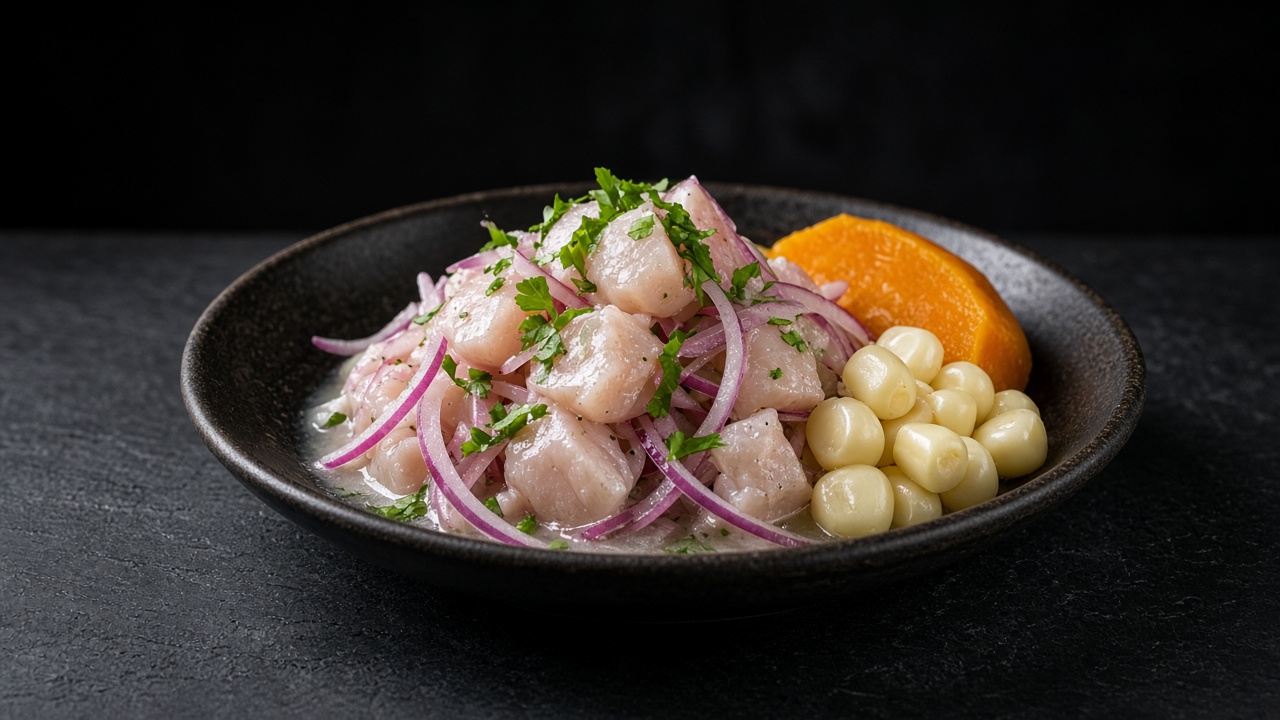
Peruvian Ceviche with Lime, Red Onion, Sweet Potato and Corn
Inspired by techniques from Serious Eats.
Cubes of sea bass cured for a few minutes in fresh lime with chilli, red onion and coriander, served cold with slices of sweet potato and corn.
Always check the labels of the products you use.
Method
- 1
Cook the sides first. Boil the whole sweet potato for 30-35 min, until a knife slips in easily, then cool, peel and cut it into 1.5 cm rounds. Give the corn 8-10 min in boiling water, drain, cool and cut into thick wheels. Chill both so everything on the plate is cold.
- 2
Crisp the onion. Drop the onion slices into iced water for 10 min, then drain them thoroughly. The cold soak leaches out some of the harsh sulphur compounds while keeping the slices snappy.
- 3
Season the fish. With roughly 10 min to go before eating, take the cubed fish from the fridge and toss it with the salt in the glass bowl. Salting first helps the fish absorb flavour and firm slightly.
- 4
Add the lime. Pour in the lime juice, add the chilli and fold gently with a spoon. Over 5-10 min, folding once or twice, the outer layer of each cube turns white and opaque while the middle stays translucent, because the acid sets the surface proteins.
- 5
Finish and plate. Fold through the onion, coriander and pepper. Spoon onto the chilled plates with some of the tangy juice, tuck the sweet potato and corn alongside and serve without delay.
Storage
Ceviche is made to be eaten straight away; throw away any leftovers. The boiled sweet potato and corn keep for 2 days covered in the fridge.
Why this label?
25.3 g protein for 280 kcal = 9 g per 100 kcal, so protein gives about 36% of the energy. High Protein needs at least 20% (5 g per 100 kcal), the condition in the Annex to EU Regulation (EC) No 1924/2006. How we decide
- Total fat: 10.9 % of energy (limit ≤ 30%)
- Saturated fat: 2.9 % of energy (limit < 10%)
- Free sugars: 0.7 % of energy (limit < 10%)
- Salt: 1.45 g (limit ≤ 1.7 g)
- Fibre or fruit & veg: 5.2 g fibre / 38 g veg (limit ≥ 3.5 g fibre or 80 g fruit & veg)
Per serving, worked out from the nutrition table against our rule based on the WHO healthy diet guidance. Not endorsed by WHO.
EU nutrition claims
- Low fat: 1.4 g fat per 100 g (limit ≤ 3 g)
- Low saturated fat: 0.4 g saturated fat per 100 g, 2.9% of energy (limits ≤ 1.5 g and ≤ 10%)
- Low sugars: 4.5 g sugars per 100 g (limit ≤ 5 g)
- Source of fibre: 1.9 g fibre per 100 kcal (needs ≥ 1.5 g)
Per 100 g of the finished dish, worked out from the nutrition per serving and the lowest likely cooked weight (about 239 g a serving), so the true values are, if anything, lower. Thresholds from the Annex to EU Regulation (EC) No 1924/2006. How we decide
Free sugars
0.5 g per serving
1 % of the 50 g daily maximum · 2 % of the ideal 25 g
Free sugars under 50 g a day, ideally about 25 g, based on WHO free-sugar guidance (not endorsed by WHO). The share shown is the share of one serving. WHO
Equipment
- 2 saucepans
- sharp knife
- bowl of iced water
- sieve
- large glass or ceramic bowl
- 4 chilled plates
Nutrition per serving (estimated values)
| Per serving | Amount |
|---|---|
| Energy | 280 kcal |
| Protein | 25.3 g |
| Carbohydrate | 39.5 g |
| of which sugars | 10.7 g |
| of which free sugars | 0.5 g |
| Fat | 3.4 g |
| of which saturates | 0.9 g |
| Fibre | 5.2 g |
| Salt | 1.45 g |
Protein per 100 kcal
9 g meets High Protein (≥ 5 g, 20% of energy)
Calculated from USDA FoodData Central ingredient values