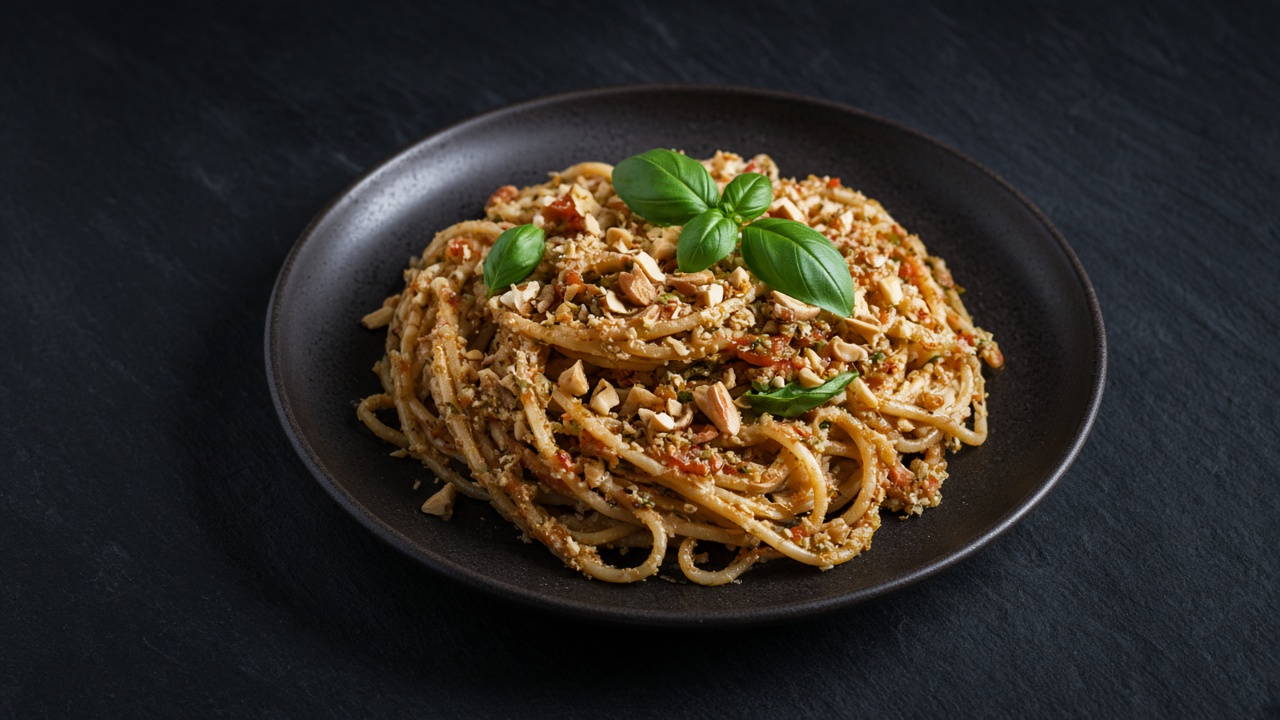
Linguine with Pesto alla Trapanese (Almond, Tomato and Basil)
Inspired by techniques from Serious Eats and America's Test Kitchen.
A raw Sicilian pesto of toasted almonds, ripe tomatoes and basil tossed through linguine for a bright, summery sauce.
Always check the labels of the products you use.
Method
- 1
Toast the Almonds. Toast the almonds in the dry frying pan over medium-low heat for 4-5 minutes until pale gold, then leave to cool. Toasting draws out the almonds' natural oils and deepens their flavour before they're pounded into the sauce.
- 2
Peel and Seed the Tomatoes. Score a cross in the base of each tomato, blanch for 30 seconds in boiling water, then plunge into iced water and slip off the skins; halve, scoop out the seeds and chop the flesh. Removing the seeds and juice stops the pesto turning watery, keeping it thick and spoonable.
- 3
Pound the Pesto. Pound the garlic with the coarse salt to a paste, add the almonds and pound again, then work in the basil, both cheeses, and finally the chopped tomatoes and olive oil until you have a rough, pinkish sauce. Pounding rather than chopping bruises and crushes the ingredients, releasing far more aroma than a quick chop would. If using a food processor, pulse the garlic and almonds first, then add everything else and pulse briefly to a rough paste.
- 4
Set Aside Two-Thirds. Spoon about two-thirds of the pesto into the serving bowl, keeping the rest back to serve on top.
- 5
Cook the Linguine. Bring 3 litres of water to the boil with the salt and cook the linguine until al dente.
- 6
Toss Off the Heat. Reserve 240ml of the pasta water, then lift the pasta into the serving bowl with 60ml of the water and toss off the heat until creamy and well coated, adding more water by the tablespoon if it looks dry. Tossing off the heat keeps the tomatoes and basil tasting fresh rather than cooked, which is the whole point of this raw sauce.
- 7
Serve. Serve with the remaining pesto spooned over the top.
Storage
Best made fresh, as the raw tomato in the pesto doesn't keep well; leftovers can be kept covered in the fridge for up to a day. Serve any leftover pesto cold rather than reheating, as heat dulls its fresh flavour; if tossing with warm pasta, use pasta that's merely hot rather than simmering. Cool leftovers in a shallow container and refrigerate within 2 hours (within 1 hour on a day above 32°C).
EU nutrition claims
- Source of protein: 3.4 g protein per 100 kcal, about 14% of energy (needs ≥ 12%)
- Low sugars: 2.6 g sugars per 100 g (limit ≤ 5 g)
Per 100 g of the finished dish, worked out from the nutrition per serving and the lowest likely cooked weight (about 223 g a serving), so the true values are, if anything, lower. Thresholds from the Annex to EU Regulation (EC) No 1924/2006. How we decide
Free sugars
0 g per serving
0 % of the 50 g daily maximum · 0 % of the ideal 25 g
Free sugars under 50 g a day, ideally about 25 g, based on WHO free-sugar guidance (not endorsed by WHO). The share shown is the share of one serving. WHO
Equipment
- small dry frying pan
- small saucepan for blanching
- bowl of iced water
- mortar and pestle or food processor
- large heatproof serving bowl
- large pot (at least 5 litres)
- colander or tongs
- heatproof mug for pasta water
Nutrition per serving (estimated values)
| Per serving | Amount |
|---|---|
| Energy | 657 kcal |
| Protein | 22.3 g |
| Carbohydrate | 82.5 g |
| of which sugars | 5.8 g |
| of which free sugars | 0 g |
| Fat | 26.9 g |
| of which saturates | 5.3 g |
| Fibre | 6.3 g |
| Salt | 1.83 g |
Protein per 100 kcal
3.4 g High Protein needs ≥ 5 g (20% of energy)
Calculated from USDA FoodData Central ingredient values