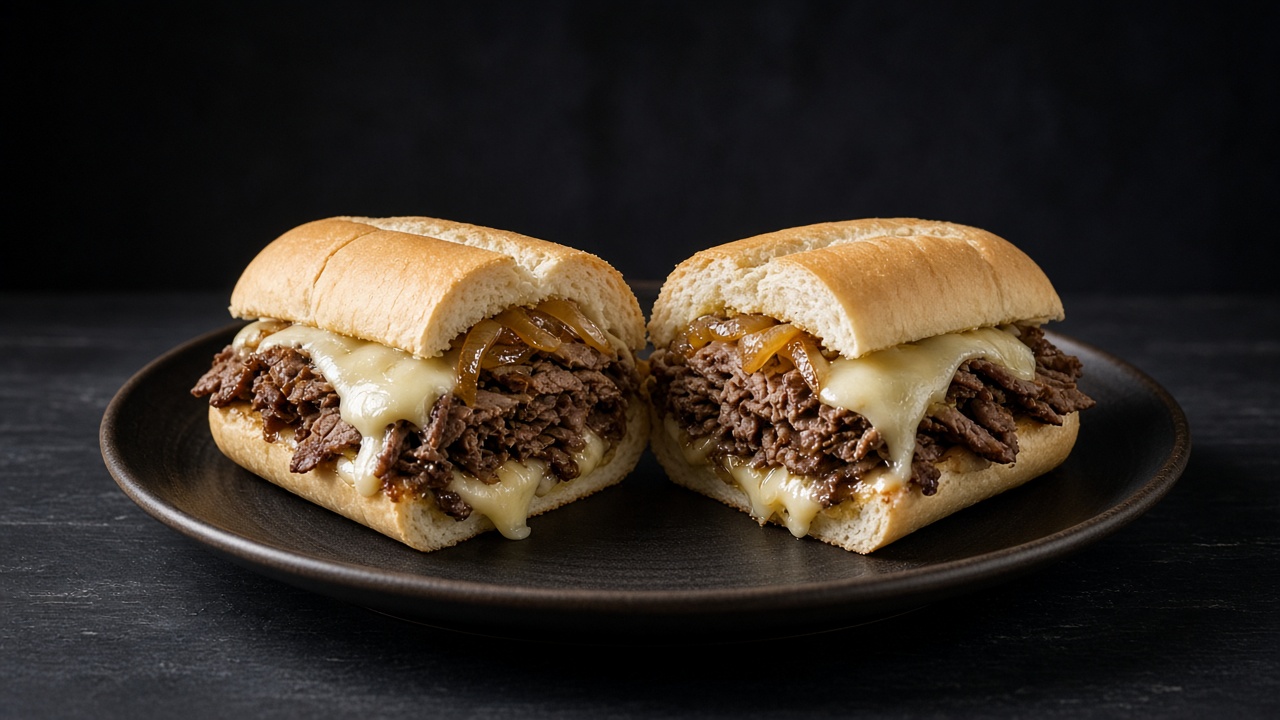
Philly Cheesesteaks with Shaved Ribeye and Soft Onions
Inspired by techniques from NYT Cooking and America's Test Kitchen.
Partly frozen ribeye is shaved paper-thin, seared hard in batches, drained, combined with golden onions, topped with melting white cheese and scooped into toasted rolls.
Always check the labels of the products you use.
Method
- 1
Freeze the steak. Put the steak on a tray in the freezer for 45-60 minutes until very firm but not frozen solid.
- 2
Toast the rolls. Heat the oven to 200 °C (180 °C fan). Split the rolls lengthwise, leaving a hinge, and toast on a tray for 5 minutes until lightly crisp.
- 3
Shave the beef. Slice the firm steak as thinly as possible across the grain, then roughly chop the pile 10-15 times.
- 4
Cook the onions. Heat 1 tbsp oil in the pan over medium heat and cook the onions for 10 minutes, stirring, until soft and golden. Tip out.
- 5
Sear the steak. Heat the remaining oil over high heat until smoking. Add the beef in one layer and cook undisturbed for 3 minutes until browned underneath, then stir for 1-2 minutes until no pink remains (at least 63 °C). Drain in the colander, then return to the pan over medium heat with the onions and pepper.
- 6
Melt the cheese. Divide the meat into 4 long piles, lay 2 slices of cheese over each and cover for 1 minute until melted.
- 7
Fill. Slide a spatula under each pile, scoop it into a roll and serve hot.
Storage
Best eaten hot. Refrigerate leftover filling within 1 hour, use within 3 days and reheat until piping hot (74 °C).
Why this label?
44.2 g protein for 870 kcal = 5.1 g per 100 kcal, so protein gives about 20% of the energy. High Protein needs at least 20% (5 g per 100 kcal), the condition in the Annex to EU Regulation (EC) No 1924/2006. How we decide
EU nutrition claims
- Low sugars: 2.8 g sugars per 100 g (limit ≤ 5 g)
Per 100 g of the finished dish, worked out from the nutrition per serving and the lowest likely cooked weight (about 250 g a serving), so the true values are, if anything, lower. Thresholds from the Annex to EU Regulation (EC) No 1924/2006. How we decide
Free sugars
3.7 g per serving
7.4 % of the 50 g daily maximum · 14.8 % of the ideal 25 g
Free sugars under 50 g a day, ideally about 25 g, based on WHO free-sugar guidance (not endorsed by WHO). The share shown is the share of one serving. WHO
Equipment
- baking tray
- very sharp knife
- large heavy frying pan or flat griddle (cast iron ideal)
- two metal spatulas
- colander set over a bowl
- instant-read thermometer
Nutrition per serving (estimated values)
| Per serving | Amount |
|---|---|
| Energy | 870 kcal |
| Protein | 44.2 g |
| Carbohydrate | 49.8 g |
| of which sugars | 6.9 g |
| of which free sugars | 3.7 g |
| Fat | 54.3 g |
| of which saturates | 20.8 g |
| Fibre | 3.1 g |
| Salt | 2.4 g |
Protein per 100 kcal
5.1 g meets High Protein (≥ 5 g, 20% of energy)
Calculated from USDA FoodData Central ingredient values