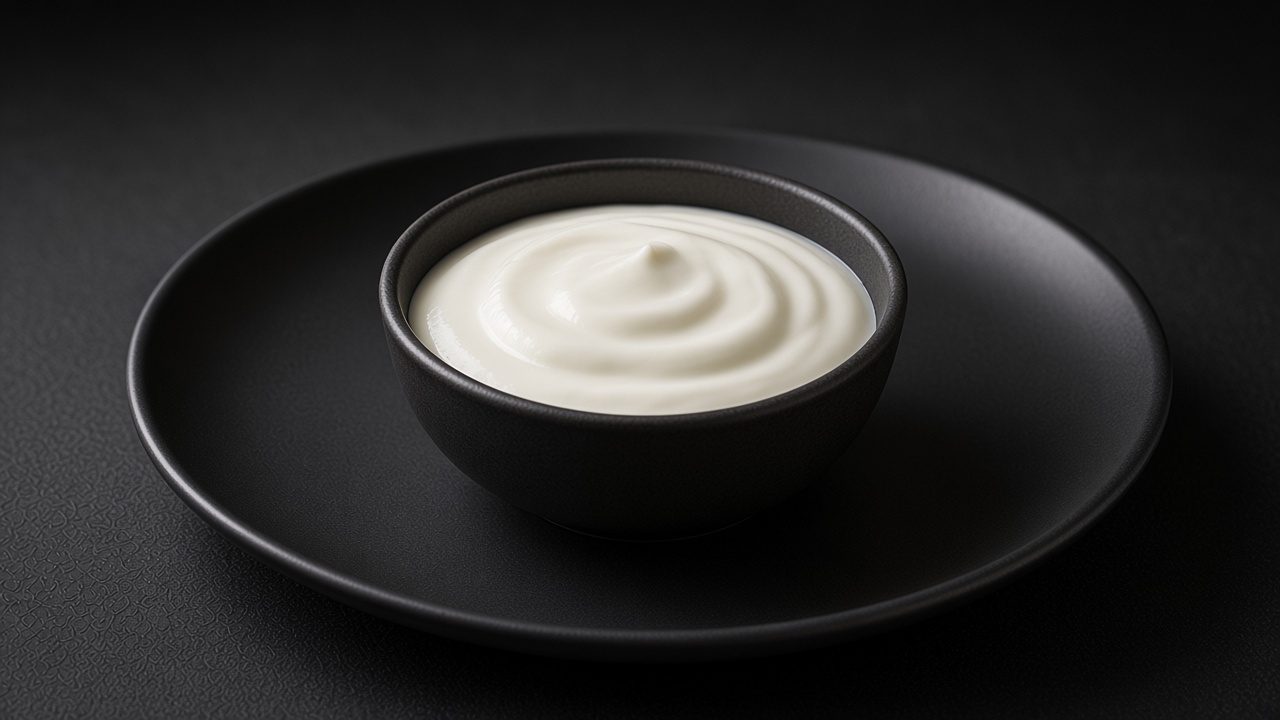
Plain Whole Milk Yoghurt
Inspired by techniques from Serious Eats.
Whole milk is heated to concentrate it slightly, cooled to a lukewarm temperature, then cultured with a spoonful of live yoghurt and held warm until it thickens and turns pleasantly tangy. The method is mostly patience: heat, cool, stir in the culture, and give it the steady warmth and time it needs to set.
Always check the labels of the products you use.
Method
- 1
Heat the milk. Pour the milk into a saucepan and heat gently over medium heat until an instant-read thermometer reads 82 °C. Hold it between 82-88 °C for 10-30 minutes; a longer hold drives off more water and gives a thicker, more concentrated yoghurt.
- 2
Cool and stir in the culture. Let the milk cool to about 43 °C. In a small bowl, whisk the yoghurt with a few spoonfuls of the warm milk until smooth, then stir this mixture back into the pot of lukewarm milk until evenly distributed.
- 3
Transfer to jars. Pour the cultured milk into glass jars or whatever incubating vessel you're using, such as a yoghurt maker or slow cooker.
- 4
Incubate. Cover and keep the jars warm, aiming to hold them near 43 °C: submerge them up to their necks in a temperature-controlled water bath, set them in a turned-off oven with the light on, wrap them in towels, or hold them in warm water in a cooler. Setting can take as little as 3-4 hours or as long as 18 hours depending on how warm you keep them. Once set, let the yoghurt sit at room temperature up to 12 hours more to build a stronger culture.
- 5
Chill and finish. Move the yoghurt to the refrigerator. If you can, let it rest a further 2-3 days before eating to let the culture strengthen further. Strain through a fine cloth or sieve for a thicker, Greek-style yoghurt if you like, and set aside a few tablespoons of this batch to start your next one.
Storage
Refrigerate in a covered container; homemade yoghurt keeps well for 1-2 weeks. Set aside a few tablespoons with live cultures to start your next batch.
Why this label?
7.4 g protein for 144 kcal = 5.1 g per 100 kcal, so protein gives about 21% of the energy. High Protein needs at least 20% (5 g per 100 kcal), the condition in the Annex to EU Regulation (EC) No 1924/2006. How we decide
EU nutrition claims
- Low salt: 0.24 g salt per 100 g (limit ≤ 0.3 g)
Per 100 g of the finished dish, worked out from the nutrition per serving and the lowest likely cooked weight (about 105 g a serving), so the true values are, if anything, lower. Thresholds from the Annex to EU Regulation (EC) No 1924/2006. How we decide
Free sugars
0 g per serving
0 % of the 50 g daily maximum · 0 % of the ideal 25 g
Free sugars under 50 g a day, ideally about 25 g, based on WHO free-sugar guidance (not endorsed by WHO). The share shown is the share of one serving. WHO
Equipment
- medium saucepan
- instant-read thermometer
- small bowl
- glass jars or another incubating vessel
- insulated cooler, turned-off oven with the light on, or a yoghurt maker
- fine-mesh strainer or cloth (if straining for a thicker yoghurt)
Nutrition per serving (estimated values)
| Per serving | Amount |
|---|---|
| Energy | 144 kcal |
| Protein | 7.4 g |
| Carbohydrate | 11.3 g |
| of which sugars | 11.3 g |
| of which free sugars | 0 g |
| Fat | 7.7 g |
| of which saturates | 4.4 g |
| Fibre | 0 g |
| Salt | 0.25 g |
Protein per 100 kcal
5.1 g meets High Protein (≥ 5 g, 20% of energy)
Calculated from USDA FoodData Central ingredient values