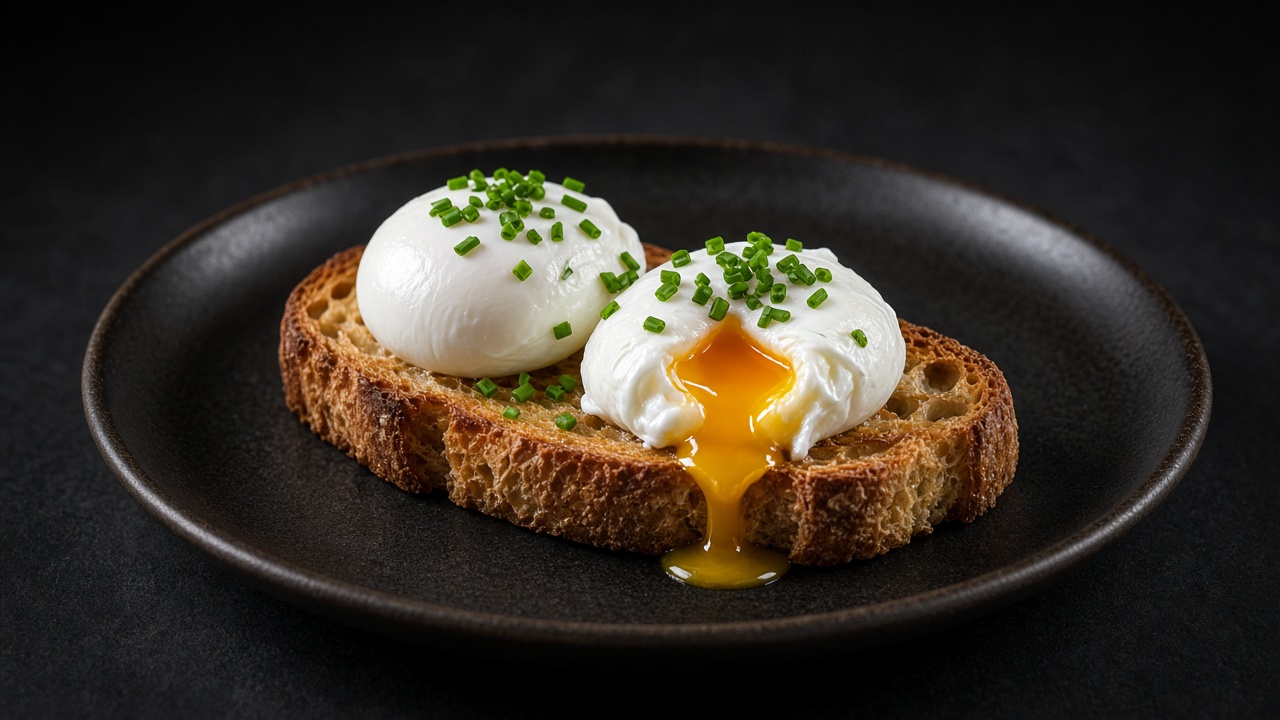
Poached Eggs on Buttered Sourdough Toast with Chives
Inspired by techniques from America's Test Kitchen and NYT Cooking.
Very fresh eggs, drained of their thin whites, are poached in barely simmering water until the yolks are set, then served on buttered sourdough with chives.
Always check the labels of the products you use.
Method
- 1
Heat the water. Bring the water to the boil in the wide pan, then lower the heat until it barely shivers, with small bubbles on the base (about 90 °C). Gentle heat cooks the white evenly without tearing it apart.
- 2
Drain the eggs. Crack one egg into the sieve set over the small bowl and swirl for 20-30 seconds so the thin, watery white drips away, then tip the egg into a ramekin. Repeat with each egg. Removing the loose white is what stops ragged wisps forming in the pan.
- 3
Poach. Hold a ramekin just above the water and gently tip in the egg, then repeat with the others, spacing them apart. Keep the water at a bare simmer and cook for 6-7 minutes, until the whites are firm and the yolk feels firm when pressed with a spoon (71 °C at the centre). Set yolks need a few minutes longer than runny ones.
- 4
Toast the bread. Meanwhile, toast the bread and spread it with the butter. Thick, well-toasted sourdough holds the eggs without going soggy.
- 5
Serve. Lift each egg with the slotted spoon, rest it on kitchen paper for a moment to drain, then set 2 on each toast. Scatter with chives, salt and pepper and serve.
Storage
Best eaten straight away. Poached eggs can be chilled in cold water for up to 1 day and reheated in hot water until piping hot. Cool leftovers in a shallow container and refrigerate within 2 hours (within 1 hour on a day above 32°C).
Why this label?
19.2 g protein for 361 kcal = 5.3 g per 100 kcal, so protein gives about 21% of the energy. High Protein needs at least 20% (5 g per 100 kcal), the condition in the Annex to EU Regulation (EC) No 1924/2006. How we decide
EU nutrition claims
- Low sugars: 2.5 g sugars per 100 g (limit ≤ 5 g)
Per 100 g of the finished dish, worked out from the nutrition per serving and the lowest likely cooked weight (about 130 g a serving), so the true values are, if anything, lower. Thresholds from the Annex to EU Regulation (EC) No 1924/2006. How we decide
Free sugars
2.8 g per serving
5.6 % of the 50 g daily maximum · 11.2 % of the ideal 25 g
Free sugars under 50 g a day, ideally about 25 g, based on WHO free-sugar guidance (not endorsed by WHO). The share shown is the share of one serving. WHO
Equipment
- wide saucepan or casserole (about 24 cm, at least 2.5 litres)
- fine sieve
- small bowl
- 4 ramekins or small dishes
- slotted spoon
- kitchen paper
- toaster or grill
- instant-read probe thermometer
Nutrition per serving (estimated values)
| Per serving | Amount |
|---|---|
| Energy | 361 kcal |
| Protein | 19.2 g |
| Carbohydrate | 32.1 g |
| of which sugars | 3.2 g |
| of which free sugars | 2.8 g |
| Fat | 17.1 g |
| of which saturates | 7.3 g |
| Fibre | 1.4 g |
| Salt | 1.99 g |
Protein per 100 kcal
5.3 g meets High Protein (≥ 5 g, 20% of energy)
Calculated from USDA FoodData Central ingredient values