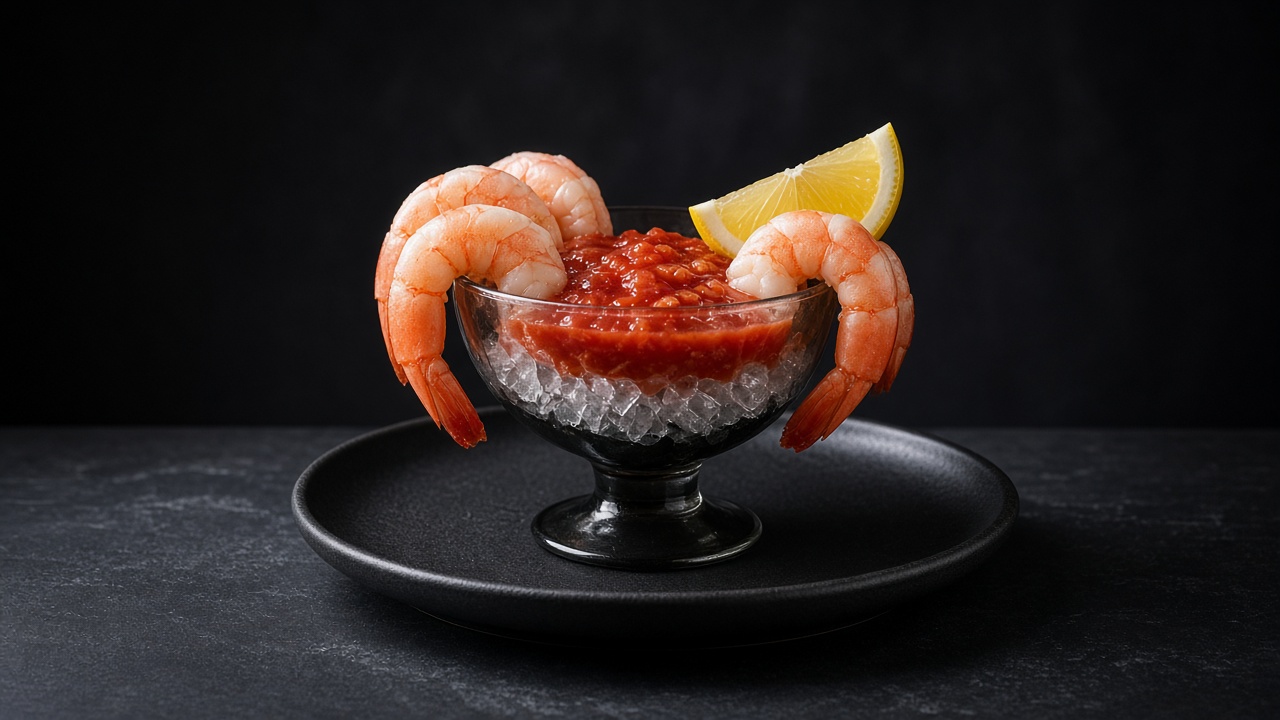
Gently Poached Prawns with Cocktail Sauce
Inspired by techniques from America's Test Kitchen, NYT Cooking and Serious Eats.
Plump king prawns gently poached in aromatic water, chilled and served around glasses of tangy horseradish cocktail sauce. A cool, elegant starter that can be prepared ahead.
Always check the labels of the products you use.
Method
- 1
Devein in the shell. Using kitchen scissors, snip along the back of each prawn shell and pull out the dark vein, leaving the shell in place. The shell shields the delicate flesh during cooking and adds flavour to the poaching liquid.
- 2
Start from cold. Put the prawns, cold water, salt, bay leaves, peppercorns and celery seeds into the saucepan, then squeeze in the lemon and drop in the halves. Heat over medium heat, stirring now and then, for 6-8 minutes until the water reaches 77°C and the prawns begin to turn pink. Starting cold heats the prawns slowly and evenly, so they stay tender.
- 3
Rest off the heat. Take the pan off the heat, cover and leave for 5-7 minutes until the prawns are pink all over, firm and opaque right through. Cut one in half to check; the centre should read at least 63°C. Gentle residual heat finishes them without the rubbery texture that rapid boiling causes.
- 4
Chill and peel. Tip the ice into the pan to stop the cooking and leave for 5 minutes until the prawns are cold. Drain, peel them, leaving the tails on, and refrigerate until serving, for up to 24 hours. Quick chilling halts carryover cooking and keeps the texture plump.
- 5
Mix the sauce. Stir together the ketchup, horseradish, lemon juice, hot sauce and cayenne. Taste, adding more horseradish if you like a sharper kick. Its sharp heat cuts through the sweetness of the ketchup and the prawns.
- 6
Assemble the glasses. Spoon the sauce into the glasses and hang the prawns around the rims. Serve well chilled with lemon wedges.
Storage
Keep the prawns and sauce chilled and eat within 24 hours. Do not leave them out of the fridge for more than 2 hours. Cool leftovers in a shallow container and refrigerate within 2 hours (within 1 hour on a day above 32°C).
Why this label?
23.1 g protein for 133 kcal = 17.4 g per 100 kcal, so protein gives about 69% of the energy. High Protein needs at least 20% (5 g per 100 kcal), the condition in the Annex to EU Regulation (EC) No 1924/2006. How we decide
EU nutrition claims
- Low fat: 0.9 g fat per 100 g (limit ≤ 3 g)
- Low saturated fat: 0.1 g saturated fat per 100 g, 0.7% of energy (limits ≤ 1.5 g and ≤ 10%)
Per 100 g of the finished dish, worked out from the nutrition per serving and the lowest likely cooked weight (about 87 g a serving), so the true values are, if anything, lower. Thresholds from the Annex to EU Regulation (EC) No 1924/2006. How we decide
Free sugars
6.6 g per serving
13.2 % of the 50 g daily maximum · 26.4 % of the ideal 25 g
Free sugars under 50 g a day, ideally about 25 g, based on WHO free-sugar guidance (not endorsed by WHO). The share shown is the share of one serving. WHO
Equipment
- kitchen scissors
- large saucepan with a lid (3-4 litres)
- colander
- 4 small glasses or bowls
- instant-read probe thermometer
Nutrition per serving (estimated values)
| Per serving | Amount |
|---|---|
| Energy | 133 kcal |
| Protein | 23.1 g |
| Carbohydrate | 9.9 g |
| of which sugars | 7.2 g |
| of which free sugars | 6.6 g |
| Fat | 0.8 g |
| of which saturates | 0.1 g |
| Fibre | 0.4 g |
| Salt | 2.23 g |
Protein per 100 kcal
17.4 g meets High Protein (≥ 5 g, 20% of energy)
Calculated from USDA FoodData Central ingredient values