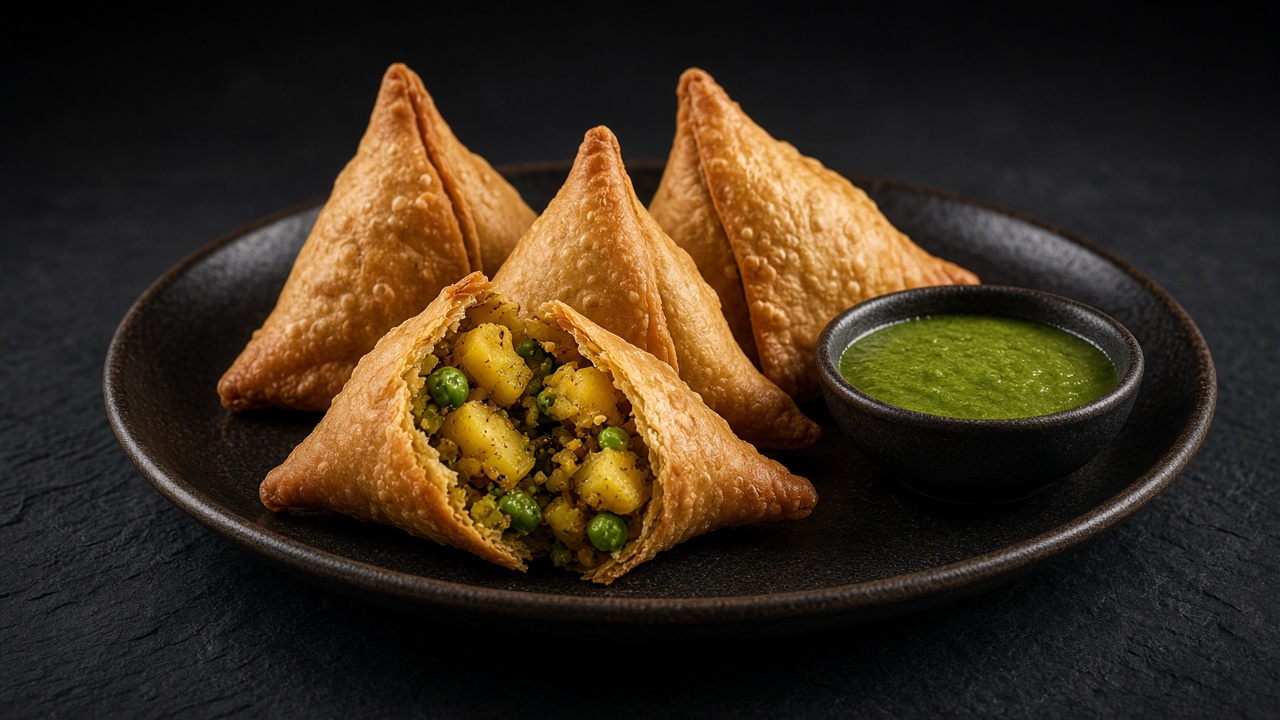
Potato and Pea Samosas with Coriander-Mint Chutney
Inspired by techniques from America's Test Kitchen and King Arthur Baking.
Crisp, blistered pastry triangles filled with a tempered potato and pea mixture, served warm with a bright coriander and mint chutney.
Always check the labels of the products you use.
Method
- 1
Make the pastry. Mix the flour and pastry salt, then rub in the 3 tbsp oil with your fingertips until it looks like damp sand. Stir in the yoghurt and enough ice-cold water to form a firm, smooth dough that is not sticky, knead for 1 minute, wrap and rest for 30 minutes. Coating the flour with oil limits gluten, giving a short, crisp crust rather than a chewy one.
- 2
Boil the potatoes. Cover the potato cubes with cold unsalted water, bring to the boil and simmer for 8-10 minutes until just tender. Drain and leave to steam dry, so the filling stays fluffy rather than wet.
- 3
Temper the spices. Heat the 2 tbsp oil in the frying pan over medium-high heat and add the cumin, fennel and mustard seeds. Fry for 30-60 seconds until the mustard seeds pop, which releases their aromatic oils into the fat. Add the turmeric, chilli flakes and onion and cook for 5-6 minutes until soft.
- 4
Finish the filling. Stir in the garlic and ginger for 1 minute, then add the potatoes, peas and filling salt and cook for 3 minutes, lightly crushing some of the potato so the mixture holds together. Off the heat, stir in the coriander and lemon juice, spread out in a bowl and cool completely. Warm filling would soften the pastry and make it tear.
- 5
Blend the chutney. Blend the coriander, mint, green chilli, lemon juice, sugar, chutney salt and water until smooth and bright green. Chill until needed; the acidity of the lemon helps keep the colour vivid.
- 6
Shape the samosas. Divide the pastry into 6 pieces and roll each into an 18 cm round about 2 mm thick, then cut in half. Wet the straight edge of one half, fold it into a cone, overlap and press the seam, then fill with about 2 rounded tbsp filling. Wet the open edge and pinch it firmly closed into a triangle, making 12 in all; any gaps will let oil in.
- 7
Fry low and slow. Heat 5-6 cm of oil in the heavy pot to 160 °C. Fry 3-4 samosas at a time for 8-10 minutes, turning, until blistered, deep golden and crisp, and bring the oil back to 160 °C between batches. Starting cooler keeps the pastry from puffing away from the filling and lets it crisp right through.
- 8
Serve warm. Drain on a wire rack and serve warm with the chilled chutney. Resting on a rack rather than paper keeps the bases crisp.
Storage
Refrigerate cooled samosas for up to 2 days and reheat on a tray in a 200 °C (180 °C fan) oven for 10-12 minutes until crisp and piping hot. The chutney keeps for 2 days in the fridge. Cool leftovers in a shallow container and refrigerate within 2 hours (within 1 hour on a day above 32°C).
EU nutrition claims
- Low saturated fat: 1.4 g saturated fat per 100 g, 3.5% of energy (limits ≤ 1.5 g and ≤ 10%)
- Low sugars: 2.9 g sugars per 100 g (limit ≤ 5 g)
Per 100 g of the finished dish, worked out from the nutrition per serving and the lowest likely cooked weight (about 129 g a serving), so the true values are, if anything, lower. Thresholds from the Annex to EU Regulation (EC) No 1924/2006. How we decide
Free sugars
0.5 g per serving
1 % of the 50 g daily maximum · 2 % of the ideal 25 g
Free sugars under 50 g a day, ideally about 25 g, based on WHO free-sugar guidance (not endorsed by WHO). The share shown is the share of one serving. WHO
Equipment
- medium saucepan
- colander
- large frying pan
- large bowl
- rolling pin
- small bowl of water
- small blender or food processor
- large heavy pot (at least 5 l)
- deep-fry thermometer
- spider or slotted spoon
- wire rack set over a tray
Nutrition per serving (estimated values)
| Per serving | Amount |
|---|---|
| Energy | 469 kcal |
| Protein | 8.5 g |
| Carbohydrate | 59.6 g |
| of which sugars | 3.7 g |
| of which free sugars | 0.5 g |
| Fat | 22.4 g |
| of which saturates | 1.8 g |
| Fibre | 5.4 g |
| Salt | 1.28 g |
Protein per 100 kcal
1.8 g High Protein needs ≥ 5 g (20% of energy)
Calculated from USDA FoodData Central ingredient values