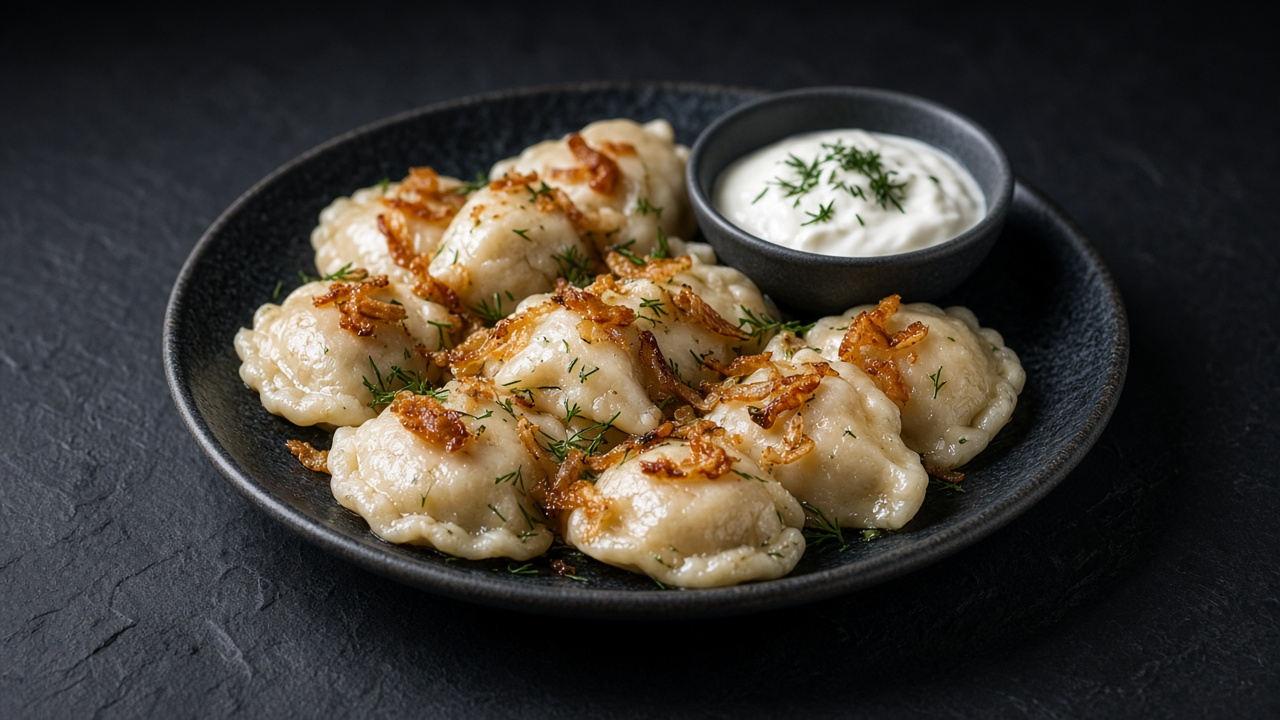
Potato and Onion Vareniki with Sour Cream
Inspired by techniques from NYT Cooking and Serious Eats.
Soft hand-folded dumplings filled with mashed potato, onion and cottage cheese, boiled and finished with butter, sour cream and dill.
Always check the labels of the products you use.
Method
- 1
Make the dough. Melt the butter into the hot water, then stir the mixture into the flour and salt, followed by the beaten egg. Knead for 5-6 minutes until the dough turns smooth and soft.
- 2
Rest the dough. Cover the dough and rest it for 30 minutes. This relaxes the gluten so it rolls out thin later without shrinking back or tearing.
- 3
Boil the potatoes. Put the potatoes in a pan of cold water with a pinch of salt and boil for 15-20 minutes, until very tender. Drain well and leave to steam dry for 2 minutes, which drives off excess moisture before mashing.
- 4
Cook the onions. While the potatoes cook, cook the chopped onions in 40 g of butter in a large frying pan over medium heat for 12-15 minutes, until soft and golden.
- 5
Mash and cool the filling. Mash the potatoes with two-thirds of the cooked onions, the cottage cheese, salt and pepper, then leave the mixture to cool completely - filling a dough while it's still warm makes the dough sticky and prone to tearing. Keep the remaining onions aside for topping later.
- 6
Shape the vareniki. Roll out half the dough to 2 mm thick and cut rounds with an 8 cm cutter. Put a heaped tablespoon (about 25 g) of filling in the centre of each round, fold it into a half-moon, and pinch the edges firmly from one end to the other, pressing out any trapped air as you go - air left inside will make them burst as they cook. Re-roll the scraps once and repeat with the remaining dough; you should get about 30 vareniki in total.
- 7
Cook the vareniki. Bring 4 litres of water to the boil with the 40 g salt, then lower to a gentle boil. Cook the vareniki in 3 batches: once they float, cook for 2-3 minutes more, until the dough at the pinched edges is tender. Lift out with a slotted spoon.
- 8
Finish and serve. Toss the cooked vareniki with the butter, then serve topped with the reserved onions, sour cream and chopped dill.
Storage
Uncooked, shaped vareniki can be frozen on a tray then bagged for up to 2 months and cooked straight from frozen, adding a minute or two to the time. Cooked vareniki keep in the fridge for up to 2 days; reheat gently in a pan with a little butter until piping hot throughout. Cool leftovers in a shallow container and refrigerate within 2 hours (within 1 hour on a day above 32°C).
EU nutrition claims
- Low sugars: 2.9 g sugars per 100 g (limit ≤ 5 g)
Per 100 g of the finished dish, worked out from the nutrition per serving and the lowest likely cooked weight (about 228 g a serving), so the true values are, if anything, lower. Thresholds from the Annex to EU Regulation (EC) No 1924/2006. How we decide
Free sugars
0 g per serving
0 % of the 50 g daily maximum · 0 % of the ideal 25 g
Free sugars under 50 g a day, ideally about 25 g, based on WHO free-sugar guidance (not endorsed by WHO). The share shown is the share of one serving. WHO
Equipment
- small saucepan
- large bowl
- saucepan for the potatoes
- potato masher or ricer
- large frying pan
- rolling pin
- 8 cm round cutter or glass
- 2 floured baking trays
- large pot (at least 5 litres)
- slotted spoon
Nutrition per serving (estimated values)
| Per serving | Amount |
|---|---|
| Energy | 729 kcal |
| Protein | 17.6 g |
| Carbohydrate | 96.3 g |
| of which sugars | 6.6 g |
| of which free sugars | 0 g |
| Fat | 30.8 g |
| of which saturates | 17.7 g |
| Fibre | 6.6 g |
| Salt | 2.35 g |
Protein per 100 kcal
2.4 g High Protein needs ≥ 5 g (20% of energy)
Calculated from USDA FoodData Central ingredient values