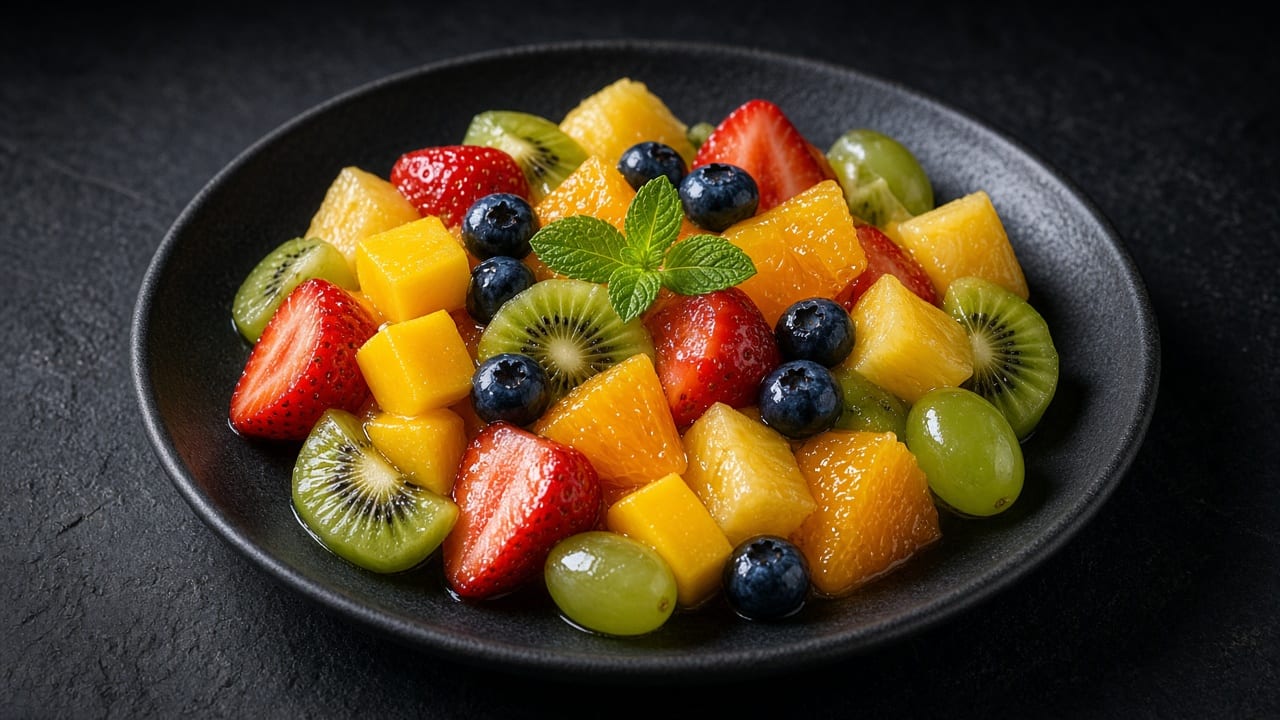
Rainbow Fruit Salad with Lime and Mint
Inspired by techniques from NYT Cooking and America's Test Kitchen.
A colourful mix of strawberries, pineapple, mango, kiwi and blueberries tossed in a fragrant lime and mint sugar for a refreshing, no-fuss fruit salad.
Based on the listed ingredients, none of the 14 major EU allergens. Always check product labels.
Method
- 1
Make the Lime Sugar. In the large bowl, rub the lime zest into the caster sugar with your fingertips for about 30 seconds until the mixture turns damp and smells strongly of lime. Rubbing the zest this way releases the fragrant oils trapped in its skin far more effectively than just scattering it on top. Stir in the lime juice and shredded mint and keep stirring until the sugar has mostly dissolved.
- 2
Toss in the Fruit. Add the strawberries, pineapple, mango, kiwi and blueberries to the bowl and toss everything gently so the fruit doesn't bruise. Leave it to sit for 5-15 minutes, no longer, so the sugar draws out some juice from the fruit and the flavours mingle. Strawberries especially turn soft and lose their shape if they sit in the sugar for too long, so don't leave it any longer than that.
- 3
Serve Cold. Spoon the fruit salad into bowls while it's still cold, topping each with a small mint sprig. It's best eaten the same day it's made, while the fruit is still firm and the colours are at their brightest.
Storage
Best eaten the same day it's made, as the fruit softens and releases more juice the longer it sits. It isn't suitable for freezing. Cool leftovers in a shallow container and refrigerate within 2 hours (within 1 hour on a day above 32°C).
Why this label?
- Total fat: 4.4 % of energy (limit ≤ 30%)
- Saturated fat: 0.9 % of energy (limit < 10%)
- Free sugars: 8.2 % of energy (limit < 10%)
- Salt: 0.01 g (limit ≤ 1.7 g)
- Fibre or fruit & veg: 3.4 g fibre / 142 g veg (limit ≥ 1.3 g fibre or 80 g fruit & veg)
Per serving, worked out from the nutrition table against our rule based on the WHO healthy diet guidance. Not endorsed by WHO.
EU nutrition claims
- Low fat: 0.3 g fat per 100 g (limit ≤ 3 g)
- Low saturated fat: 0.1 g saturated fat per 100 g, 0.9% of energy (limits ≤ 1.5 g and ≤ 10%)
- Low salt: 0.01 g salt per 100 g (limit ≤ 0.3 g)
- High fibre: 3.3 g fibre per 100 kcal (needs ≥ 3 g)
Per 100 g of the finished dish, worked out from the nutrition per serving and the lowest likely cooked weight (about 171 g a serving), so the true values are, if anything, lower. Thresholds from the Annex to EU Regulation (EC) No 1924/2006. How we decide
Free sugars
2.1 g per serving
4.2 % of the 50 g daily maximum · 8.4 % of the ideal 25 g
Free sugars under 50 g a day, ideally about 25 g, based on WHO free-sugar guidance (not endorsed by WHO). The share shown is the share of one serving. WHO
Equipment
- fine grater
- citrus juicer
- large bowl
- chopping board and knife
Nutrition per serving (estimated values)
| Per serving | Amount |
|---|---|
| Energy | 102 kcal |
| Protein | 1.3 g |
| Carbohydrate | 25.8 g |
| of which sugars | 20.2 g |
| of which free sugars | 2.1 g |
| Fat | 0.5 g |
| of which saturates | 0.1 g |
| Fibre | 3.4 g |
| Salt | 0.01 g |
Protein per 100 kcal
1.3 g High Protein needs ≥ 5 g (20% of energy)
Calculated from USDA FoodData Central ingredient values