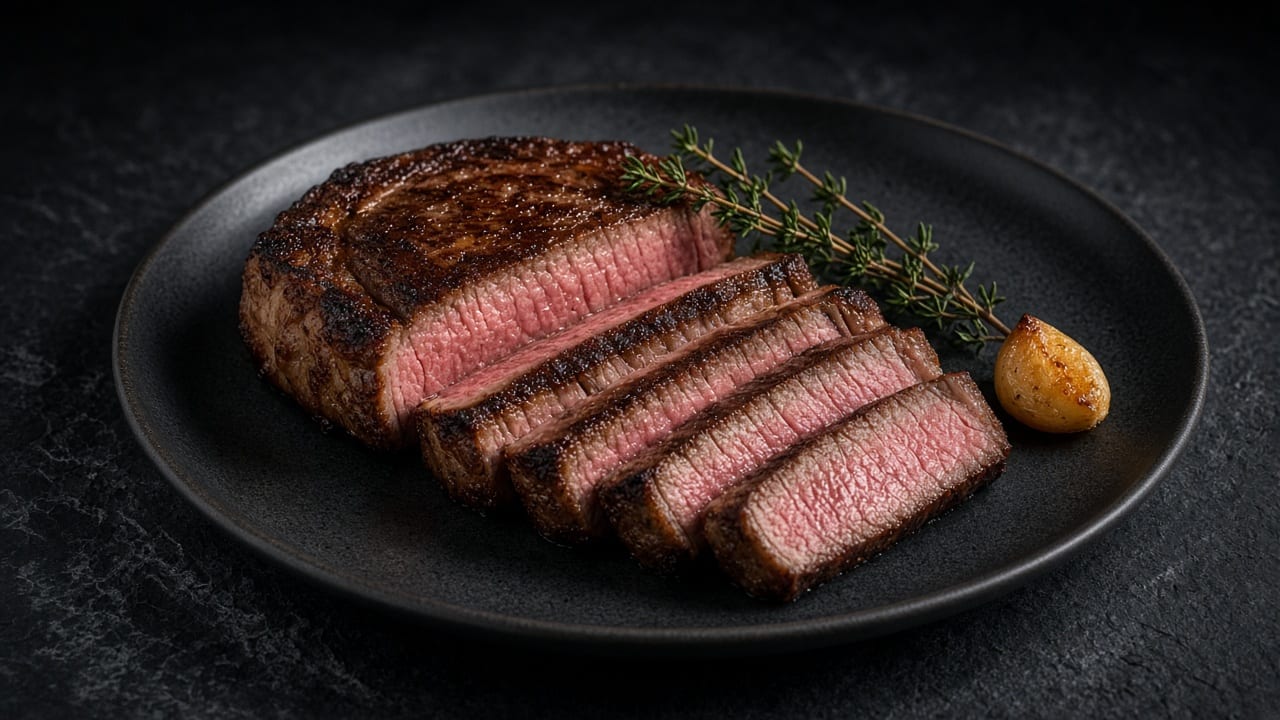
Reverse-Seared Rib-Eye Steak with Thyme and Garlic
Inspired by techniques from NYT Cooking.
Thick rib-eye steaks are slow-roasted at a low oven heat, then finished in a smoking-hot pan with butter, garlic and thyme for an even cook and a dark, savoury crust.
Always check the labels of the products you use.
Method
- 1
Dry and season. Pat the steaks completely dry and season every surface with the salt and pepper. If time allows, leave them uncovered on the rack in the fridge for 1-24 h, then take them out 30 min before cooking. A drier surface browns far faster in the pan, so the crust forms before the inside overcooks.
- 2
Slow roast. Heat the oven to 120°C (fan 100°C) and roast the steaks on the rack in the tray for 35-55 min, until a thermometer pushed into the centre of each reads 54°C. This is only a halfway mark, because the sear will finish the cooking. Trust the thermometer rather than the clock, as thickness and starting temperature vary.
- 3
Brief rest. Leave the steaks on the rack for 10 min. During this pause the surface cools and dries a little more, which helps the pan sear quickly and cleanly.
- 4
Sear hard and fast. Set the pan over high heat until it just begins to smoke, add the oil and lay in the steaks. Sear for 1-1.5 min per side until deeply browned, then stand them on their fat edge for 1 min to render it. Very high heat gives a rich crust in seconds, so the gently cooked centre is left undisturbed.
- 5
Baste with butter. Lower the heat to medium and add the butter, garlic and thyme. Once the butter foams, tilt the pan and spoon it over the steaks for 1 min; the milk solids brown and carry the garlic and herb flavour onto the crust.
- 6
Check and slice. Probe the centre of each steak: it must read at least 63°C. If it falls short, keep basting over medium heat and check every 30 s. Rest on the board for 3 min, then slice across the grain and spoon the pan butter, garlic and thyme over the top.
Storage
Cool leftovers within 2 hours and refrigerate in a covered container for up to 3 days, or freeze for up to 3 months. Reheat gently until piping hot (74°C), or slice cold for sandwiches and salads.
Why this label?
44.1 g protein for 767 kcal = 5.7 g per 100 kcal, so protein gives about 23% of the energy. High Protein needs at least 20% (5 g per 100 kcal), the condition in the Annex to EU Regulation (EC) No 1924/2006. How we decide
EU nutrition claims
- Sugar-free: 0 g sugars per 100 g (limit ≤ 0.5 g)
Per 100 g of the finished dish, worked out from the nutrition per serving and the lowest likely cooked weight (about 143 g a serving), so the true values are, if anything, lower. Thresholds from the Annex to EU Regulation (EC) No 1924/2006. How we decide
Free sugars
0 g per serving
0 % of the 50 g daily maximum · 0 % of the ideal 25 g
Free sugars under 50 g a day, ideally about 25 g, based on WHO free-sugar guidance (not endorsed by WHO). The share shown is the share of one serving. WHO
Equipment
- wire rack set in a rimmed baking tray
- heavy cast-iron or carbon-steel frying pan (28 cm)
- tongs
- large spoon for basting
- carving board
- instant-read probe thermometer
Nutrition per serving (estimated values)
| Per serving | Amount |
|---|---|
| Energy | 767 kcal |
| Protein | 44.1 g |
| Carbohydrate | 1.7 g |
| of which sugars | 0 g |
| of which free sugars | 0 g |
| Fat | 63.7 g |
| of which saturates | 26 g |
| Fibre | 0.4 g |
| Salt | 1.81 g |
Protein per 100 kcal
5.7 g meets High Protein (≥ 5 g, 20% of energy)
Calculated from USDA FoodData Central ingredient values