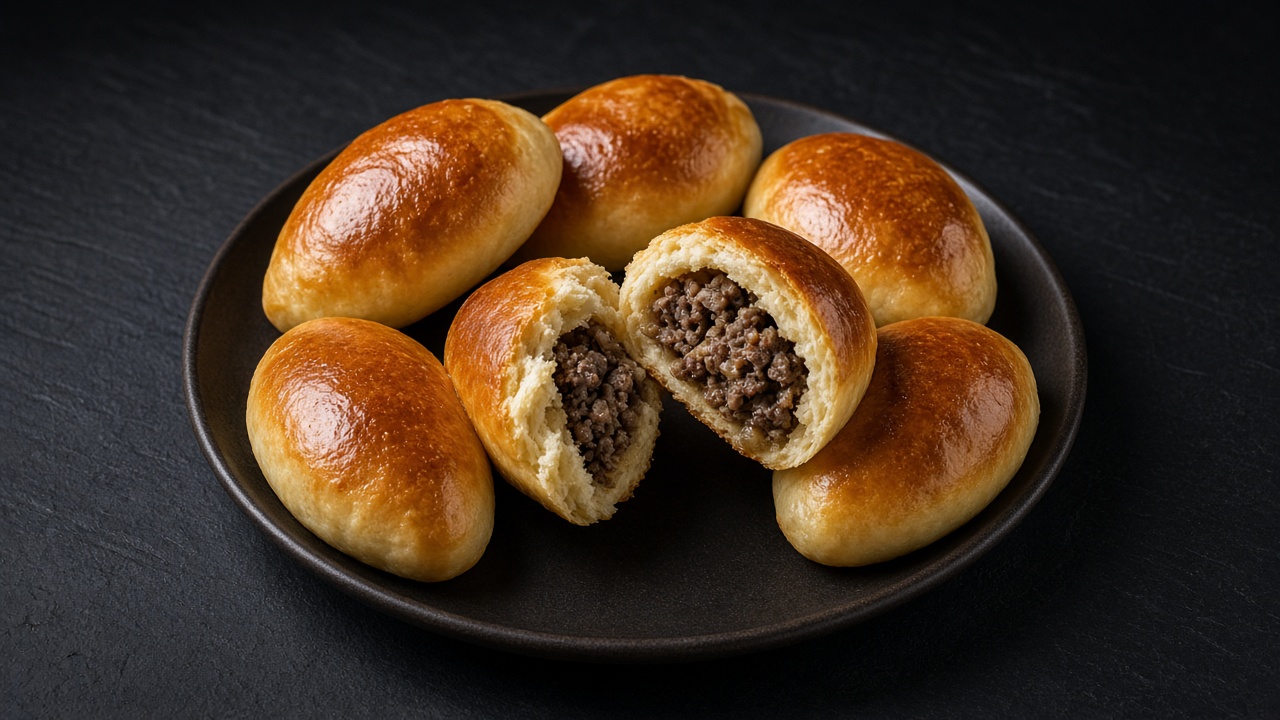
Russian Pirozhki Buns with Beef and Cheddar
Inspired by techniques from King Arthur Baking.
Soft, cheese-flecked yeasted dough is wrapped around a savoury beef and cheddar filling and baked to golden, pillowy buns.
Always check the labels of the products you use.
Method
- 1
Dough. Mix and knead the flour, cheddar, soured cream, butter, water, eggs, sugar, salt and yeast to a soft, smooth dough, then cover in an oiled bowl and leave to rise for about 90 minutes until puffy.
- 2
Filling. Heat the oil in a frying pan on medium, soften the onion, then add the garlic and beef mince and cook for 5-10 minutes, breaking it up, until browned and reaching 71°C; season, stir in the parsley, cool fully, then mix in the grated cheddar.
- 3
Shape. Divide the dough into 16 pieces of about 58 g, roll into balls on lined trays, cover and rest for 15 minutes.
- 4
Fill. Flatten each ball to a 12 cm round, brush with egg wash, spoon 2 tbsp filling into the centre, draw the edges up over it and pinch firmly shut.
- 5
Prove. Place the buns seam down on the trays, cover and leave to rise for 1 hour until puffy.
- 6
Bake. Heat the oven to 200°C, brush the buns with the remaining egg wash and bake for 15-20 minutes until golden.
- 7
Serve. Cool for 5-10 minutes before serving, and refrigerate any leftovers.
Storage
Refrigerate leftovers and eat within a couple of days, warming gently in the oven to refresh before serving. Cool leftovers in a shallow container and refrigerate within 2 hours (within 1 hour on a day above 32°C).
EU nutrition claims
- Source of protein: 3.9 g protein per 100 kcal, about 16% of energy (needs ≥ 12%)
- Low sugars: 3.7 g sugars per 100 g (limit ≤ 5 g)
Per 100 g of the finished dish, worked out from the nutrition per serving and the lowest likely cooked weight (about 118 g a serving), so the true values are, if anything, lower. Thresholds from the Annex to EU Regulation (EC) No 1924/2006. How we decide
Free sugars
3.1 g per serving
6.2 % of the 50 g daily maximum · 12.4 % of the ideal 25 g
Free sugars under 50 g a day, ideally about 25 g, based on WHO free-sugar guidance (not endorsed by WHO). The share shown is the share of one serving. WHO
Equipment
- stand mixer with dough hook (or large bowl)
- lightly oiled bowl
- frying pan
- wooden spoon
- digital scale
- 2 baking trays lined with baking paper
- pastry brush
- tea towel
- digital thermometer
Nutrition per serving (estimated values)
| Per serving | Amount |
|---|---|
| Energy | 520 kcal |
| Protein | 20.4 g |
| Carbohydrate | 51.9 g |
| of which sugars | 4.4 g |
| of which free sugars | 3.1 g |
| Fat | 25.1 g |
| of which saturates | 12.4 g |
| Fibre | 2.1 g |
| Salt | 1.98 g |
Protein per 100 kcal
3.9 g High Protein needs ≥ 5 g (20% of energy)
Calculated from USDA FoodData Central ingredient values