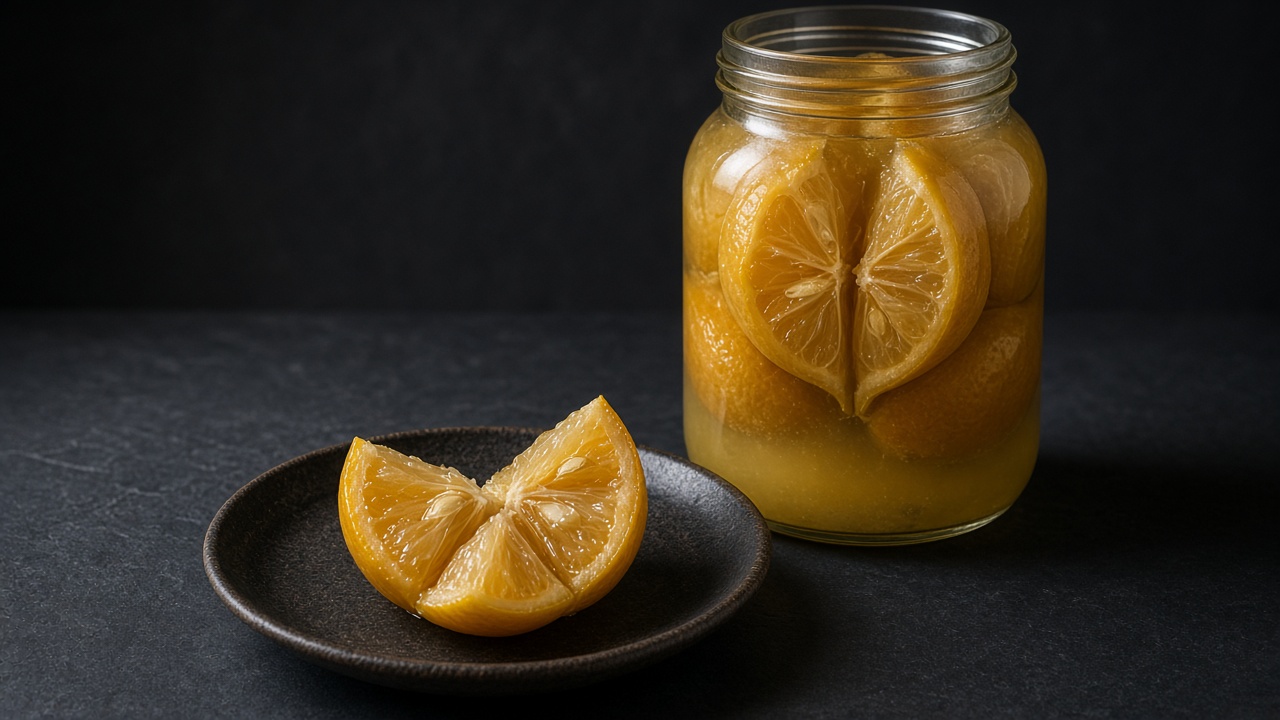
Salt-Preserved Lemons
Inspired by techniques from America's Test Kitchen and Food Network Kitchen.
Lemons cut into joined quarters, packed with salt and covered in lemon juice, then cured in the fridge until the rind is soft, glossy and fragrant.
Based on the listed ingredients, none of the 14 major EU allergens. Always check product labels.
Method
- 1
Cut the lemons. Trim the tips from the lemons, then cut each one lengthwise into quarters, stopping 2 cm from the base so the pieces stay joined. Keeping them whole at the base makes them easy to fill and pack.
- 2
Pack with salt. Working over the bowl, open each lemon and pack about 1 1/2 tbsp salt inside. Rub the cut faces together, then press the lemon into the jar. Add any salt and juice left in the bowl, as that juice is already the start of your brine.
- 3
Cover with juice. Pour in lemon juice until the lemons are completely submerged, pressing them down as you go and topping up with more juice if needed. Close the jar tightly and give it a good shake. Anything left above the liquid can discolour, so full cover matters.
- 4
Cure in the fridge. Refrigerate the jar, shaking or turning it once a day for the first week and then every few days, for 3-6 weeks. The lemons are ready when the rind is soft and glossy. Slowly, the salt and acid soften the peel and mellow its bitterness.
- 5
Rinse and use. Lift out a piece with a clean fork and rinse it under cold water. Scrape away the pulp and pith if you like, then slice or chop the rind. A little goes a long way, so start with a small amount.
Storage
Keep the jar in the fridge, with the lemons covered in juice, for up to 6 months. Always use a clean fork to take pieces out. Cool leftovers in a shallow container and refrigerate within 2 hours (within 1 hour on a day above 32°C).
EU nutrition claims
- Source of protein: 3.3 g protein per 100 kcal, about 13% of energy (needs ≥ 12%)
- Low energy: 20 kcal per 100 g (limit ≤ 40 kcal)
- Low fat: 0.2 g fat per 100 g (limit ≤ 3 g)
- Low saturated fat: 0 g saturated fat per 100 g, 0% of energy (limits ≤ 1.5 g and ≤ 10%)
- Low sugars: 1.8 g sugars per 100 g (limit ≤ 5 g)
- High fibre: 8.9 g fibre per 100 kcal (needs ≥ 3 g)
Per 100 g of the finished dish, worked out from the nutrition per serving and the lowest likely cooked weight (about 45 g a serving), so the true values are, if anything, lower. Thresholds from the Annex to EU Regulation (EC) No 1924/2006. How we decide
Free sugars
0.1 g per serving
0.2 % of the 50 g daily maximum · 0.4 % of the ideal 25 g
Free sugars under 50 g a day, ideally about 25 g, based on WHO free-sugar guidance (not endorsed by WHO). The share shown is the share of one serving. WHO
Equipment
- sharp knife
- medium bowl
- 1 litre glass jar with tight lid, washed in hot soapy water and dried
- small spoon
Nutrition per serving (estimated values)
| Per serving | Amount |
|---|---|
| Energy | 9 kcal |
| Protein | 0.3 g |
| Carbohydrate | 2.9 g |
| of which sugars | 0.8 g |
| of which free sugars | 0.1 g |
| Fat | 0.1 g |
| of which saturates | 0 g |
| Fibre | 0.8 g |
| Salt | 0.73 g |
Protein per 100 kcal
3.3 g High Protein needs ≥ 5 g (20% of energy)
Calculated from USDA FoodData Central ingredient values