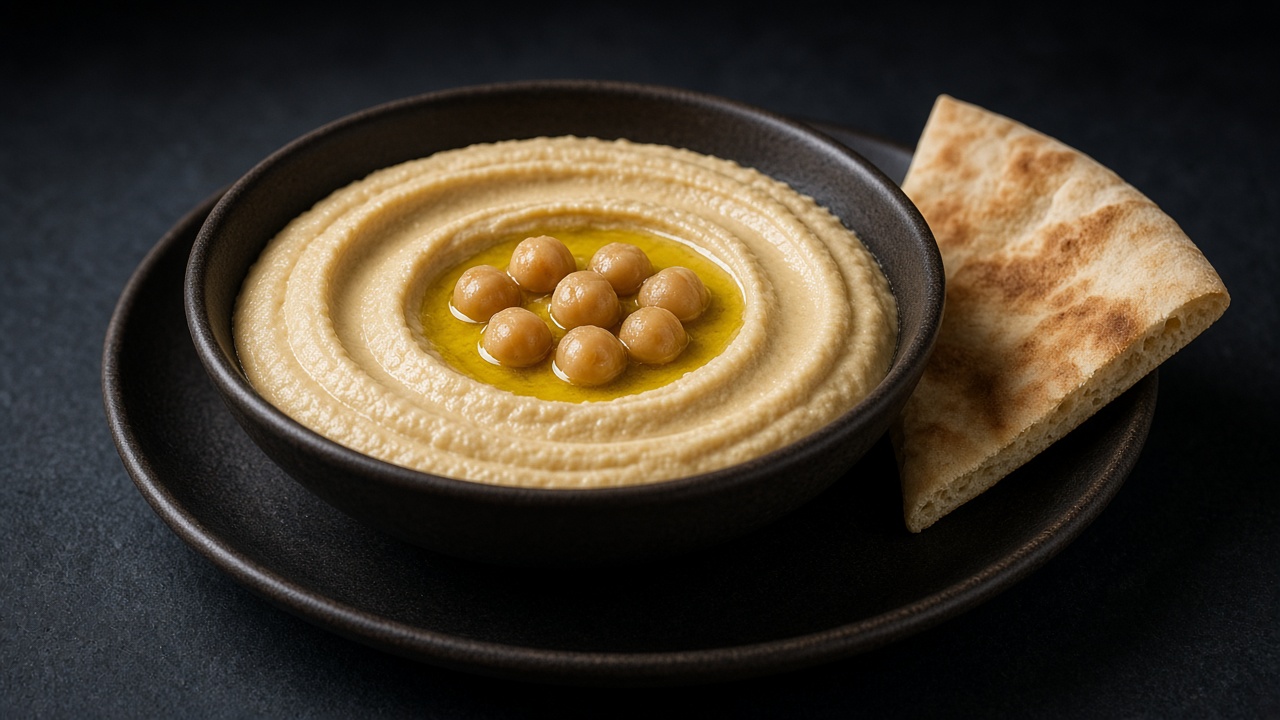
Silky Hummus with Tahini, Lemon and Cumin
Inspired by techniques from America's Test Kitchen and NYT Cooking.
Canned chickpeas are simmered soft and skinned, then blended with a strained garlic-lemon liquid, cumin, plenty of tahini and olive oil, and served with warm pita.
Always check the labels of the products you use.
Method
- 1
Simmer the chickpeas. Put the chickpeas, bicarbonate of soda and 1.5 litres water in the pan. Bring to the boil and simmer 20-25 minutes until very soft and the skins float.
- 2
Infuse the lemon. Stir the garlic, lemon juice and salt in a small bowl and leave 10 minutes. Strain, pressing on the garlic, and discard the solids.
- 3
Remove the skins. Drain the chickpeas, return to the pan and cover with cold water. Swish with your fingers and pour off the floating skins; repeat 3-4 times. Drain and keep 2 tbsp whole chickpeas aside.
- 4
Blend. Blend the remaining chickpeas with the lemon liquid, 60 ml cold water and the cumin for 1 minute. Add the tahini and 2 tbsp oil and blend 1 minute more until pale and creamy, adding water a teaspoon at a time if it is too thick.
- 5
Serve. Spread in a shallow bowl and top with the reserved chickpeas, a pinch of cumin, parsley and a drizzle of oil. Serve with warm pita, or with crudités or gluten-free crackers to keep it gluten-free.
Storage
Keep covered in the fridge for up to 4 days. Do not leave out for more than 2 hours. Cool leftovers in a shallow container and refrigerate within 2 hours (within 1 hour on a day above 32°C).
EU nutrition claims
- Source of protein: 3.1 g protein per 100 kcal, about 12% of energy (needs ≥ 12%)
- Source of fibre: 2.4 g fibre per 100 kcal (needs ≥ 1.5 g)
Per 100 g of the finished dish, worked out from the nutrition per serving and the lowest likely cooked weight (about 33 g a serving), so the true values are, if anything, lower. Thresholds from the Annex to EU Regulation (EC) No 1924/2006. How we decide
Free sugars
0.3 g per serving
0.6 % of the 50 g daily maximum · 1.2 % of the ideal 25 g
Free sugars under 50 g a day, ideally about 25 g, based on WHO free-sugar guidance (not endorsed by WHO). The share shown is the share of one serving. WHO
Equipment
- medium saucepan
- colander
- fine sieve
- small bowl
- food processor
- spatula
Nutrition per serving (estimated values)
| Per serving | Amount |
|---|---|
| Energy | 221 kcal |
| Protein | 6.9 g |
| Carbohydrate | 17.9 g |
| of which sugars | 2.7 g |
| of which free sugars | 0.3 g |
| Fat | 14.7 g |
| of which saturates | 2 g |
| Fibre | 5.2 g |
| Salt | 1.12 g |
Protein per 100 kcal
3.1 g High Protein needs ≥ 5 g (20% of energy)
Calculated from USDA FoodData Central ingredient values