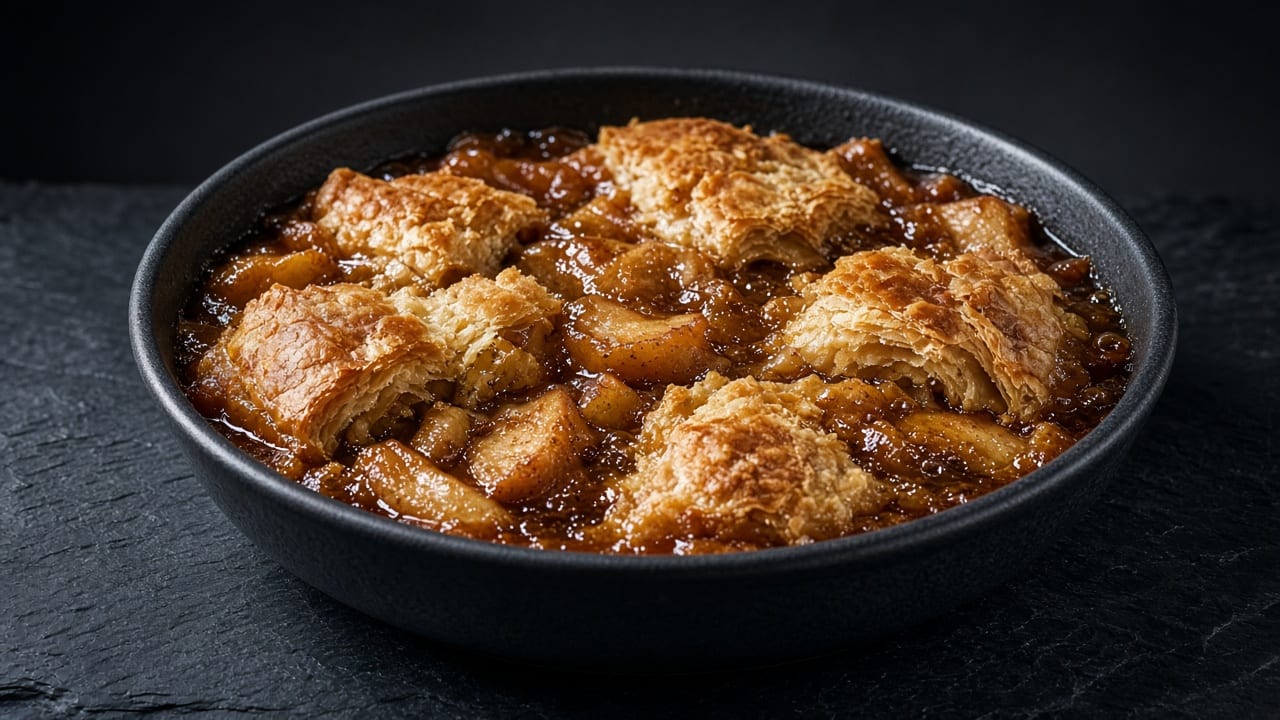
Skillet Apple Pandowdy
Inspired by techniques from America's Test Kitchen and King Arthur Baking.
Tender skillet apples in a light apple-juice syrup under shingled squares of flaky sour-cream pastry, baked golden and pressed into the juices.
Always check the labels of the products you use.
Method
- 1
Make the pastry. Mix the water and sour cream. Pulse or rub the flour, sugar and salt with the frozen butter until the pieces are like large peas, then add the sour-cream water and mix just until large clumps form. Press into a disc, wrap and chill 1 h; frozen butter gives bold flaky layers.
- 2
Cut the squares. Heat the oven to 200 °C (180 °C fan). Roll the dough to a 25 cm round on a floured surface, cut into roughly 6 cm squares (edge pieces will be smaller), lay on the lined tray and chill 30 min. Cold squares keep their shape in the heat.
- 3
Cook the apples. Peel, core and cut the apples into 1 cm wedges and toss with the brown sugar, cinnamon and salt. Melt the butter in the pan over medium heat, add the apples, cover and cook 10 min, stirring now and then, until they soften and release juice. Whisk the apple juice, cornflour and lemon juice, stir in and simmer uncovered 2-3 min until thickened, then take off the heat.
- 4
Shingle the top. Lay the pastry squares over the apples, overlapping slightly like loose shingles. Brush with egg and sprinkle with the sugar mixed with the cinnamon for a crackly, spiced finish.
- 5
Bake and press. Bake 20-25 min until the pastry is golden and puffed and the juices bubble between the pieces. With a spoon, press a few squares into the juices, then bake 5 min more; the pressed pieces soak up syrup while the rest stay crisp.
- 6
Rest and serve. Cool 15 min, then spoon into 6 bowls with plain yoghurt or whipped cream. Leftovers keep, covered and chilled, up to 2 days; warm them at 180 °C (160 °C fan) for 15 min.
Storage
Keep covered in the fridge up to 2 days and reheat at 180 °C (160 °C fan) about 15 min until hot. The pastry softens on standing.
EU nutrition claims
- Low salt: 0.23 g salt per 100 g (limit ≤ 0.3 g)
Per 100 g of the finished dish, worked out from the nutrition per serving and the lowest likely cooked weight (about 178 g a serving), so the true values are, if anything, lower. Thresholds from the Annex to EU Regulation (EC) No 1924/2006. How we decide
Free sugars
13.8 g per serving
27.6 % of the 50 g daily maximum · 55.2 % of the ideal 25 g
Free sugars under 50 g a day, ideally about 25 g, based on WHO free-sugar guidance (not endorsed by WHO). The share shown is the share of one serving. WHO
Equipment
- food processor or mixing bowl
- rolling pin
- pizza wheel or sharp knife
- baking tray lined with baking paper
- 25 cm ovenproof frying pan with lid
- pastry brush
- wire rack
Nutrition per serving (estimated values)
| Per serving | Amount |
|---|---|
| Energy | 361 kcal |
| Protein | 2.8 g |
| Carbohydrate | 50 g |
| of which sugars | 30.4 g |
| of which free sugars | 13.8 g |
| Fat | 18.2 g |
| of which saturates | 11.1 g |
| Fibre | 4.5 g |
| Salt | 0.4 g |
Protein per 100 kcal
0.8 g High Protein needs ≥ 5 g (20% of energy)
Calculated from USDA FoodData Central ingredient values