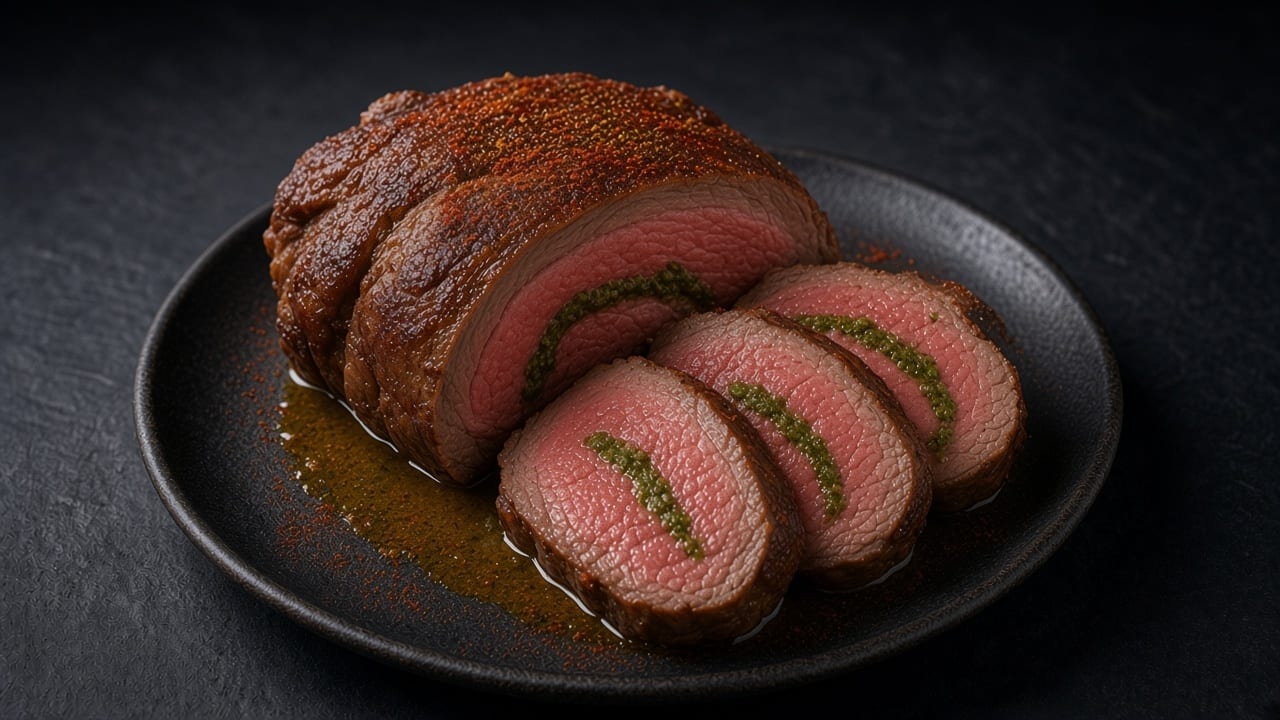
Moroccan-Spiced Roast Leg of Lamb (Méchoui)
Inspired by techniques from America's Test Kitchen.
Méchoui-style lamb for the oven: a boneless half leg of lamb spread with a butter paste of coriander, garlic, thyme, paprika and cumin, rolled, seared and roasted over broth, basted with more spiced butter until rosy, then sliced with its juices.
Always check the labels of the products you use.
Method
- 1
Heat the oven. Heat the oven to 190 °C (170 °C fan) at least 20 minutes before roasting. Pour the stock into the roasting tin and set the rack inside.
- 2
Make the spiced butter. Blitz the coriander, garlic, thyme, paprika, cumin, 4 g of the salt and the pepper in the food processor until finely chopped. Add the butter and pulse until smooth.
- 3
Flatten and fill. Lay the lamb cut side up between sheets of cling film and pound it to an even 2 cm. Spread half the spiced butter over the cut side, leaving a 2.5 cm border. Roll it up tightly and tie with string at 2.5 cm intervals. Pat dry and season with the remaining 2 g salt.
- 4
Sear. Heat the oil in the frying pan over medium-high heat and brown the lamb on all sides, about 2 minutes per side and 30 seconds on each end. Move it to the rack in the tin. Melt the remaining spiced butter in the small pan.
- 5
Roast. Roast for 45-55 minutes, brushing with the melted butter every 10 minutes, until the thickest part reads 54-57 °C for medium-rare (or 63 °C for medium with a 3-minute rest).
- 6
Rest and slice. Move the lamb to the board, cover loosely and rest for 10-15 minutes. Remove the string, slice 1 cm thick and pour the pan juices over.
Storage
Cool leftovers in a shallow container and refrigerate within 2 hours. Keep for up to 3 days; eat cold or reheat until piping hot (74 °C).
Why this label?
54.7 g protein for 692 kcal = 7.9 g per 100 kcal, so protein gives about 32% of the energy. High Protein needs at least 20% (5 g per 100 kcal), the condition in the Annex to EU Regulation (EC) No 1924/2006. How we decide
EU nutrition claims
- Sugar-free: 0.2 g sugars per 100 g (limit ≤ 0.5 g)
Per 100 g of the finished dish, worked out from the nutrition per serving and the lowest likely cooked weight (about 190 g a serving), so the true values are, if anything, lower. Thresholds from the Annex to EU Regulation (EC) No 1924/2006. How we decide
Free sugars
0 g per serving
0 % of the 50 g daily maximum · 0 % of the ideal 25 g
Free sugars under 50 g a day, ideally about 25 g, based on WHO free-sugar guidance (not endorsed by WHO). The share shown is the share of one serving. WHO
Equipment
- food processor
- roasting tin with a rack
- meat mallet or rolling pin
- kitchen string
- large frying pan
- instant-read thermometer
- small saucepan
- carving board
Nutrition per serving (estimated values)
| Per serving | Amount |
|---|---|
| Energy | 692 kcal |
| Protein | 54.7 g |
| Carbohydrate | 2.2 g |
| of which sugars | 0.3 g |
| of which free sugars | 0 g |
| Fat | 50.5 g |
| of which saturates | 23.9 g |
| Fibre | 0.6 g |
| Salt | 1.76 g |
Protein per 100 kcal
7.9 g meets High Protein (≥ 5 g, 20% of energy)
Calculated from USDA FoodData Central ingredient values