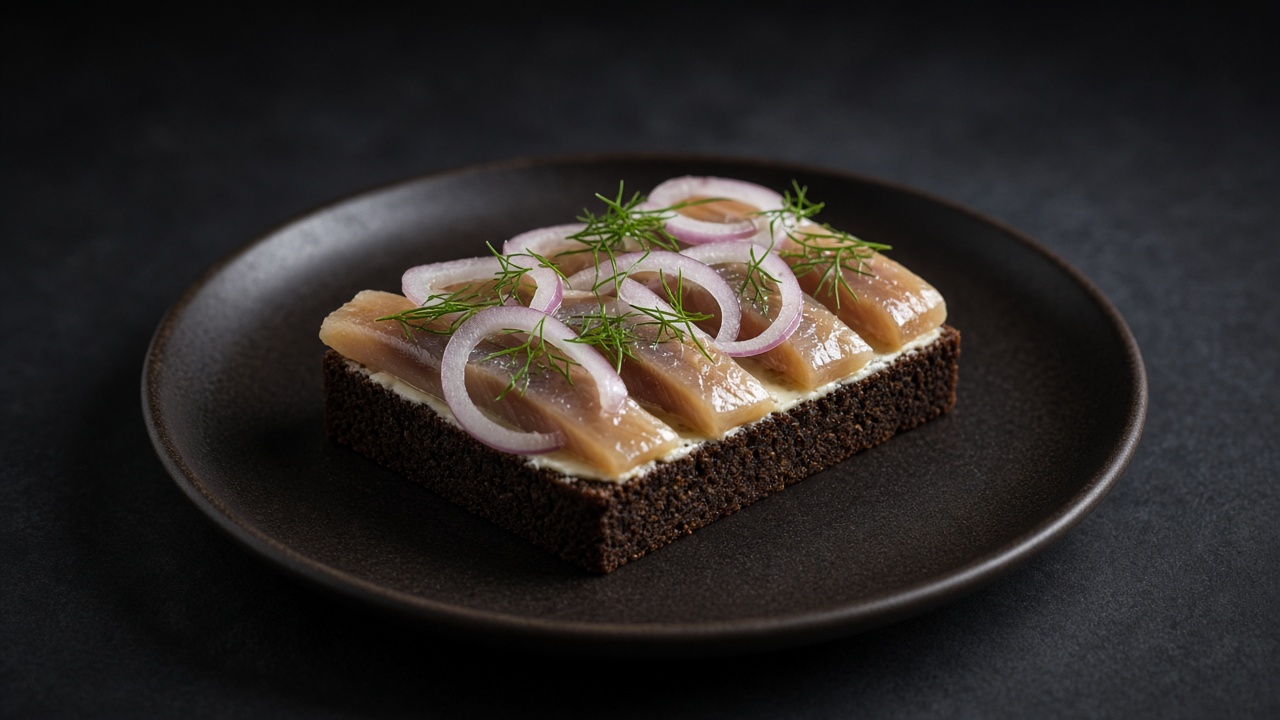
Smørrebrød with Pickled Herring, Onion and Dill
Inspired by techniques from Serious Eats.
Thin slices of dark rye bread buttered to the edges and covered with pickled herring, red onion rings, optional egg and dill. Ready in 10 minutes and eaten with a knife and fork.
Always check the labels of the products you use.
Method
- 1
Trim the bread. Cut the rye into neat rectangles about 8 x 12 cm.
- 2
Butter. Spread the butter thinly right to the edges. It adds richness and stops the topping soaking into the bread.
- 3
Add the herring. Pat the herring dry, cut it into bite-size pieces and lay them close together so they cover the bread completely. Tuck the onion rings and egg slices in between.
- 4
Finish. Scatter with dill and a little pepper and serve straight away, with a knife and fork.
Storage
Assemble just before serving. Opened herring keeps in its marinade in the fridge for up to 1 week. Cool leftovers in a shallow container and refrigerate within 2 hours (within 1 hour on a day above 32°C).
EU nutrition claims
- Source of protein: 4.2 g protein per 100 kcal, about 17% of energy (needs ≥ 12%)
Per serving, from the nutrition table. Condition from the Annex to EU Regulation (EC) No 1924/2006. How we decide
Free sugars
1.5 g per serving
3 % of the 50 g daily maximum · 6 % of the ideal 25 g
Free sugars under 50 g a day, ideally about 25 g, based on WHO free-sugar guidance (not endorsed by WHO). The share shown is the share of one serving. WHO
Equipment
- bread knife
- butter knife
- kitchen paper
Nutrition per serving (estimated values)
| Per serving | Amount |
|---|---|
| Energy | 293 kcal |
| Protein | 12.3 g |
| Carbohydrate | 25.3 g |
| of which sugars | 5.9 g |
| of which free sugars | 1.5 g |
| Fat | 15.6 g |
| of which saturates | 4.4 g |
| Fibre | 2.5 g |
| Salt | 1.74 g |
Protein per 100 kcal
4.2 g High Protein needs ≥ 5 g (20% of energy)
Calculated from USDA FoodData Central ingredient values