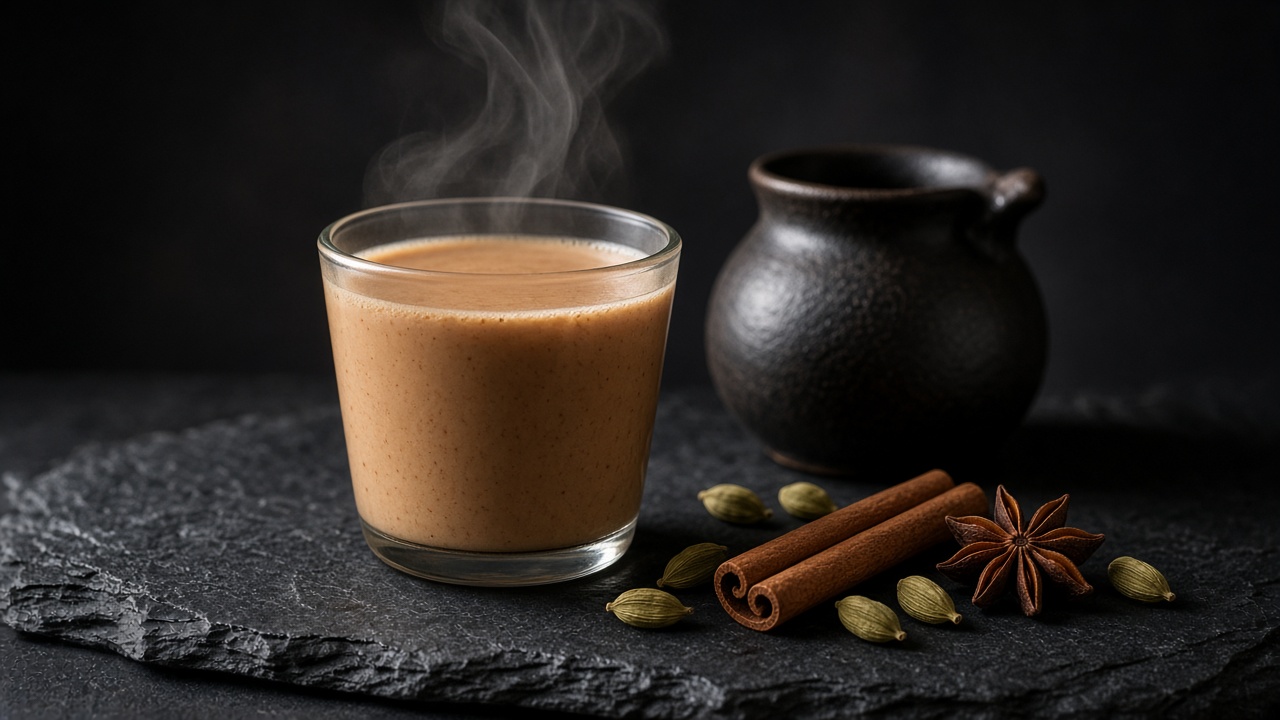
Spiced Masala Chai with Ginger and Cardamom
Inspired by techniques from NYT Cooking and America's Test Kitchen.
Cardamom, cinnamon, cloves, peppercorns and star anise are cracked and toasted, simmered with ginger and strong black tea, then boiled with milk and a little sugar and strained.
Always check the labels of the products you use.
Method
- 1
Crack the spices. Put the cardamom, cinnamon, cloves, peppercorns and star anise on a board and press down hard with the base of a heavy pan until coarsely cracked. Cracking opens the pods and releases their oils.
- 2
Toast. Tip the spices into the saucepan and toast over medium heat, stirring, for 1-2 minutes until fragrant.
- 3
Simmer with tea. Add the water and ginger, bring to the boil, then lower the heat and simmer for 5 minutes. Add the tea and simmer for 3 minutes more, until very dark.
- 4
Boil with milk. Pour in the milk and sugar, bring back to a lively boil and cook for 2 minutes, watching closely as milk tea boils over in seconds.
- 5
Strain and serve. Strain through the sieve into the jug, pressing on the tea leaves, and pour into 4 mugs.
Storage
Best fresh. Refrigerate leftovers, covered, for up to 2 days and reheat until steaming. Cool leftovers in a shallow container and refrigerate within 2 hours (within 1 hour on a day above 32°C).
EU nutrition claims
- Source of protein: 4 g protein per 100 kcal, about 16% of energy (needs ≥ 12%)
- Low salt: 0.11 g salt per 100 ml (limit ≤ 0.3 g)
Per 100 ml of the finished dish, worked out from the nutrition per serving and the lowest likely cooked weight (about 109 ml a serving), so the true values are, if anything, lower. Thresholds from the Annex to EU Regulation (EC) No 1924/2006. How we decide
Caffeine · Free sugars
- Per serving: at least 30 mg caffeine (serving: 1 cup (about 150 ml tea)). Source: about 150 ml brewed per serving × USDA FDC SR Legacy #173227 (brewed black tea, 20 mg/100 g) This brew uses more tea per ml than standard brewed tea, so the real amount is likely higher..
- Scaling: making more servings does not change the caffeine in each serving; what counts is how many servings you drink in a day. 1 serving: 30 mg · 2 servings: 60 mg · 3 servings: 90 mg · 4 servings: 120 mg.
- General guideline: EFSA Scientific Opinion on the safety of caffeine (2015): for healthy adults, up to 200 mg in a single dose and up to 400 mg per day do not raise safety concerns. 1 serving = 8 % of 400 mg. EFSA
4.2 g per serving
8.4 % of the 50 g daily maximum · 16.8 % of the ideal 25 g
Free sugars under 50 g a day, ideally about 25 g, based on WHO free-sugar guidance (not endorsed by WHO). The share shown is the share of one serving. WHO
Equipment
- heavy frying pan or rolling pin, for crushing
- medium saucepan
- fine sieve
- heatproof jug
Nutrition per serving (estimated values)
| Per serving | Amount |
|---|---|
| Energy | 85 kcal |
| Protein | 3.4 g |
| Carbohydrate | 10.8 g |
| of which sugars | 9.5 g |
| of which free sugars | 4.2 g |
| Fat | 3.4 g |
| of which saturates | 1.9 g |
| Fibre | 0.5 g |
| Salt | 0.12 g |
Protein per 100 kcal
4 g High Protein needs ≥ 5 g (20% of energy)
Calculated from USDA FoodData Central ingredient values