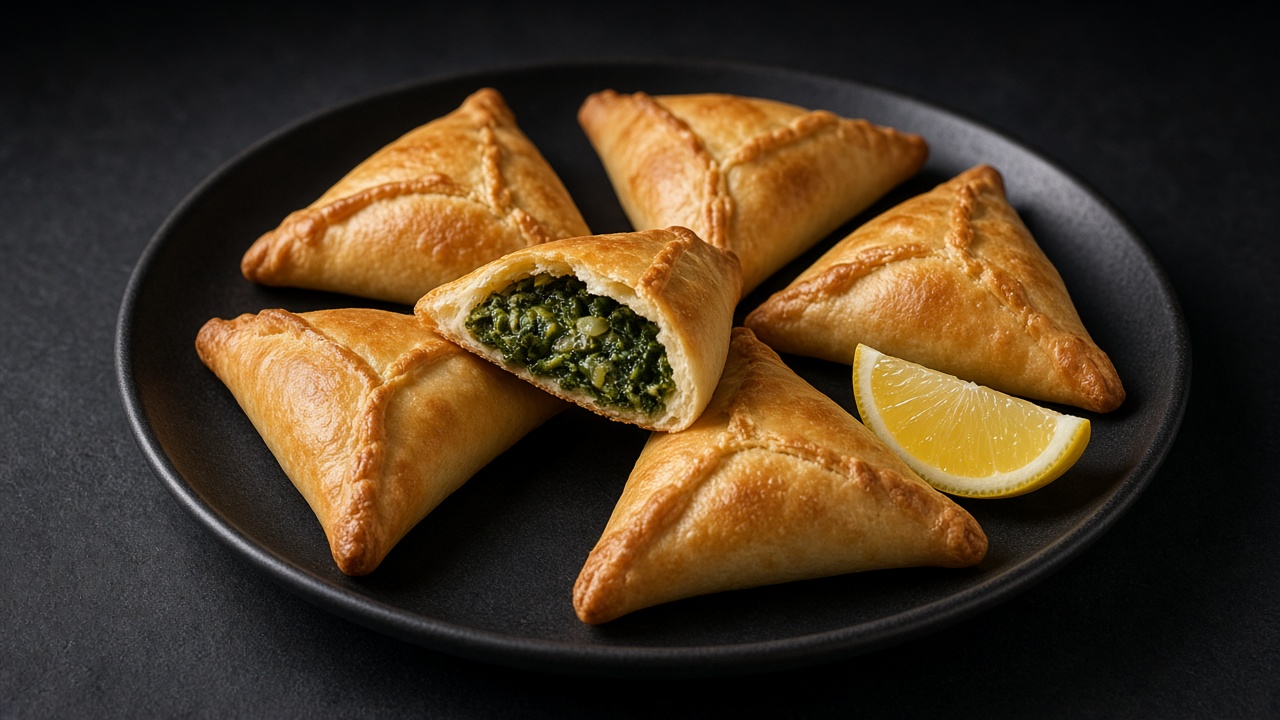
Spinach Fatayer with Sumac and Lemon
Inspired by techniques from King Arthur Baking.
Soft, golden triangular pies of olive-oil bread dough wrapped around a tangy spinach, onion, sumac and lemon filling.
Always check the labels of the products you use.
Method
- 1
Knead. Mix the flour, yeast, sugar, salt, water and oil to a rough dough, then knead for 8 minutes by hand (5 in a mixer) until smooth, soft and springy. Kneading builds the gluten that lets the dough stretch thinly without tearing.
- 2
Rise. Cut the dough into 12 equal pieces (about 55 g each) and roll them into balls. Set them on a floured tray, cover and leave for 45-60 minutes, until puffy and soft.
- 3
Filling. Meanwhile, squeeze the spinach again in a towel, then mix it with the onion, sumac, lemon juice, oil, salt and chilli. The salt and acid draw out more water, so the filling should be moist but not dripping.
- 4
Heat. Preheat the oven to 200 °C (180 °C fan), and line two baking trays with paper.
- 5
Shape. Roll each ball into an 11-12 cm round. Put about 30 g filling in the centre, lift the edge at three points and pinch the seams together firmly from the centre outwards to make a closed triangle. Firm pinching stops the seams opening in the oven.
- 6
Bake. Set the fatayer on the trays, brush them with oil and bake for 15-18 minutes, until golden. Serve warm with lemon wedges for squeezing.
Storage
Keep in an airtight box in the fridge for up to 3 days or freeze for up to 2 months. Reheat at 180 °C for 8-10 minutes. Cool leftovers in a shallow container and refrigerate within 2 hours (within 1 hour on a day above 32°C).
EU nutrition claims
- Low sugars: 4.1 g sugars per 100 g (limit ≤ 5 g)
Per 100 g of the finished dish, worked out from the nutrition per serving and the lowest likely cooked weight (about 73 g a serving), so the true values are, if anything, lower. Thresholds from the Annex to EU Regulation (EC) No 1924/2006. How we decide
Free sugars
2.1 g per serving
4.2 % of the 50 g daily maximum · 8.4 % of the ideal 25 g
Free sugars under 50 g a day, ideally about 25 g, based on WHO free-sugar guidance (not endorsed by WHO). The share shown is the share of one serving. WHO
Equipment
- large mixing bowl or stand mixer with dough hook
- clean tea towel
- 2 baking trays
- baking paper
- rolling pin
- pastry brush
Nutrition per serving (estimated values)
| Per serving | Amount |
|---|---|
| Energy | 418 kcal |
| Protein | 8.1 g |
| Carbohydrate | 52.8 g |
| of which sugars | 3 g |
| of which free sugars | 2.1 g |
| Fat | 20.1 g |
| of which saturates | 2.8 g |
| Fibre | 3.7 g |
| Salt | 1.55 g |
Protein per 100 kcal
1.9 g High Protein needs ≥ 5 g (20% of energy)
Calculated from USDA FoodData Central ingredient values