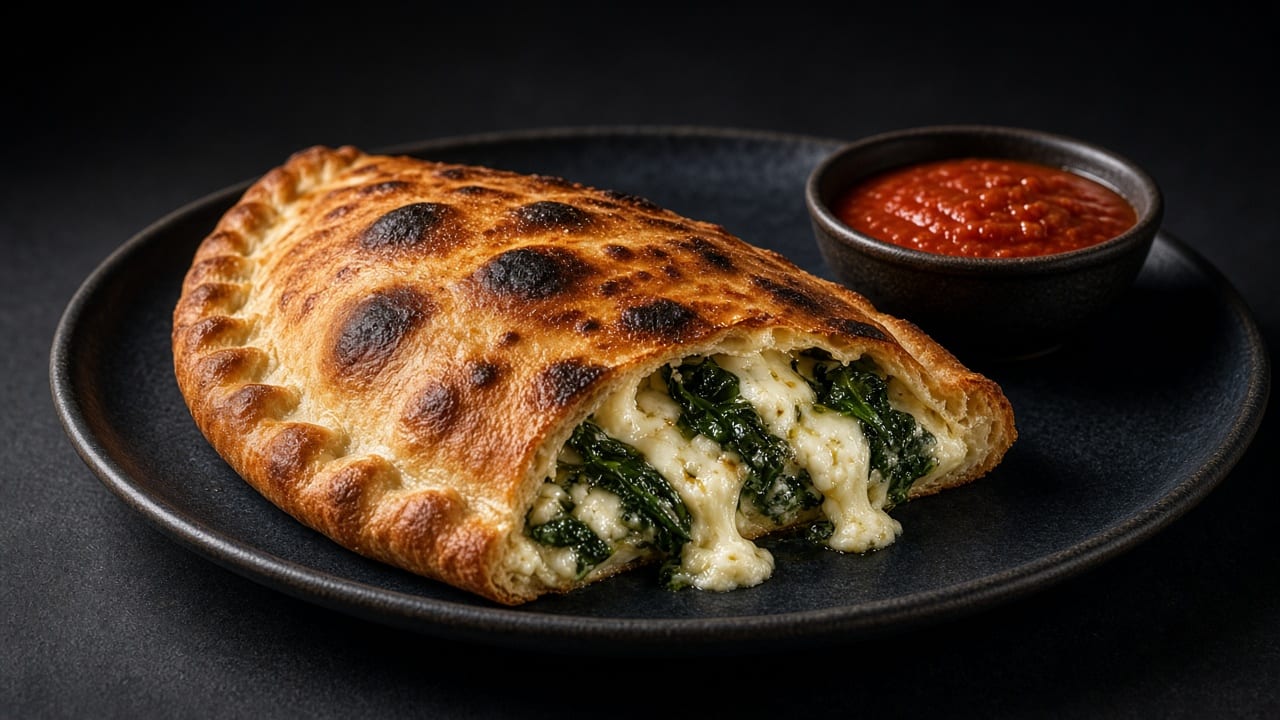
Spinach and Ricotta Calzones with Tomato Dipping Sauce
Inspired by techniques from NYT Cooking and America's Test Kitchen.
Golden, crisp half-moon calzones stuffed with garlicky spinach, ricotta, mozzarella, Parmesan and basil, baked on a hot stone and served with a warm garlic and oregano tomato sauce for dipping.
Always check the labels of the products you use.
Method
- 1
Knead and rise. Mix the flour, yeast and salt, add the water and oil and knead for 10 minutes until smooth and elastic. Cover and leave for 1 hour 30 minutes, until doubled. Well-developed gluten lets the dough stretch around the filling without tearing.
- 2
Prepare the filling. Heat the oil in the frying pan over medium heat, add the garlic for 30 seconds, then the spinach, turning for about 2 minutes until wilted. Tip it into the colander, cool, then squeeze very dry in the tea towel and chop. Mix with the ricotta, mozzarella, Parmesan, basil, pepper and chilli and chill until needed, since a cold, dry filling keeps the calzones from leaking.
- 3
Simmer the sauce. Warm the oil and garlic in the saucepan over low heat until the garlic sizzles, then add the passata and oregano. Simmer for 10 minutes until slightly thickened and keep warm. Starting the garlic in cool oil infuses it gently without burning.
- 4
Preheat the stone. Put the stone or steel on the lowest shelf and heat the oven to 240°C (fan 220°C) for at least 45 minutes. A thoroughly hot stone crisps the base of the calzones before the filling can soak through.
- 5
Shape and fill. Divide the dough into 4 balls of about 190g and rest them, covered, for 15 minutes. Roll each into a 22cm round on a floured sheet of baking paper and spoon a quarter of the filling onto one half, leaving a 2cm border. The rest relaxes the dough so it rolls out without shrinking back.
- 6
Seal tightly. Brush the border with water, fold the other half over and press the edges together. Fold the edge over itself and crimp with a fork to seal firmly. Brush the tops with the glaze oil and cut 2 small slits in each so steam can escape instead of bursting the seams.
- 7
Bake until 74°C. Slide 2 calzones on their paper onto the stone and bake for 15-18 minutes, until deep golden and crisp underneath. Push the probe in through a slit: the centre of the filling should reach 74°C. Bake the second pair, then rest them for 5 minutes, as the filling is very hot, and serve with the warm sauce for dipping.
Storage
Cool leftovers within 2 hours and refrigerate for up to 3 days. Reheat in a hot oven or a dry frying pan until piping hot (74°C).
EU nutrition claims
- Source of protein: 4 g protein per 100 kcal, about 16% of energy (needs ≥ 12%)
- Low sugars: 2.8 g sugars per 100 g (limit ≤ 5 g)
Per 100 g of the finished dish, worked out from the nutrition per serving and the lowest likely cooked weight (about 172 g a serving), so the true values are, if anything, lower. Thresholds from the Annex to EU Regulation (EC) No 1924/2006. How we decide
Free sugars
0 g per serving
0 % of the 50 g daily maximum · 0 % of the ideal 25 g
Free sugars under 50 g a day, ideally about 25 g, based on WHO free-sugar guidance (not endorsed by WHO). The share shown is the share of one serving. WHO
Equipment
- large mixing bowl
- frying pan
- colander and clean tea towel
- small saucepan
- rolling pin
- pizza stone or baking steel (or a heavy baking tray turned upside down)
- baking paper
- pastry brush
- fork
- instant-read probe thermometer
Nutrition per serving (estimated values)
| Per serving | Amount |
|---|---|
| Energy | 817 kcal |
| Protein | 32.4 g |
| Carbohydrate | 97.4 g |
| of which sugars | 4.8 g |
| of which free sugars | 0 g |
| Fat | 33.4 g |
| of which saturates | 13.3 g |
| Fibre | 5.8 g |
| Salt | 2.39 g |
Protein per 100 kcal
4 g High Protein needs ≥ 5 g (20% of energy)
Calculated from USDA FoodData Central ingredient values