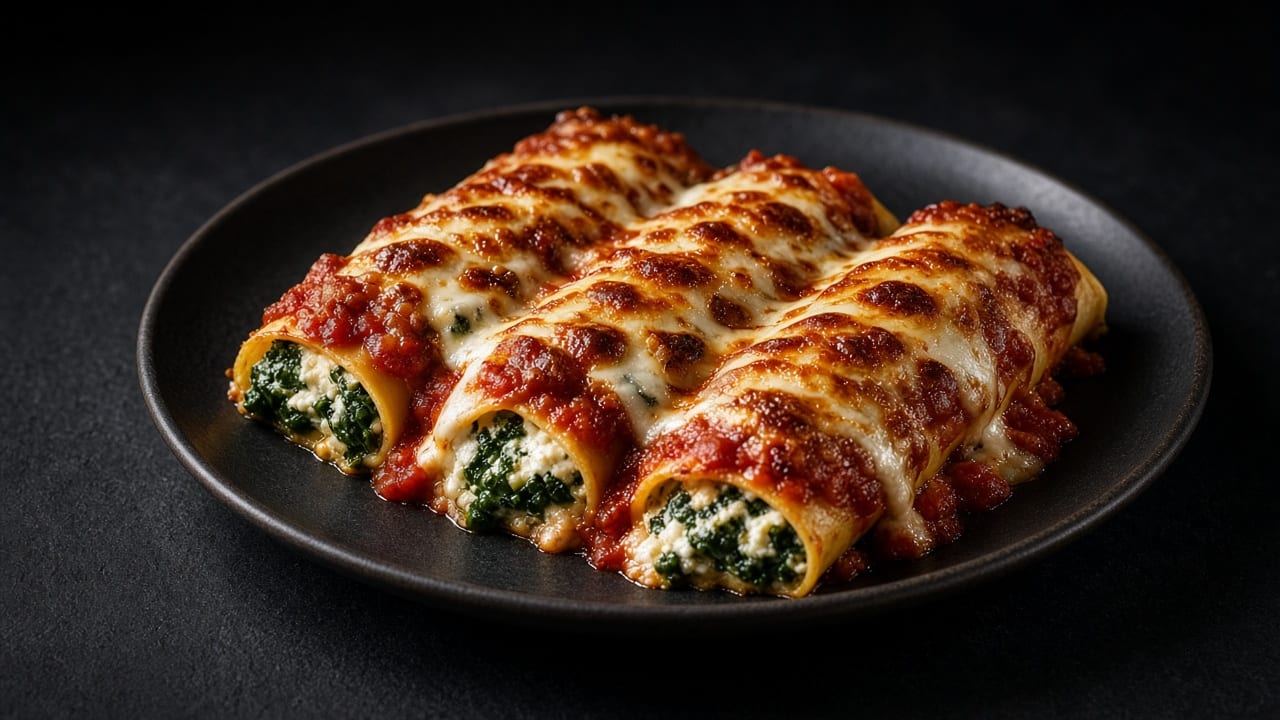
Spinach and Ricotta Cannelloni in Tomato Sauce
Inspired by techniques from Serious Eats and America's Test Kitchen.
Dried cannelloni tubes filled with a spinach and ricotta mixture, baked under tomato sauce, mozzarella and Parmesan until bubbling and golden.
Always check the labels of the products you use.
Method
- 1
Wilt the spinach. Wilt the spinach in a covered saucepan over medium heat for 3-4 minutes, using just the water clinging to the leaves and tossing once or twice. Once cool enough to handle, wring it out firmly in a tea towel until no more liquid runs out, since any leftover water would turn the filling runny. Chop the wrung spinach finely.
- 2
Mix the filling. While the spinach cools, drain the ricotta between two tea towels for 10 minutes to pull out excess whey. Combine the ricotta, chopped spinach, Parmesan, egg yolk, nutmeg, salt and pepper in a bowl until evenly mixed - the egg yolk helps bind everything so the filling holds its shape once baked.
- 3
Make the tomato sauce. Warm the olive oil with the garlic in a saucepan over medium-low heat for 2 minutes, just until the garlic turns pale gold without browning. Add the chopped tomatoes, passata, water and salt, and simmer for 10 minutes, then tear in the basil. The sauce should still look quite loose at this stage, since the dry cannelloni tubes will soak up liquid as they bake.
- 4
Preheat the oven. Preheat the oven to 190°C (170°C fan) at least 20 minutes ahead, so it reaches full temperature before the dish goes in.
- 5
Fill the tubes. Spread half the tomato sauce over the base of the baking dish. Pipe the ricotta and spinach filling into the dry cannelloni tubes using a piping bag or a food bag with the corner snipped off, then lay them in a single, snug layer over the sauce.
- 6
Cover and top. Pour the remaining sauce over the tubes so they're completely covered, as any exposed pasta will stay hard and chalky in the oven. Scatter the torn mozzarella and remaining Parmesan over the top.
- 7
Bake. Cover the dish with foil and bake for 30 minutes, then uncover and bake for a further 15-20 minutes, until bubbling and golden in patches. The pasta is done when a knife slides easily through a tube and an instant-read thermometer in the centre reads 74°C.
- 8
Rest before serving. Let the cannelloni rest for 10 minutes out of the oven before serving. This short rest allows the sauce to settle so it holds together on the plate rather than running everywhere.
Storage
Leftovers keep covered in the fridge for up to 3 days, or can be frozen (baked or unbaked) for up to 2 months. Reheat in a 180°C oven until piping hot and the centre reaches 74°C, covering with foil if it's browning too quickly. Cool leftovers in a shallow container and refrigerate within 2 hours (within 1 hour on a day above 32°C).
Why this label?
23.5 g protein for 461 kcal = 5.1 g per 100 kcal, so protein gives about 20% of the energy. High Protein needs at least 20% (5 g per 100 kcal), the condition in the Annex to EU Regulation (EC) No 1924/2006. How we decide
EU nutrition claims
- Low sugars: 2.7 g sugars per 100 g (limit ≤ 5 g)
Per 100 g of the finished dish, worked out from the nutrition per serving and the lowest likely cooked weight (about 272 g a serving), so the true values are, if anything, lower. Thresholds from the Annex to EU Regulation (EC) No 1924/2006. How we decide
Free sugars
0 g per serving
0 % of the 50 g daily maximum · 0 % of the ideal 25 g
Free sugars under 50 g a day, ideally about 25 g, based on WHO free-sugar guidance (not endorsed by WHO). The share shown is the share of one serving. WHO
Equipment
- large saucepan with lid
- colander
- 2 clean tea towels
- large bowl
- piping bag or strong food bag with the corner snipped (or a teaspoon)
- medium saucepan
- baking dish about 23 x 33 cm
- foil
- instant-read thermometer
Nutrition per serving (estimated values)
| Per serving | Amount |
|---|---|
| Energy | 461 kcal |
| Protein | 23.5 g |
| Carbohydrate | 44.6 g |
| of which sugars | 7.4 g |
| of which free sugars | 0 g |
| Fat | 22.3 g |
| of which saturates | 11.1 g |
| Fibre | 5.8 g |
| Salt | 1.95 g |
Protein per 100 kcal
5.1 g meets High Protein (≥ 5 g, 20% of energy)
Calculated from USDA FoodData Central ingredient values