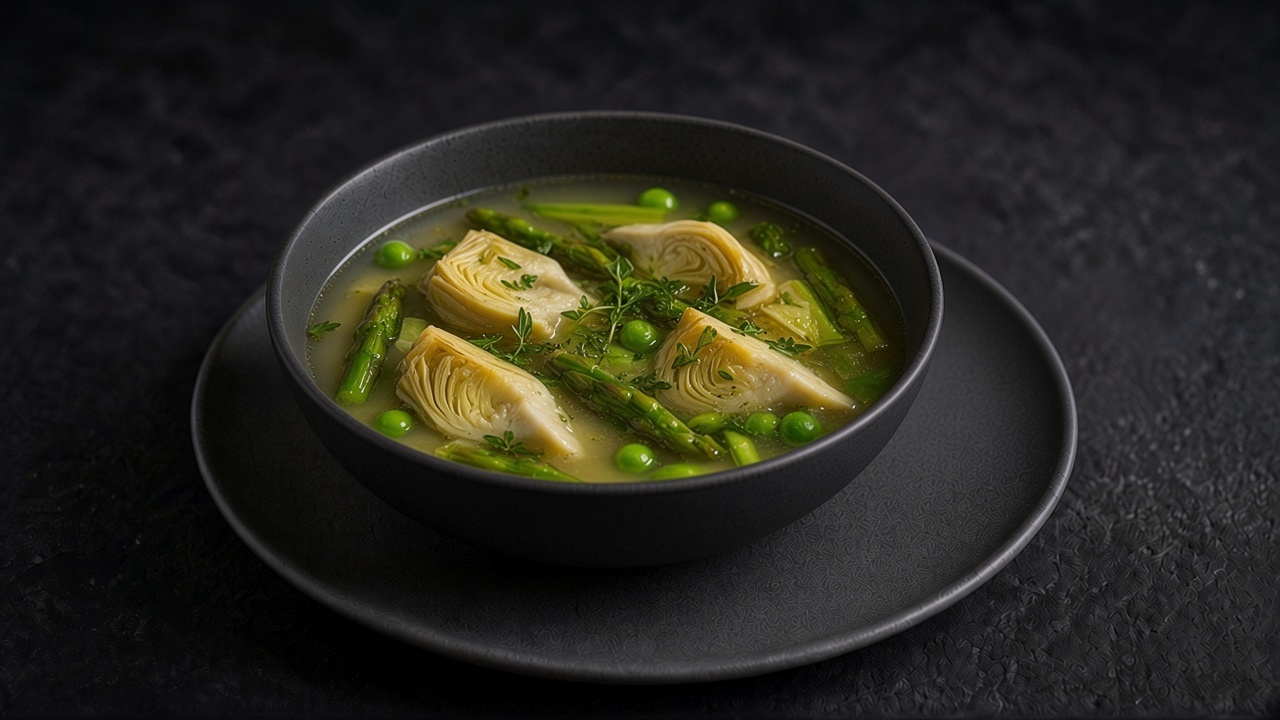
Spring Vegetable Stew
Inspired by techniques from America's Test Kitchen.
A brothy spring stew of artichokes, fava beans, asparagus and peas, simmered together until each vegetable is just tender and finished with lemon zest, basil and mint. It leans on the vegetables themselves for flavour rather than a long-cooked base, so it stays bright, green and fresh-tasting.
Always check the labels of the products you use.
Method
- 1
Prep the lemon and artichokes. Finely grate about 2 tsp zest from the lemon and set aside. Halve the lemon and squeeze the juice into a bowl filled with 960 ml water, then drop in the spent halves. Working with one artichoke at a time, trim the stem to about 2 cm and cut off the top quarter. Snap off the bottom 3-4 rows of tough outer leaves by pulling them downward, then use the paring knife to pare away the dark green parts of the stem and base. Quarter each artichoke and drop the pieces straight into the lemon water.
- 2
Blanch the fava beans. Bring 480 ml water and the baking soda to the boil in the small saucepan. Add the fava beans and cook until the edges just begin to darken, 1-2 min. Drain and rinse well under cold water.
- 3
Soften the leek. Heat the olive oil in the skillet over medium heat until shimmering. Add the leek, 1 tbsp water and 1 tsp of the salt; cook, stirring, until softened, about 3 min. Stir in the garlic and cook until fragrant, about 30 sec.
- 4
Simmer the stew. Lift the artichokes out of the lemon water, shaking off the excess, and add them to the skillet. Stir in the broth and bring to a simmer. Reduce the heat to medium-low, cover and cook until the artichokes are almost tender, 6-8 min. Stir in the asparagus and peas, cover and cook until crisp-tender, 5-7 min. Stir in the fava beans and cook until heated through and the artichokes are fully tender, about 2 min more.
- 5
Finish and serve. Off the heat, stir in the basil, mint and reserved lemon zest. Season with the remaining salt and the pepper to taste, drizzle with extra olive oil and serve right away.
Storage
Best eaten the day it's made, while the asparagus and peas are still bright and crisp-tender. Refrigerate covered for up to 2 days and reheat gently on the stove. Cool leftovers in a shallow container and refrigerate within 2 hours (within 1 hour on a day above 32°C).
Why this label?
13.2 g protein for 237 kcal = 5.6 g per 100 kcal, so protein gives about 22% of the energy. High Protein needs at least 20% (5 g per 100 kcal), the condition in the Annex to EU Regulation (EC) No 1924/2006. How we decide
- Total fat: 20.9 % of energy (limit ≤ 30%)
- Saturated fat: 3 % of energy (limit < 10%)
- Free sugars: 0 % of energy (limit < 10%)
- Salt: 1.38 g (limit ≤ 1.7 g)
- Fibre or fruit & veg: 12.4 g fibre / 176 g veg (limit ≥ 3 g fibre or 80 g fruit & veg)
Per serving, worked out from the nutrition table against our rule based on the WHO healthy diet guidance. Not endorsed by WHO.
EU nutrition claims
- Low fat: 2.3 g fat per 100 g (limit ≤ 3 g)
- Low saturated fat: 0.3 g saturated fat per 100 g, 3% of energy (limits ≤ 1.5 g and ≤ 10%)
- Low sugars: 3.7 g sugars per 100 g (limit ≤ 5 g)
- High fibre: 5.2 g fibre per 100 kcal (needs ≥ 3 g)
Per 100 g of the finished dish, worked out from the nutrition per serving and the lowest likely cooked weight (about 237 g a serving), so the true values are, if anything, lower. Thresholds from the Annex to EU Regulation (EC) No 1924/2006. How we decide
Free sugars
0 g per serving
0 % of the 50 g daily maximum · 0 % of the ideal 25 g
Free sugars under 50 g a day, ideally about 25 g, based on WHO free-sugar guidance (not endorsed by WHO). The share shown is the share of one serving. WHO
Equipment
- chef's knife
- paring knife
- cutting board
- fine grater
- medium bowl
- small saucepan
- fine-mesh sieve or colander
- 30 cm skillet with a lid
- wooden spoon
Nutrition per serving (estimated values)
| Per serving | Amount |
|---|---|
| Energy | 237 kcal |
| Protein | 13.2 g |
| Carbohydrate | 36.9 g |
| of which sugars | 8.7 g |
| of which free sugars | 0 g |
| Fat | 5.5 g |
| of which saturates | 0.8 g |
| Fibre | 12.4 g |
| Salt | 1.38 g |
Protein per 100 kcal
5.6 g meets High Protein (≥ 5 g, 20% of energy)
Calculated from USDA FoodData Central ingredient values