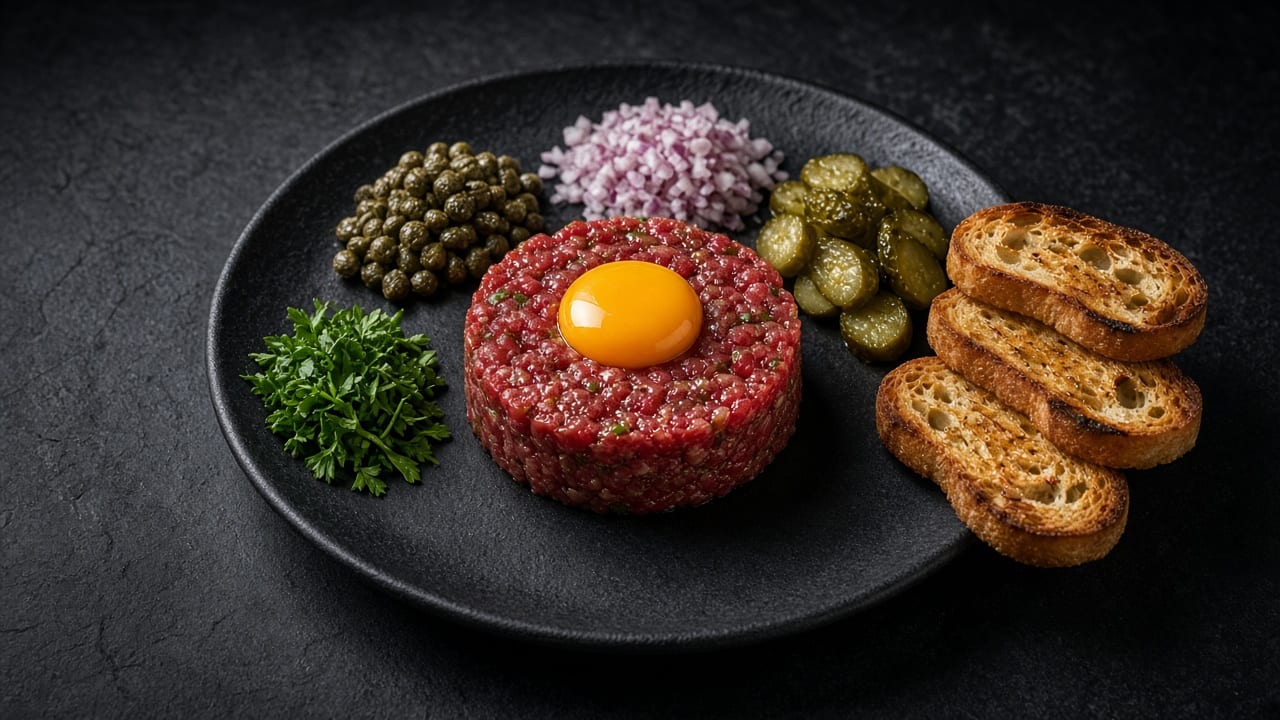
Steak Tartare with Capers, Cornichons and Egg Yolk
Inspired by techniques from Serious Eats.
Tender beef fillet chopped by hand and folded with a mustardy mayonnaise, capers, cornichons, shallot and herbs, shaped into rounds and topped with a golden yolk, with crisp baguette toasts on the side.
Always check the labels of the products you use.
Method
- 1
Firm up the fillet. Wrap the trimmed beef and give it 15 min in the freezer. Slightly firm meat holds its shape under the knife, so every cut is clean instead of squashed.
- 2
Bake the toasts. Heat the oven to 200 °C (180 °C fan). Brush the baguette slices with 1 tbsp oil, spread them on the tray and bake for 6-8 min until golden and crisp, then leave them to cool.
- 3
Whisk the dressing. Combine the mayonnaise, mustard, lemon juice, the remaining 1 tbsp oil, the salt and the pepper in the small bowl. A quick whisk gives a smooth, glossy sauce that will coat the beef evenly.
- 4
Chop by hand. Cut the beef into 5 mm slices, then into 5 mm strips, then across into tiny cubes; keep chopping until fine. Tip it straight into the bowl sitting over ice. A knife leaves distinct little pieces with a tender bite, where a mincer would turn it pasty.
- 5
Fold it together. Add the dressing, shallots, capers, cornichons, parsley and chives and fold gently with a spoon just until evenly mixed. Taste, adding more pepper if you like; overworking warms the meat and dulls the texture.
- 6
Shape the rounds. Set the ring on a chilled plate, spoon in a quarter of the beef and press lightly, then lift the ring away. Make a shallow dip on top with the back of a spoon and slide a yolk into it, then repeat for the other plates.
- 7
Serve straight away. Bring the plates to the table with the toasts while everything is still cold. Each person breaks their yolk and stirs it through the beef, where it acts as a rich, last-minute sauce.
Storage
Steak tartare does not keep: serve it as soon as it is mixed and throw away any leftovers. The toasts stay crisp for 2 days in an airtight tin.
Why this label?
28.7 g protein for 417 kcal = 6.9 g per 100 kcal, so protein gives about 28% of the energy. High Protein needs at least 20% (5 g per 100 kcal), the condition in the Annex to EU Regulation (EC) No 1924/2006. How we decide
EU nutrition claims
- Low sugars: 1.7 g sugars per 100 g (limit ≤ 5 g)
Per 100 g of the finished dish, worked out from the nutrition per serving and the lowest likely cooked weight (about 148 g a serving), so the true values are, if anything, lower. Thresholds from the Annex to EU Regulation (EC) No 1924/2006. How we decide
Free sugars
1.5 g per serving
3 % of the 50 g daily maximum · 6 % of the ideal 25 g
Free sugars under 50 g a day, ideally about 25 g, based on WHO free-sugar guidance (not endorsed by WHO). The share shown is the share of one serving. WHO
Equipment
- sharp chef's knife
- chilled chopping board
- large bowl set over a bowl of ice
- small bowl
- 8 cm ring mould
- baking tray
- pastry brush
- 4 chilled plates
Nutrition per serving (estimated values)
| Per serving | Amount |
|---|---|
| Energy | 417 kcal |
| Protein | 28.7 g |
| Carbohydrate | 18.9 g |
| of which sugars | 2.5 g |
| of which free sugars | 1.5 g |
| Fat | 24.8 g |
| of which saturates | 6.2 g |
| Fibre | 1.4 g |
| Salt | 1.55 g |
Protein per 100 kcal
6.9 g meets High Protein (≥ 5 g, 20% of energy)
Calculated from USDA FoodData Central ingredient values