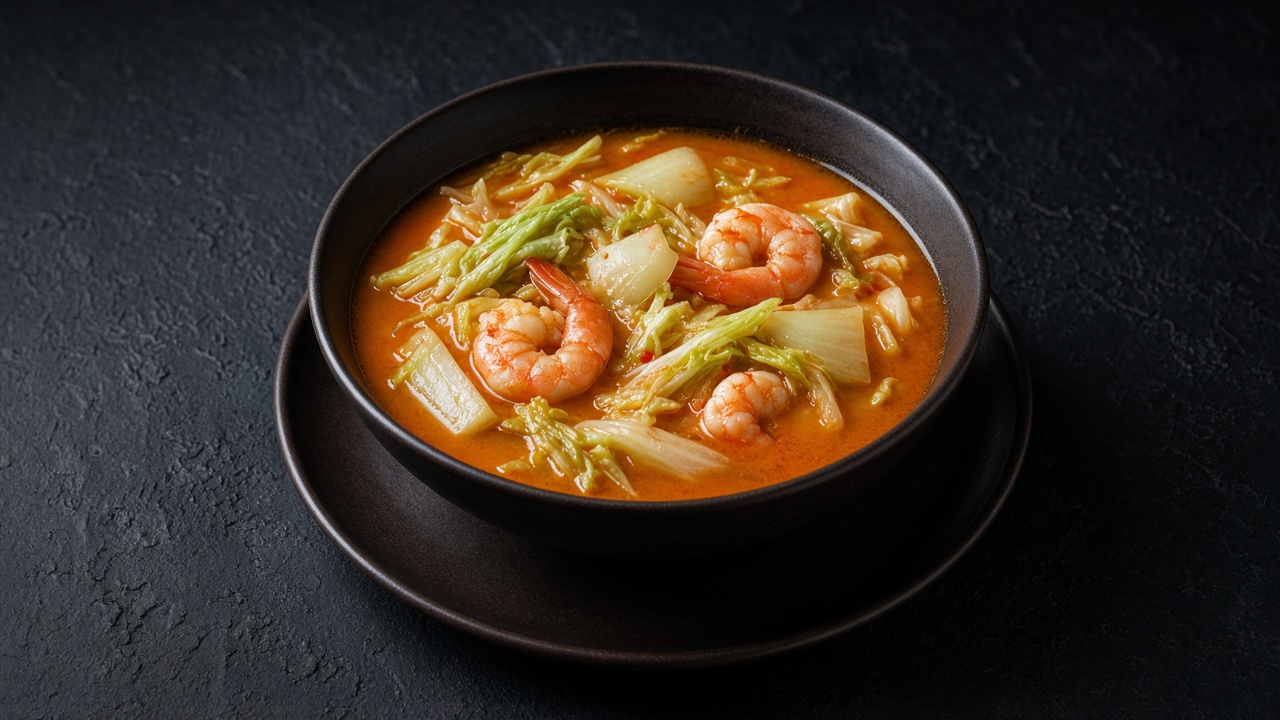
Thai Sour Curry with Prawns and Napa Cabbage
Inspired by techniques from Serious Eats.
A punchy, sour and salty Thai curry built on a pounded chilli paste, with crisp cabbage and plump prawns cooked briefly to keep everything fresh.
Always check the labels of the products you use.
Method
- 1
Pound. Pound ¾ tsp salt with 20 dried chillies in a mortar until flaked, then add 15 g fresh chillies, the turmeric, garlic and shallots, pounding well between each, and finally 30 g shrimp paste, until fine, about 15 min in total, or blend everything with 240 ml of the water until smooth.
- 2
Mix. Whisk the paste with 240 ml water in a saucepan until smooth, then stir in the remaining water, 80 g tamarind paste, 12 g sugar and 3 tbsp fish sauce, and bring to the boil.
- 3
Wilt. Add 300 g napa cabbage and cook for 3-4 min until just wilted but still crisp-tender.
- 4
Poach. Add 400 g prawns, push under the liquid and cook until pink and opaque, 2-3 min.
- 5
Finish. Take off the heat and stir in 1 tbsp lime juice, tasting for a sour, salty and hot balance.
- 6
Serve. Serve immediately in bowls with jasmine rice.
Storage
This curry is best served the moment it's made, as the prawns and cabbage don't keep their texture well once cooled and reheated. Cool leftovers in a shallow container and refrigerate within 2 hours (within 1 hour on a day above 32°C).
Why this label?
24.6 g protein for 197 kcal = 12.5 g per 100 kcal, so protein gives about 50% of the energy. High Protein needs at least 20% (5 g per 100 kcal), the condition in the Annex to EU Regulation (EC) No 1924/2006. How we decide
EU nutrition claims
- Low fat: 0.6 g fat per 100 g (limit ≤ 3 g)
- Low saturated fat: 0.2 g saturated fat per 100 g, 1.4% of energy (limits ≤ 1.5 g and ≤ 10%)
- Source of fibre: 1.6 g fibre per 100 kcal (needs ≥ 1.5 g)
Per 100 g of the finished dish, worked out from the nutrition per serving and the lowest likely cooked weight (about 198 g a serving), so the true values are, if anything, lower. Thresholds from the Annex to EU Regulation (EC) No 1924/2006. How we decide
Free sugars
3.5 g per serving
7 % of the 50 g daily maximum · 14 % of the ideal 25 g
Free sugars under 50 g a day, ideally about 25 g, based on WHO free-sugar guidance (not endorsed by WHO). The share shown is the share of one serving. WHO
Equipment
- mortar and pestle or blender
- medium saucepan (about 3 litres)
- whisk
- wooden spoon
- serving bowls
Nutrition per serving (estimated values)
| Per serving | Amount |
|---|---|
| Energy | 197 kcal |
| Protein | 24.6 g |
| Carbohydrate | 24.1 g |
| of which sugars | 13.6 g |
| of which free sugars | 3.5 g |
| Fat | 1.2 g |
| of which saturates | 0.3 g |
| Fibre | 3.2 g |
| Salt | 6.35 g |
Protein per 100 kcal
12.5 g meets High Protein (≥ 5 g, 20% of energy)
Calculated from USDA FoodData Central ingredient values