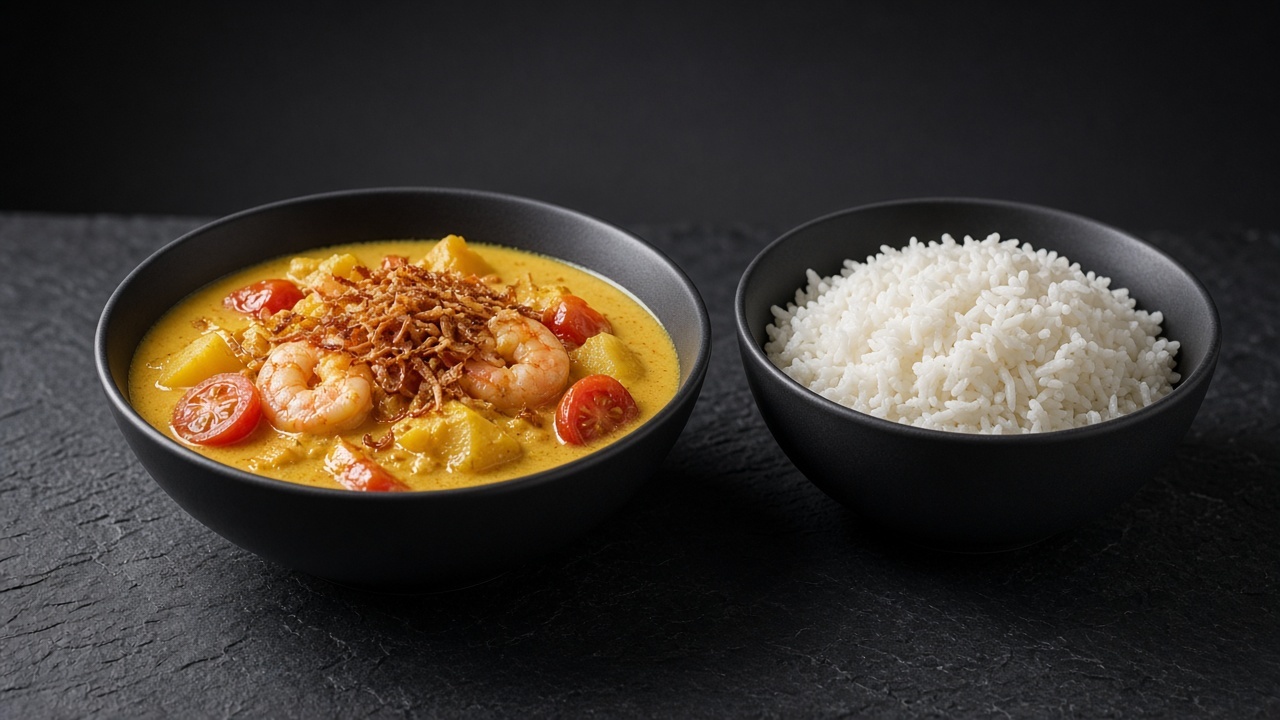
Thai Yellow Coconut Curry with Prawns, Potatoes and Crispy Shallots
Inspired by techniques from Serious Eats.
Potatoes are parboiled, yellow curry paste is fried in thick coconut milk until the oil separates, then thinned coconut milk, palm sugar, fish sauce, potatoes, cherry tomatoes and prawns are simmered briefly and topped with crispy shallots.
Always check the labels of the products you use.
Method
- 1
Fry the shallots. Heat 100 ml oil in a small pan over medium heat and fry the 3 sliced shallots, stirring, until light golden, 6 to 8 min. Lift onto kitchen paper to crisp; keep 1 tbsp of the oil.
- 2
Parboil the potatoes. Simmer 450 g potato chunks in unsalted water until just tender, 10 to 12 min, and drain.
- 3
Fry the paste. Heat the 1 tbsp shallot oil in a wide pan, add 60 g yellow curry paste and the thick cream from the top of the coconut milk in two or three additions, and fry, stirring, until it darkens and the oil separates, about 5 min.
- 4
Make the sauce. Stir in 10 g palm sugar, 2 tsp fish sauce, the rest of the coconut milk and 120 ml water. Add the potatoes and 100 g cherry tomatoes and simmer 5 min.
- 5
Cook the prawns. Add 600 g prawns and simmer until pink, opaque and 63 °C, 3 to 4 min.
- 6
Serve. Top with the crispy shallots and serve with jasmine rice.
Storage
Best eaten fresh. Refrigerate leftovers within 1 hour and eat within 1 day, reheated gently until piping hot. Keep the shallots separate and airtight.
Why this label?
36.1 g protein for 503 kcal = 7.2 g per 100 kcal, so protein gives about 29% of the energy. High Protein needs at least 20% (5 g per 100 kcal), the condition in the Annex to EU Regulation (EC) No 1924/2006. How we decide
EU nutrition claims
- Low sugars: 2.5 g sugars per 100 g (limit ≤ 5 g)
Per 100 g of the finished dish, worked out from the nutrition per serving and the lowest likely cooked weight (about 299 g a serving), so the true values are, if anything, lower. Thresholds from the Annex to EU Regulation (EC) No 1924/2006. How we decide
Free sugars
2.5 g per serving
5 % of the 50 g daily maximum · 10 % of the ideal 25 g
Free sugars under 50 g a day, ideally about 25 g, based on WHO free-sugar guidance (not endorsed by WHO). The share shown is the share of one serving. WHO
Equipment
- medium saucepan (about 3 l)
- colander
- small saucepan
- slotted spoon
- plate lined with kitchen paper
- silicone spatula
- instant-read probe thermometer
Nutrition per serving (estimated values)
| Per serving | Amount |
|---|---|
| Energy | 503 kcal |
| Protein | 36.1 g |
| Carbohydrate | 33.3 g |
| of which sugars | 7.4 g |
| of which free sugars | 2.5 g |
| Fat | 27.2 g |
| of which saturates | 19.5 g |
| Fibre | 4.4 g |
| Salt | 2.22 g |
Protein per 100 kcal
7.2 g meets High Protein (≥ 5 g, 20% of energy)
Calculated from USDA FoodData Central ingredient values