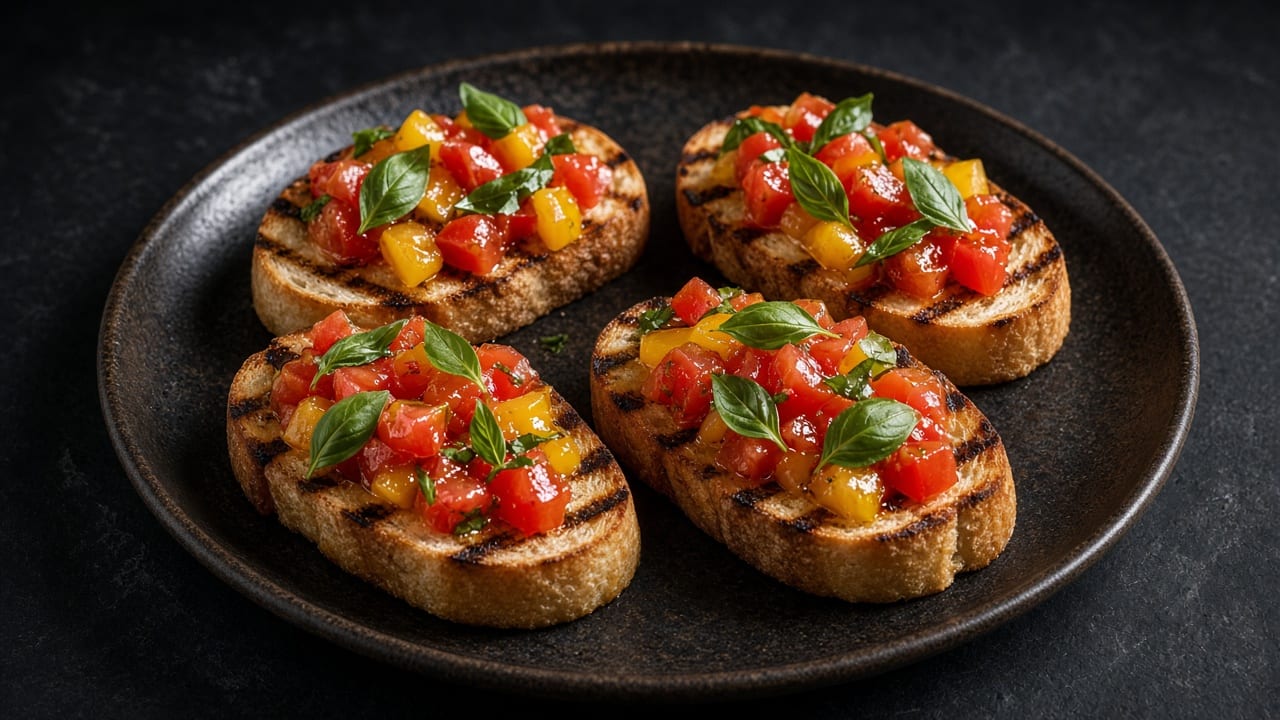
Tomato and Basil Bruschetta
Inspired by techniques from America's Test Kitchen and Serious Eats.
Thick slices of charred country bread rubbed with garlic and piled high with ripe red and yellow tomatoes and fresh basil.
Always check the labels of the products you use.
Method
- 1
Salt and drain. Toss the diced tomatoes with the salt in a sieve set over a bowl and leave for 15 minutes. The salt draws out excess juice, concentrating the flavour and keeping the toast from going soggy. Tip away the juice.
- 2
Dress the tomatoes. Mix the drained tomatoes in the bowl with the basil, 2 tbsp olive oil and the pepper. Shredding the basil finely spreads its aroma through every spoonful without large, wilting leaves.
- 3
Char the bread. Heat the grill pan over high heat, or the oven grill (broiler) to high. Toast the bread for 1-2 minutes a side, until crisp and golden with dark char lines but still soft in the middle. A crisp surface with a tender centre gives the best contrast under the juicy topping.
- 4
Garlic and oil. While the toasts are hot, rub one side of each with the cut garlic, then brush with the remaining olive oil. The rough, hot surface acts like a grater, so the garlic melts into the bread.
- 5
Top and serve. Spoon the tomato mixture over the toasts with a slotted spoon, piling it high, and serve within 10 minutes. Using a slotted spoon leaves behind any liquid that collects in the bowl.
Storage
The topping can be made up to 2 hours ahead and kept at room temperature. Leftover topping keeps covered in the fridge for 1 day; let it come back to room temperature before using, and toast fresh bread. Cool leftovers in a shallow container and refrigerate within 2 hours (within 1 hour on a day above 32°C).
EU nutrition claims
- Low saturated fat: 1.1 g saturated fat per 100 g, 5.7% of energy (limits ≤ 1.5 g and ≤ 10%)
- Low sugars: 3.8 g sugars per 100 g (limit ≤ 5 g)
Per 100 g of the finished dish, worked out from the nutrition per serving and the lowest likely cooked weight (about 203 g a serving), so the true values are, if anything, lower. Thresholds from the Annex to EU Regulation (EC) No 1924/2006. How we decide
Free sugars
3.7 g per serving
7.4 % of the 50 g daily maximum · 14.8 % of the ideal 25 g
Free sugars under 50 g a day, ideally about 25 g, based on WHO free-sugar guidance (not endorsed by WHO). The share shown is the share of one serving. WHO
Equipment
- large bowl
- sieve
- grill pan, barbecue or oven grill (broiler)
- pastry brush
- slotted spoon
- serving platter
Nutrition per serving (estimated values)
| Per serving | Amount |
|---|---|
| Energy | 366 kcal |
| Protein | 10.1 g |
| Carbohydrate | 47.8 g |
| of which sugars | 7.7 g |
| of which free sugars | 3.7 g |
| Fat | 15.8 g |
| of which saturates | 2.3 g |
| Fibre | 3.7 g |
| Salt | 1.95 g |
Protein per 100 kcal
2.8 g High Protein needs ≥ 5 g (20% of energy)
Calculated from USDA FoodData Central ingredient values