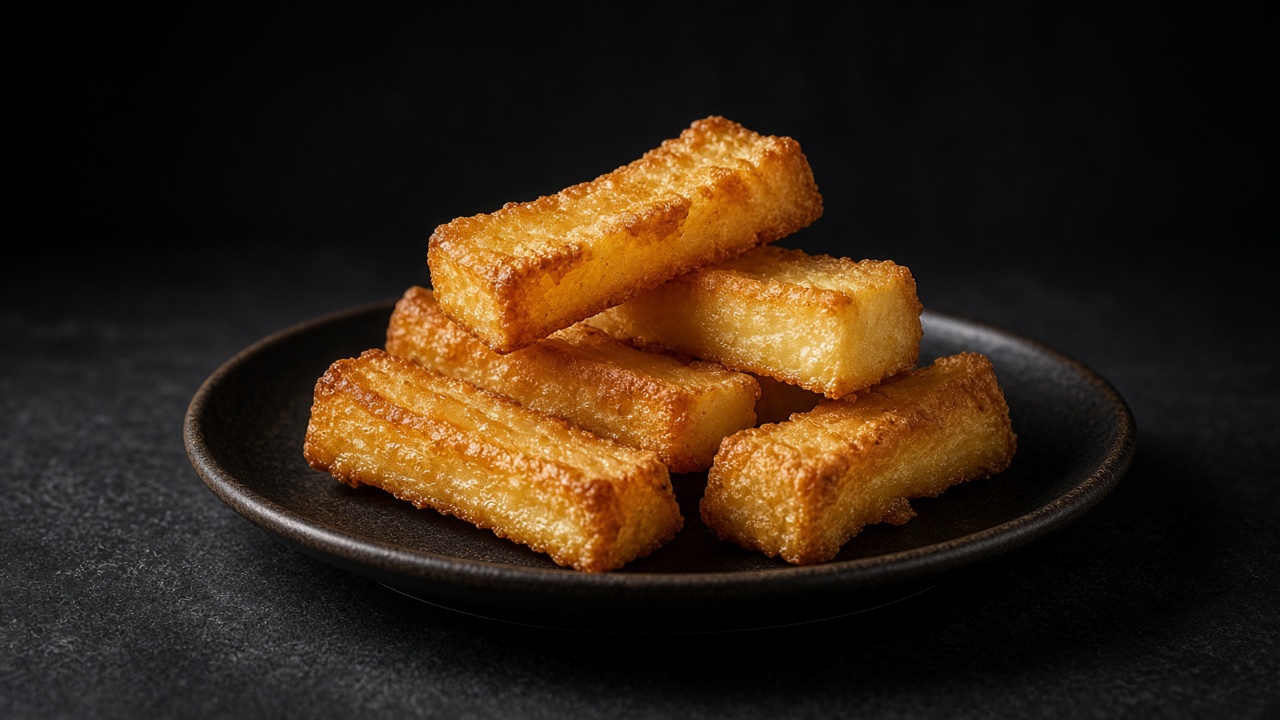
Triple-Cooked Chips
Inspired by techniques from Serious Eats.
These chunky chips are parboiled, fried twice at different temperatures and chilled between each stage to build an exceptionally crisp shell around a fluffy centre. The extra steps take time but give a crunch that lasts well after they leave the fryer.
Always check the labels of the products you use.
Method
- 1
Cut the chips. Cut the potatoes into thick blocks, about 2x2cm and 8-9cm long, then rinse under cold water until it runs clear. Squared-off chips in this Pont-Neuf style give more flat surface to crisp up than a thinner cut.
- 2
First cook — simmer. Put the chips into a pan of cold water with the vinegar and 30g salt, bring to the boil and simmer for 10-12 minutes until just tender and the edges are starting to crack. Those small fissures are exactly what you want, as they turn into the craggy crust later on.
- 3
Dry and chill. Lift the chips carefully onto a wire rack and leave to dry for 5 minutes, then chill or freeze for 1 hour until firm. Cooling firms up the starch on the surface, which stops the chips falling apart in the next frying stage.
- 4
Second cook — seal. Heat the oil to 130°C and fry the chips in batches for about 5 minutes until a pale crust has formed but no real colour yet. Drain on the rack.
- 5
Chill again. Chill or freeze the fried chips for a further 30 minutes until firm. Drying the chips out between each stage drives off surface moisture, which is what keeps the final crust crisp rather than soggy.
- 6
Third cook — crisp. Heat the oil to 190°C and fry the chips in batches for 3-5 minutes until deep golden and glassy-looking on the outside. The high heat at this final stage flashes the outside into a hard, glossy shell while the inside stays fluffy.
- 7
Season and serve. Drain well, scatter with the flaky sea salt and serve immediately while the crust is at its crispest. Never leave hot oil unattended at any stage of frying.
Storage
Chips are best eaten straight away, but can be parboiled and frozen after the first cook for up to 1 month. Finish from frozen with the second and third fry as above, making sure they're piping hot all the way through before serving. Cool leftovers in a shallow container and refrigerate within 2 hours (within 1 hour on a day above 32°C).
EU nutrition claims
- Low saturated fat: 0.7 g saturated fat per 100 g, 3.7% of energy (limits ≤ 1.5 g and ≤ 10%)
- Low sugars: 1 g sugars per 100 g (limit ≤ 5 g)
Per 100 g of the finished dish, worked out from the nutrition per serving and the lowest likely cooked weight (about 213 g a serving), so the true values are, if anything, lower. Thresholds from the Annex to EU Regulation (EC) No 1924/2006. How we decide
Free sugars
0 g per serving
0 % of the 50 g daily maximum · 0 % of the ideal 25 g
Free sugars under 50 g a day, ideally about 25 g, based on WHO free-sugar guidance (not endorsed by WHO). The share shown is the share of one serving. WHO
Equipment
- large heavy pot or Dutch oven (at least 5 litres) or a deep fryer
- deep-frying or probe thermometer
- spider strainer or slotted spoon
- 2 rimmed baking trays, one lined with kitchen paper, one with a wire rack
- large pan for simmering
- wire rack
Nutrition per serving (estimated values)
| Per serving | Amount |
|---|---|
| Energy | 369 kcal |
| Protein | 5.1 g |
| Carbohydrate | 43.7 g |
| of which sugars | 2.1 g |
| of which free sugars | 0 g |
| Fat | 20.2 g |
| of which saturates | 1.5 g |
| Fibre | 5.2 g |
| Salt | 1.61 g |
Protein per 100 kcal
1.4 g High Protein needs ≥ 5 g (20% of energy)
Calculated from USDA FoodData Central ingredient values