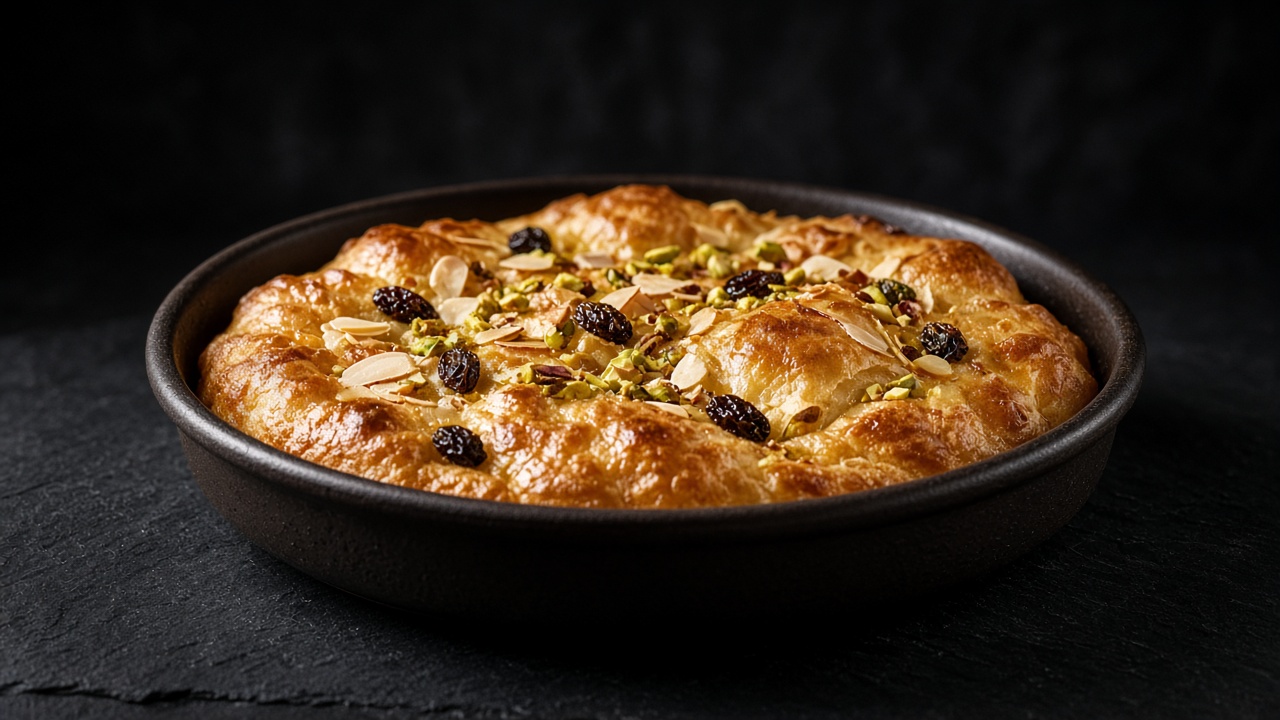
Umm Ali: Baked Filo and Milk Pudding with Almonds, Hazelnuts, Pistachios and Raisins
Inspired by techniques from Claudia Roden.
Buttered filo baked crisp, broken up with raisins, almonds, hazelnuts and pistachios, then soaked in hot sweetened milk and cream and baked again until puffed and golden.
Always check the labels of the products you use.
Method
- 1
Heat the oven. Heat the oven to 175 °C (155 °C fan) for at least 20 min. Butter the baking sheet and the baking dish.
- 2
Butter the filo. Keep the filo under the damp towel. Lay one sheet on the baking sheet and brush it with melted butter, then lay the next sheet on top and brush again. Repeat until all the sheets are stacked and buttered.
- 3
Bake the filo crisp. Bake for 10-12 min until crisp and very lightly coloured on top. Turn the oven up to 220 °C (200 °C fan).
- 4
Layer with fruit and nuts. When cool enough to handle, break the pastry into pieces with your hands into the baking dish, scattering the raisins and nuts between the layers. Keep a small handful of nuts and raisins back for the top.
- 5
Boil the milk. Bring the milk, cream and sugar to the boil in the saucepan, stirring until the sugar dissolves. Watch it closely, as it can boil over quickly.
- 6
Bake again. Pour the hot milk over the pastry, scatter over the reserved nuts and raisins and dust with cinnamon if using. Bake for 20-30 min until puffed, bubbling at the edges and golden on top.
- 7
Serve. Serve hot, spooning some of the milk into each bowl.
Storage
Best eaten warm on the day. Leftovers keep covered in the fridge for 2 days; reheat in a 180 °C oven until piping hot.
EU nutrition claims
- Low salt: 0.2 g salt per 100 g (limit ≤ 0.3 g)
Per 100 g of the finished dish, worked out from the nutrition per serving and the lowest likely cooked weight (about 197 g a serving), so the true values are, if anything, lower. Thresholds from the Annex to EU Regulation (EC) No 1924/2006. How we decide
Free sugars
16.6 g per serving
33.2 % of the 50 g daily maximum · 66.4 % of the ideal 25 g
Free sugars under 50 g a day, ideally about 25 g, based on WHO free-sugar guidance (not endorsed by WHO). The share shown is the share of one serving. WHO
Equipment
- large baking sheet
- 20 x 28 cm (or similar) baking dish
- pastry brush
- clean damp tea towel
- medium saucepan
Nutrition per serving (estimated values)
| Per serving | Amount |
|---|---|
| Energy | 672 kcal |
| Protein | 13.4 g |
| Carbohydrate | 53.3 g |
| of which sugars | 39 g |
| of which free sugars | 16.6 g |
| Fat | 47.7 g |
| of which saturates | 22.5 g |
| Fibre | 4 g |
| Salt | 0.4 g |
Protein per 100 kcal
2 g High Protein needs ≥ 5 g (20% of energy)
Calculated from USDA FoodData Central ingredient values