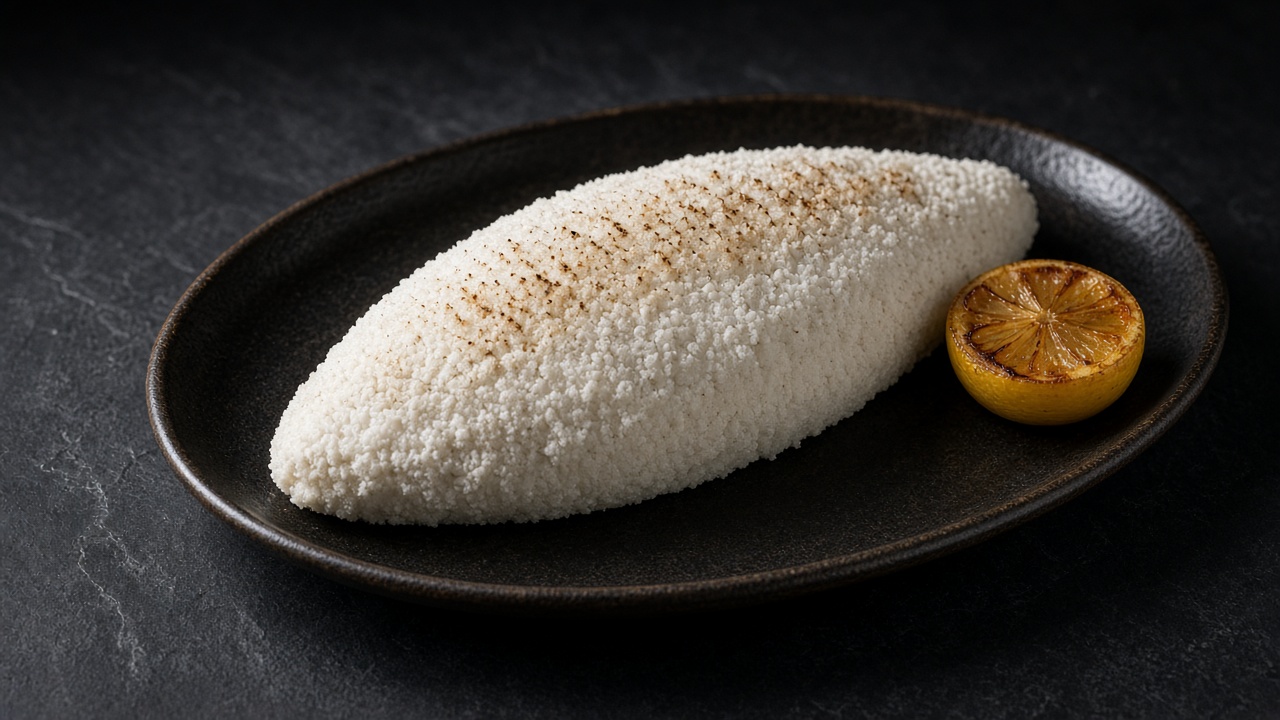
Whole Sea Bass Baked in a Salt Crust with Lemon and Herbs
Inspired by techniques from NYT Cooking and America's Test Kitchen.
A whole sea bass is packed inside a thick, egg-white-bound salt crust and baked so it steams gently in its own juices, then cracked open at the table for moist, delicately seasoned flesh.
Always check the labels of the products you use.
Method
- 1
Heat the Oven. Set the oven to 200°C (fan 180°C) and line the large tray with baking paper. Starting from a fully hot oven helps the thick salt crust heat through evenly in good time.
- 2
Stuff the Cavities. Rinse the sea bass inside and out under cold water and pat completely dry. Fill each cavity with half the lemon slices, garlic, thyme, rosemary and parsley. These aromatics perfume the flesh gently as the fish steams inside its crust.
- 3
Mix the Salt Crust. Combine the salt, egg whites and water by hand in a large bowl until the mixture feels like damp sand and holds together when squeezed, adding a little more water if it still crumbles. The egg white binds the crystals into a solid shell that hardens around the fish as it bakes.
- 4
Pack the Fish. Spread about a third of the salt mixture into two beds on the tray, each a little longer than a fish and about 1cm thick, then lay a fish on each bed. Press the rest of the salt all over to seal them completely in a 1cm layer, leaving just the heads and tails peeking out. Patch any gaps carefully, since they let steam escape and let too much salt reach the flesh.
- 5
Bake and Check. Bake for 25-30 minutes, then push a probe thermometer through the crust into the thickest part of the back, just behind the head, checking it reads at least 63°C. If it isn't there yet, bake for a further 5 minutes and test again. The hardened crust traps steam so thoroughly that the fish cooks in its own juices rather than drying in the oven's heat.
- 6
Rest the Fish. Leave the fish to rest on the tray for 5 minutes once out of the oven. This brief pause lets the juices inside settle back through the flesh before you break into the crust.
- 7
Char the Lemon. While the fish rests, cook the lemon halves cut side down in the dry small pan over medium-high heat for 2-3 minutes until browned. Charring mellows their sharpness into a gentler contrast for the fish.
- 8
Crack and Serve. Tap the crust all over with the back of a heavy spoon and lift it off in large pieces, then brush away loose salt and peel off and discard the top skin, which carries too much salt to eat. Lift the top fillet off the bone in pieces, remove the backbone, then lift out the lower fillet, leaving the bottom skin behind, checking carefully for stray bones. Drizzle with olive oil, grind over pepper and serve with the charred lemon.
Storage
Best eaten the day it's baked, since the crust is discarded once cracked and the flesh doesn't hold up well cold. Any leftover fillet meat can be refrigerated in a sealed container for up to 1 day and reheated gently until piping hot (74°C). Cool leftovers in a shallow container and refrigerate within 2 hours (within 1 hour on a day above 32°C).
Why this label?
24.2 g protein for 222 kcal = 10.9 g per 100 kcal, so protein gives about 44% of the energy. High Protein needs at least 20% (5 g per 100 kcal), the condition in the Annex to EU Regulation (EC) No 1924/2006. How we decide
EU nutrition claims
- Low saturated fat: 0.9 g saturated fat per 100 g, 8.5% of energy (limits ≤ 1.5 g and ≤ 10%)
- Sugar-free: 0.1 g sugars per 100 g (limit ≤ 0.5 g)
Per 100 g of the finished dish, worked out from the nutrition per serving and the lowest likely cooked weight (about 232 g a serving), so the true values are, if anything, lower. Thresholds from the Annex to EU Regulation (EC) No 1924/2006. How we decide
Free sugars
0.2 g per serving
0.4 % of the 50 g daily maximum · 0.8 % of the ideal 25 g
Free sugars under 50 g a day, ideally about 25 g, based on WHO free-sugar guidance (not endorsed by WHO). The share shown is the share of one serving. WHO
Equipment
- large rimmed baking tray
- baking paper
- large mixing bowl
- instant-read probe thermometer
- small frying pan (20 cm)
- heavy spoon or rolling pin, to crack the crust
- fish slice and large spoon
- pastry brush
- warm serving platter
Nutrition per serving (estimated values)
| Per serving | Amount |
|---|---|
| Energy | 222 kcal |
| Protein | 24.2 g |
| Carbohydrate | 1.5 g |
| of which sugars | 0.2 g |
| of which free sugars | 0.2 g |
| Fat | 12.8 g |
| of which saturates | 2.1 g |
| Fibre | 0.3 g |
| Salt | 0.95 g |
Protein per 100 kcal
10.9 g meets High Protein (≥ 5 g, 20% of energy)
Calculated from USDA FoodData Central ingredient values