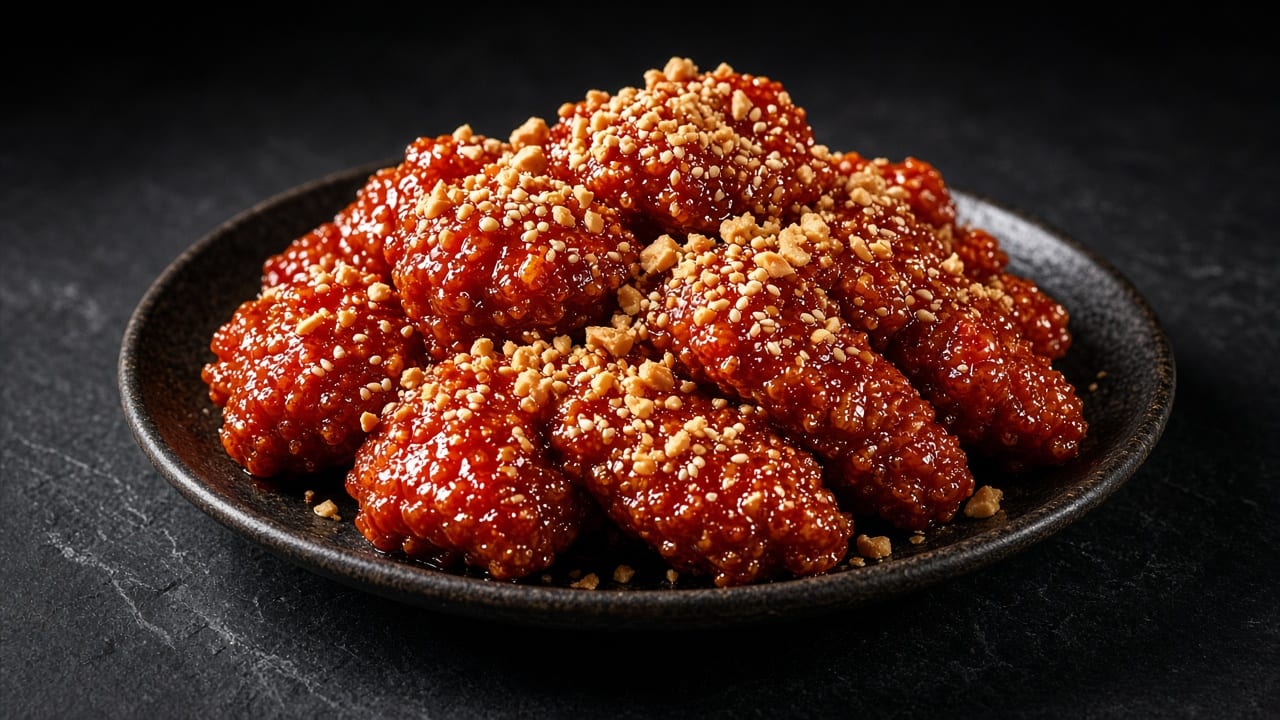
Yangnyeom Chicken (Korean Sweet-Spicy Fried Chicken)
Inspired by techniques from Serious Eats, America's Test Kitchen and NYT Cooking.
Chicken thighs are double-fried for extra crunch, then tossed in a sticky, sweet-spicy gochujang sauce and finished with peanuts and sesame seeds.
Always check the labels of the products you use.
Method
- 1
Season and batter. Season the chicken with the salt, pepper and garlic powder. Whisk the cornflour, flour, baking powder and ice-cold water into a thin batter, about the consistency of single cream, then stir in the chicken to coat.
- 2
First fry. Heat the oil to 175°C. Fry the chicken in batches, dropping pieces in one by one so they don't stick together, for 4-5 minutes until pale gold and reaching 74°C inside, then drain on the rack.
- 3
Rest the chicken. Before the second fry, let all the pieces rest for 5 minutes. This short rest lets the crust set properly, so it holds together rather than tearing when it goes back into the hot oil.
- 4
Second fry. Raise the oil to 190°C and refry the chicken in batches for 1-2 minutes until deep golden and very crisp. This second, hotter fry drives out the moisture the first fry left behind in the crust, which is exactly what keeps it crunchy once the sauce goes on.
- 5
Make the sauce. Simmer the gochujang, ketchup, honey, soy sauce, garlic, vinegar and water in a small pan over medium heat for 2-3 minutes until glossy and bubbling, then stir in the sesame oil off the heat so its aroma stays fresh.
- 6
Toss and serve. In a large bowl, toss the hot fried chicken through the sauce until every piece is coated, then scatter over the crushed peanuts and sesame seeds. Serve immediately, while the crust is still at its crispest.
Storage
Best eaten straight away while crisp. If needed, keep the chicken and sauce separately in the fridge for up to 2 days, reheat the chicken in a hot oven until piping hot (74°C) and crisp again, then toss in the warmed sauce. Cool leftovers in a shallow container and refrigerate within 2 hours (within 1 hour on a day above 32°C).
Why this label?
43.3 g protein for 611 kcal = 7.1 g per 100 kcal, so protein gives about 28% of the energy. High Protein needs at least 20% (5 g per 100 kcal), the condition in the Annex to EU Regulation (EC) No 1924/2006. How we decide
Free sugars
13.2 g per serving
26.4 % of the 50 g daily maximum · 52.8 % of the ideal 25 g
Free sugars under 50 g a day, ideally about 25 g, based on WHO free-sugar guidance (not endorsed by WHO). The share shown is the share of one serving. WHO
Equipment
- heavy pot or wok
- frying thermometer
- wire rack over a tray
- large bowl
- small saucepan
Nutrition per serving (estimated values)
| Per serving | Amount |
|---|---|
| Energy | 611 kcal |
| Protein | 43.3 g |
| Carbohydrate | 43.9 g |
| of which sugars | 13.7 g |
| of which free sugars | 13.2 g |
| Fat | 28.8 g |
| of which saturates | 4.1 g |
| Fibre | 1.6 g |
| Salt | 2.87 g |
Protein per 100 kcal
7.1 g meets High Protein (≥ 5 g, 20% of energy)
Calculated from USDA FoodData Central ingredient values