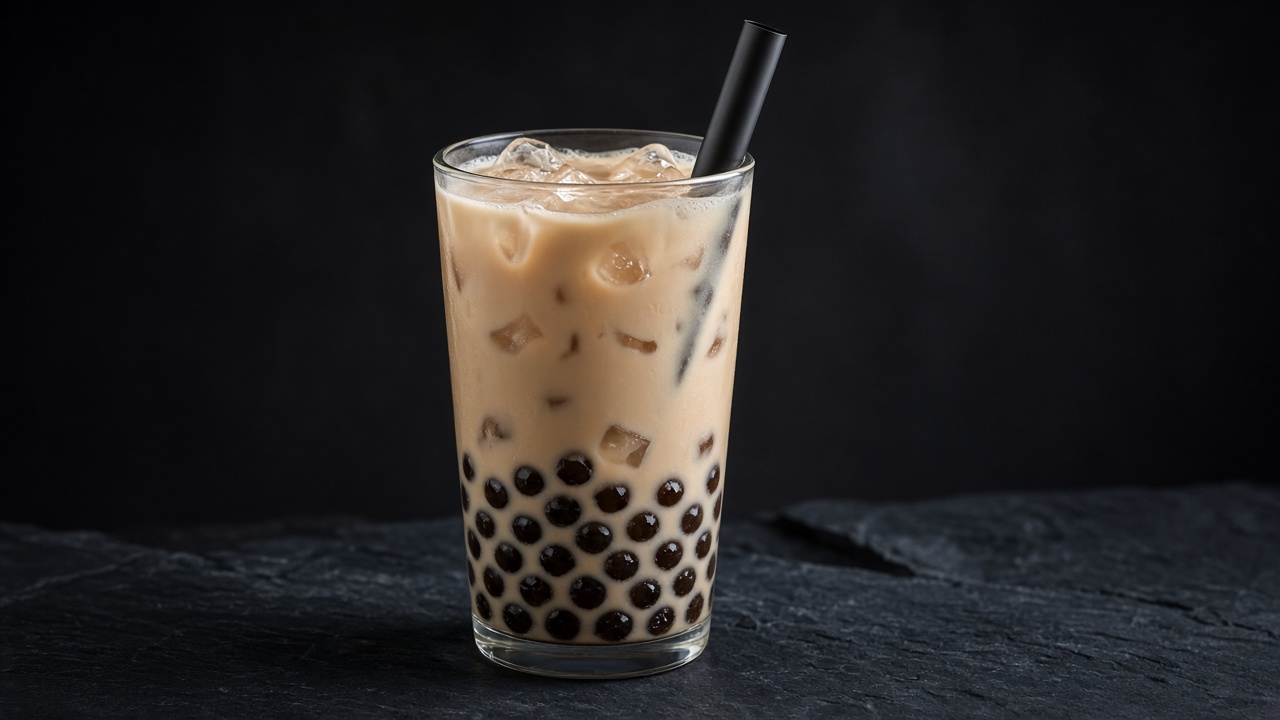
Brown Sugar Bubble Tea with Tapioca Pearls
Inspired by techniques from BBC Good Food.
Strong chilled black tea and cold milk over chewy tapioca pearls soaked in brown sugar syrup, served iced with wide straws.
Always check the labels of the products you use.
Method
- 1
Brew the tea. Steep the tea bags in the freshly boiled water for 10 minutes for a strong brew. Squeeze them out, cool the tea, then chill it. You need about 360 ml.
- 2
Make the syrup. Boil the brown sugar and water in a small pan, stirring, then simmer for 3 minutes until slightly thickened. Take off the heat.
- 3
Cook the pearls. Drop the pearls into plenty of boiling water and stir so they don't stick. Cook as the packet says, usually 5 minutes, then cover and rest for 2-3 minutes until chewy right through. Lift them out with a slotted spoon straight into the warm syrup and stir.
- 4
Soak. Leave the pearls in the syrup at room temperature for 20-30 minutes so they turn glossy and sweet. Use them within 4 hours; chilling makes them hard.
- 5
Assemble. Divide the pearls and syrup between the glasses, add ice, then pour in the cold tea and milk. Stir well and serve with wide straws.
Storage
The tea keeps in the fridge for up to 4 days. Make the pearls fresh and use within 4 hours. Cool leftovers in a shallow container and refrigerate within 2 hours (within 1 hour on a day above 32°C).
EU nutrition claims
- Low fat: 0.9 g fat per 100 ml (limit ≤ 1.5 g)
- Low saturated fat: 0.5 g saturated fat per 100 ml, 4.8% of energy (limits ≤ 0.75 g and ≤ 10%)
- Low salt: 0.04 g salt per 100 ml (limit ≤ 0.3 g)
Per 100 ml of the finished dish, worked out from the nutrition per serving and the lowest likely cooked weight (about 322 ml a serving), so the true values are, if anything, lower. Thresholds from the Annex to EU Regulation (EC) No 1924/2006. How we decide
Caffeine · Free sugars
- Per serving: at least 50 mg caffeine (serving: 1 glass (about 250 ml tea)). Source: about 250 ml brewed per serving × USDA FDC SR Legacy #173227 (brewed black tea, 20 mg/100 g) This brew uses more tea per ml than standard brewed tea, so the real amount is likely higher..
- Scaling: making more servings does not change the caffeine in each serving; what counts is how many servings you drink in a day. 1 serving: 50 mg · 2 servings: 100 mg · 3 servings: 150 mg · 4 servings: 200 mg.
- General guideline: EFSA Scientific Opinion on the safety of caffeine (2015): for healthy adults, up to 200 mg in a single dose and up to 400 mg per day do not raise safety concerns. 1 serving = 13 % of 400 mg. EFSA
34 g per serving
68 % of the 50 g daily maximum · 136 % of the ideal 25 g
Free sugars under 50 g a day, ideally about 25 g, based on WHO free-sugar guidance (not endorsed by WHO). The share shown is the share of one serving. WHO
Equipment
- jug or teapot
- small saucepan
- medium saucepan
- slotted spoon
- 2 tall glasses (about 450 ml)
- 2 wide bubble-tea straws
Nutrition per serving (estimated values)
| Per serving | Amount |
|---|---|
| Energy | 317 kcal |
| Protein | 3 g |
| Carbohydrate | 70.4 g |
| of which sugars | 39.8 g |
| of which free sugars | 34 g |
| Fat | 3 g |
| of which saturates | 1.7 g |
| Fibre | 0.3 g |
| Salt | 0.14 g |
Protein per 100 kcal
0.9 g High Protein needs ≥ 5 g (20% of energy)
Calculated from USDA FoodData Central ingredient values