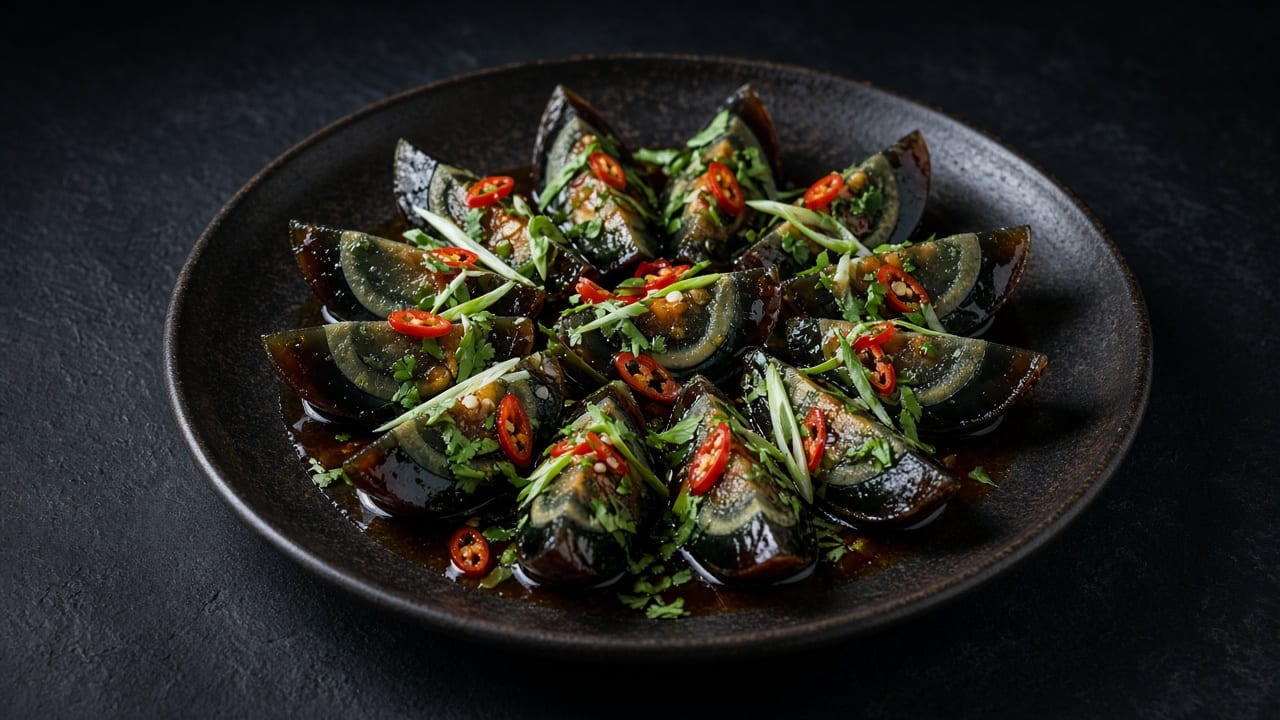
Century Eggs with Chilli-Soy Dressing (Pidan)
Inspired by techniques from Serious Eats.
Lead-free century eggs cut into neat wedges and dressed with soy, rice vinegar, sesame and chilli oils, garlic and ginger, finished with fresh chilli, spring onion and coriander. Ready in 15 minutes.
Always check the labels of the products you use.
Method
- 1
Peel and air. Crack off the clay or shell coating, peel the eggs and rinse them under cold water. Leave them on a plate for 10 min; the sharp, ammonia-like aroma from the cure fades as they sit in the air.
- 2
Cut into wedges. Dip the knife in hot water and wipe it between cuts, or press a taut thread through the egg, to cut each one lengthways into 6 wedges. A warm, clean blade glides through the soft yolk instead of smearing it. Fan the wedges on the plate.
- 3
Mix the dressing. In the small bowl, stir the soy sauce, vinegar, sesame oil, chilli oil, sugar, garlic and ginger until the sugar has dissolved. The sugar and vinegar balance the egg's rich, savoury depth.
- 4
Dress and serve. Spoon the dressing over the eggs and scatter with chilli, spring onion and coriander. Serve straight away, cold, as a starter or alongside rice congee.
Storage
Best eaten as soon as it is dressed. Unpeeled century eggs keep in a cool, dry cupboard until the date on the pack; peeled leftovers keep covered in the fridge for 1 day. Cool leftovers in a shallow container and refrigerate within 2 hours (within 1 hour on a day above 32°C).
Why this label?
8.5 g protein for 141 kcal = 6 g per 100 kcal, so protein gives about 24% of the energy. High Protein needs at least 20% (5 g per 100 kcal), the condition in the Annex to EU Regulation (EC) No 1924/2006. How we decide
EU nutrition claims
- Low sugars: 2 g sugars per 100 g (limit ≤ 5 g)
Per 100 g of the finished dish, worked out from the nutrition per serving and the lowest likely cooked weight (about 72 g a serving), so the true values are, if anything, lower. Thresholds from the Annex to EU Regulation (EC) No 1924/2006. How we decide
Free sugars
0.5 g per serving
1 % of the 50 g daily maximum · 2 % of the ideal 25 g
Free sugars under 50 g a day, ideally about 25 g, based on WHO free-sugar guidance (not endorsed by WHO). The share shown is the share of one serving. WHO
Equipment
- small bowl
- sharp knife or length of clean thread
- serving plate
Nutrition per serving (estimated values)
| Per serving | Amount |
|---|---|
| Energy | 141 kcal |
| Protein | 8.5 g |
| Carbohydrate | 2.7 g |
| of which sugars | 1.4 g |
| of which free sugars | 0.5 g |
| Fat | 10.5 g |
| of which saturates | 2.5 g |
| Fibre | 0.3 g |
| Salt | 1.74 g |
Protein per 100 kcal
6 g meets High Protein (≥ 5 g, 20% of energy)
Calculated from USDA FoodData Central ingredient values