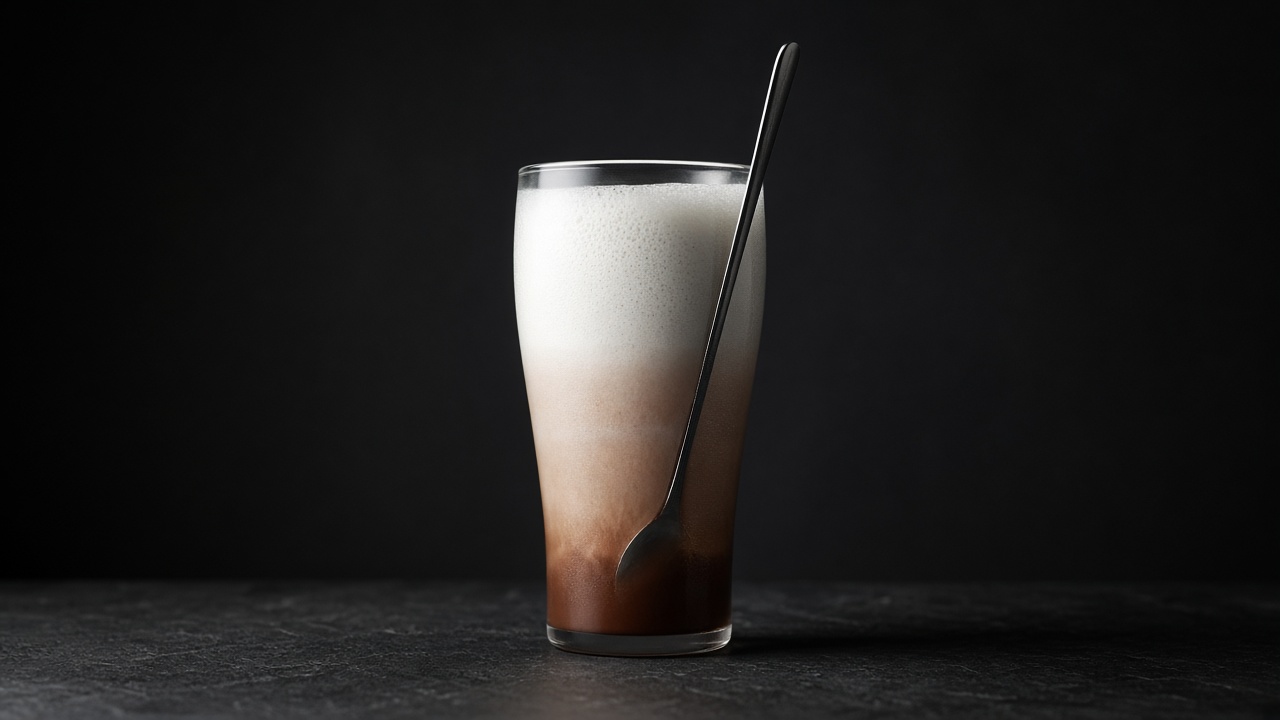
Brooklyn Egg Cream with Shaken Milk Foam
Inspired by techniques from Serious Eats.
A classic cold drink made from cold milk and soda water shaken until foamy, topped with chocolate syrup and a thick foam head.
Always check the labels of the products you use.
Method
- 1
Chill. Chill a tall 350 ml glass.
- 2
Shake. Put 60 ml very cold whole milk and about 2 tbsp of the soda water in a cocktail shaker or jar with 1 ice cube, close and shake hard 15–20 s until frothy.
- 3
Pour. Pour into the chilled glass.
- 4
Top. Top up with the remaining soda water, pouring into the centre so a thick white foam rises to the rim.
- 5
Drizzle. Drizzle 2½ tbsp chocolate syrup through the foam so it sinks to the bottom, leaving a white head over a dark base.
- 6
Drink. Stir gently only in the lower part if you want it mixed, keeping the foam intact, and drink immediately.
Storage
Consume immediately. Cool leftovers in a shallow container and refrigerate within 2 hours (within 1 hour on a day above 32°C).
EU nutrition claims
- Low fat: 0.9 g fat per 100 ml (limit ≤ 1.5 g)
- Low saturated fat: 0.5 g saturated fat per 100 ml, 7.3% of energy (limits ≤ 0.75 g and ≤ 10%)
- Low salt: 0.06 g salt per 100 ml (limit ≤ 0.3 g)
Per 100 ml of the finished dish, worked out from the nutrition per serving and the lowest likely cooked weight (about 266 ml a serving), so the true values are, if anything, lower. Thresholds from the Annex to EU Regulation (EC) No 1924/2006. How we decide
Caffeine · Free sugars
- Per serving: about 3 mg caffeine (serving: 1 glass). Source: 2.5 tbsp (about 49 g) chocolate syrup × USDA FDC SR Legacy #174117 (chocolate syrup, 6 mg/100 g).
- Scaling: making more servings does not change the caffeine in each serving; what counts is how many servings you drink in a day. 1 serving: 3 mg · 2 servings: 6 mg · 3 servings: 9 mg · 4 servings: 12 mg.
- General guideline: EFSA Scientific Opinion on the safety of caffeine (2015): for healthy adults, up to 200 mg in a single dose and up to 400 mg per day do not raise safety concerns. 1 serving = 1 % of 400 mg. EFSA
27.5 g per serving
55 % of the 50 g daily maximum · 110 % of the ideal 25 g
Free sugars under 50 g a day, ideally about 25 g, based on WHO free-sugar guidance (not endorsed by WHO). The share shown is the share of one serving. WHO
Equipment
- cocktail shaker or jar with lid
- tall 350 ml glass, chilled
- long spoon
Nutrition per serving (estimated values)
| Per serving | Amount |
|---|---|
| Energy | 173 kcal |
| Protein | 3 g |
| Carbohydrate | 35.5 g |
| of which sugars | 30.6 g |
| of which free sugars | 27.5 g |
| Fat | 2.5 g |
| of which saturates | 1.4 g |
| Fibre | 1.2 g |
| Salt | 0.17 g |
Protein per 100 kcal
1.7 g High Protein needs ≥ 5 g (20% of energy)
Calculated from USDA FoodData Central ingredient values