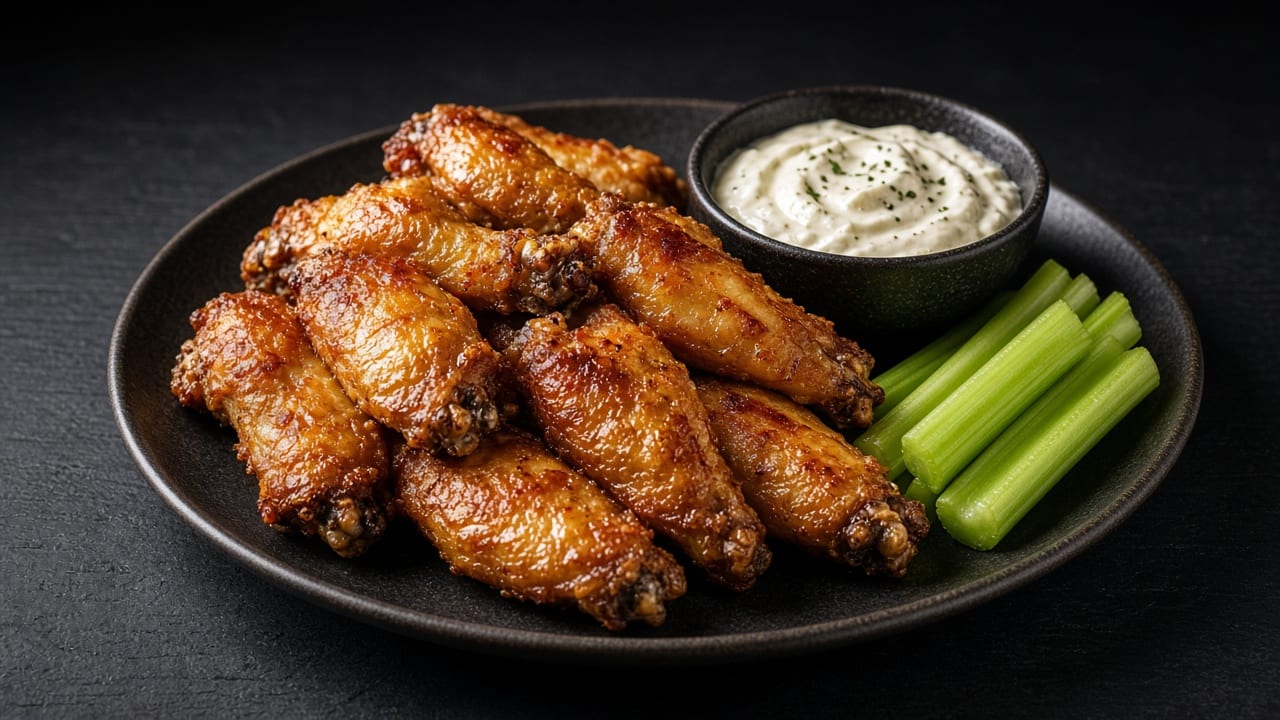
Crispy Oven-Baked Chicken Wings
Inspired by techniques from America's Test Kitchen and Serious Eats.
Wings are coated in a baking-powder seasoning and baked low then high on a rack, for deeply crisp, blistered skin without deep frying, served with celery and a cool garlic-chive soured cream dip.
Always check the labels of the products you use.
Method
- 1
Dry and season. Pat the split wings thoroughly dry with kitchen paper, then toss them in a large bowl with the baking powder, salt, pepper, garlic powder and smoked paprika until lightly and evenly coated. Baking powder raises the pH of the skin, helping it brown deeply and blister as it bakes - never use bicarbonate of soda here, as it leaves a soapy taste.
- 2
Arrange on racks. Spread the wings skin-side up on wire racks set over two baking trays, spacing them so they don't touch. For extra crispness, refrigerate uncovered for 1 hour up to overnight before baking, which dries the skin further; this step is optional. About 20 minutes before baking, heat the oven to 120°C (100°C fan) with shelves in the lower-middle and upper-middle positions.
- 3
Render at low heat. Bake at 120°C (100°C fan) on the lower-middle shelves for 30 minutes. This gentle start slowly renders fat out of the skin before any colour develops, setting up a crisper, less greasy finish later.
- 4
Blast at high heat. Raise the oven to 220°C (200°C fan) and bake for a further 40-50 minutes, swapping the trays' shelf positions halfway through. Bake until the skin is deep golden, blistered and crackly, and the thickest drumette reads at least 74°C - wings are especially good taken to 80°C or above, where the connective tissue softens right through.
- 5
Rest briefly. Pull the wings from the oven and leave them for 5 minutes before touching. This short rest lets residual steam escape so the crackly skin doesn't go soft underneath.
- 6
Make the dip and serve. While the wings rest, stir the soured cream with the garlic powder, chives, lemon juice and a pinch of salt. Pile the wings onto a platter with the celery sticks and the dip, and serve straight away while the skin is at its crispest.
Air-fryer option
sourced: America's Test Kitchen, "Air-Fryer Chicken Wings": America’s Test Kitchen
instead of baking in the oven as in the method below, the wings can be made in the air fryer.
- Oil: no oil: the wings cook in their own fat (as in the source)
- Air fryer: 204 °C, about 25 min, flipping halfway
- Steps:
- 1
Pat the wings dry and season them with the salt, pepper, garlic powder and smoked paprika as in step 1, leaving out the baking powder (the source seasons with salt and pepper only).
- 2
Arrange the wings in an even layer in the basket; they will overlap a little (the source cooks about 1.1 kg wings at a time in a large air fryer, so cook this recipe's 1.2 kg in 2 batches in a smaller one).
- 3
Air-fry at 204 °C until golden and crisp, about 25 minutes, flipping the wings halfway. Serve with the dip as in step 6.
- 1
Storage
Keep cooked wings in the fridge for up to 3 days, or freeze for up to 2 months. Reheat in a hot oven until piping hot and 74°C in the centre to bring back some crispness; microwaving will leave the skin soft. Cool leftovers in a shallow container and refrigerate within 2 hours (within 1 hour on a day above 32°C).
Why this label?
33.9 g protein for 428 kcal = 7.9 g per 100 kcal, so protein gives about 32% of the energy. High Protein needs at least 20% (5 g per 100 kcal), the condition in the Annex to EU Regulation (EC) No 1924/2006. How we decide
EU nutrition claims
- Low sugars: 1.3 g sugars per 100 g (limit ≤ 5 g)
Per 100 g of the finished dish, worked out from the nutrition per serving and the lowest likely cooked weight (about 132 g a serving), so the true values are, if anything, lower. Thresholds from the Annex to EU Regulation (EC) No 1924/2006. How we decide
Free sugars
0 g per serving
0 % of the 50 g daily maximum · 0 % of the ideal 25 g
Free sugars under 50 g a day, ideally about 25 g, based on WHO free-sugar guidance (not endorsed by WHO). The share shown is the share of one serving. WHO
Equipment
- 2 large baking trays
- 2 wire racks that fit the trays
- large mixing bowl
- instant-read thermometer
Nutrition per serving (estimated values)
| Per serving | Amount |
|---|---|
| Energy | 428 kcal |
| Protein | 33.9 g |
| Carbohydrate | 4.6 g |
| of which sugars | 1.7 g |
| of which free sugars | 0 g |
| Fat | 29.9 g |
| of which saturates | 9.7 g |
| Fibre | 1.1 g |
| Salt | 2.58 g |
Protein per 100 kcal
7.9 g meets High Protein (≥ 5 g, 20% of energy)
Calculated from USDA FoodData Central ingredient values