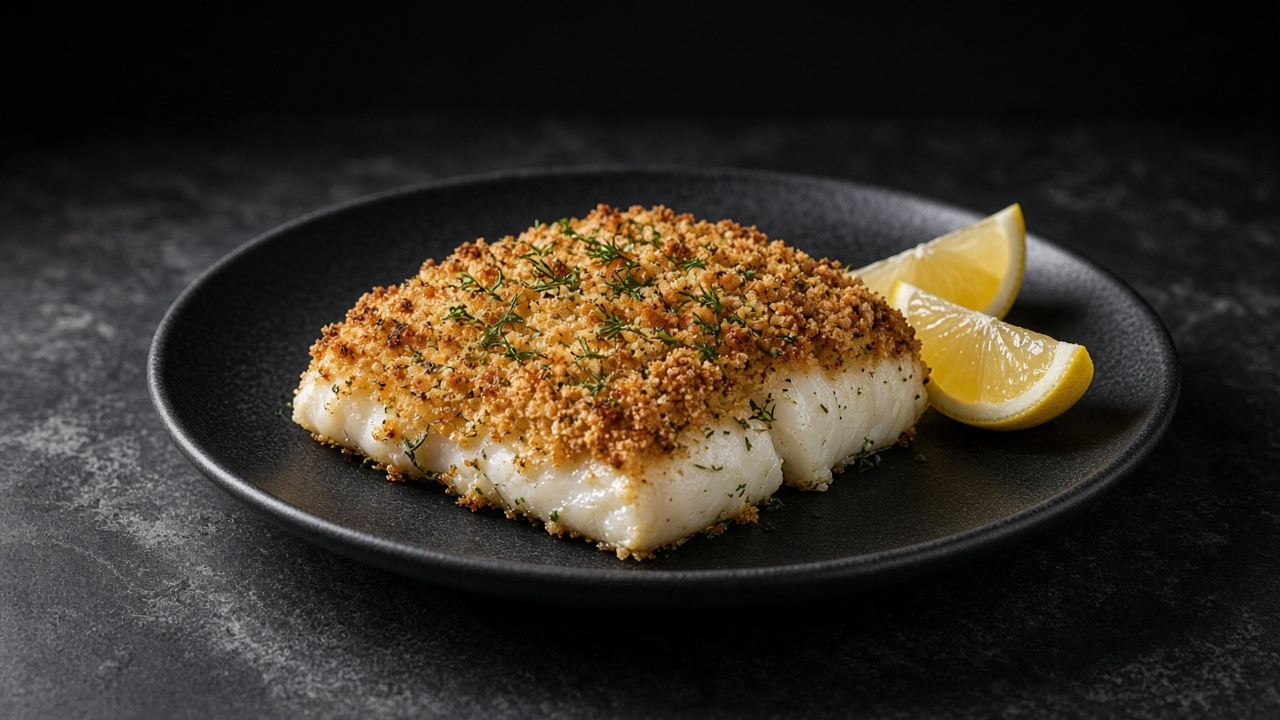
Crunchy Cracker-Crusted Baked Cod
Inspired by techniques from America's Test Kitchen.
Thick cod fillets are spread with a tangy mayonnaise and mustard mixture, then pressed with buttery cracker crumbs and baked hot and fast so the top turns golden and crunchy while the fish stays moist. It is ready in well under 30 minutes, with almost no hands-on work beyond crushing crackers and mixing a quick coating.
Always check the labels of the products you use.
Method
- 1
Heat the oven and prepare the dish. Set a rack in the middle of the oven and heat to 230 °C (210 °C fan). Coat a 33x23 cm baking dish with vegetable oil spray.
- 2
Season the fish. Pat the cod dry with kitchen paper and season with the fine salt and pepper. Lay the fillets in the baking dish, spaced about 1 cm apart.
- 3
Coat the fish. Toss the cracker crumbs with half the dill in one bowl. In a separate bowl, mix the remaining dill with the mayonnaise, mustard, lemon juice and cayenne. Spread the mayonnaise mixture over the top and sides of the fish, then press the crumbs into it so they stick.
- 4
Bake. Bake until the crumbs are golden brown and all but the very centre of the fish has turned from translucent to opaque, about 15 minutes. Serve with the lemon wedges.
Storage
Refrigerate leftovers in an airtight container for up to 2 days; reheat in a hot oven rather than a microwave to keep the crumb topping from going soft. Cool leftovers in a shallow container and refrigerate within 2 hours (within 1 hour on a day above 32°C).
Why this label?
33.5 g protein for 325 kcal = 10.3 g per 100 kcal, so protein gives about 41% of the energy. High Protein needs at least 20% (5 g per 100 kcal), the condition in the Annex to EU Regulation (EC) No 1924/2006. How we decide
EU nutrition claims
- Low saturated fat: 1.5 g saturated fat per 100 g, 7.5% of energy (limits ≤ 1.5 g and ≤ 10%)
- Low sugars: 1 g sugars per 100 g (limit ≤ 5 g)
Per 100 g of the finished dish, worked out from the nutrition per serving and the lowest likely cooked weight (about 185 g a serving), so the true values are, if anything, lower. Thresholds from the Annex to EU Regulation (EC) No 1924/2006. How we decide
Free sugars
0 g per serving
0 % of the 50 g daily maximum · 0 % of the ideal 25 g
Free sugars under 50 g a day, ideally about 25 g, based on WHO free-sugar guidance (not endorsed by WHO). The share shown is the share of one serving. WHO
Equipment
- 33x23 cm baking dish
- vegetable oil spray
- kitchen paper
- mixing bowl
- small bowl
- instant-read thermometer or paring knife
Nutrition per serving (estimated values)
| Per serving | Amount |
|---|---|
| Energy | 325 kcal |
| Protein | 33.5 g |
| Carbohydrate | 11.1 g |
| of which sugars | 1.8 g |
| of which free sugars | 0 g |
| Fat | 15.7 g |
| of which saturates | 2.7 g |
| Fibre | 0.9 g |
| Salt | 1.57 g |
Protein per 100 kcal
10.3 g meets High Protein (≥ 5 g, 20% of energy)
Calculated from USDA FoodData Central ingredient values