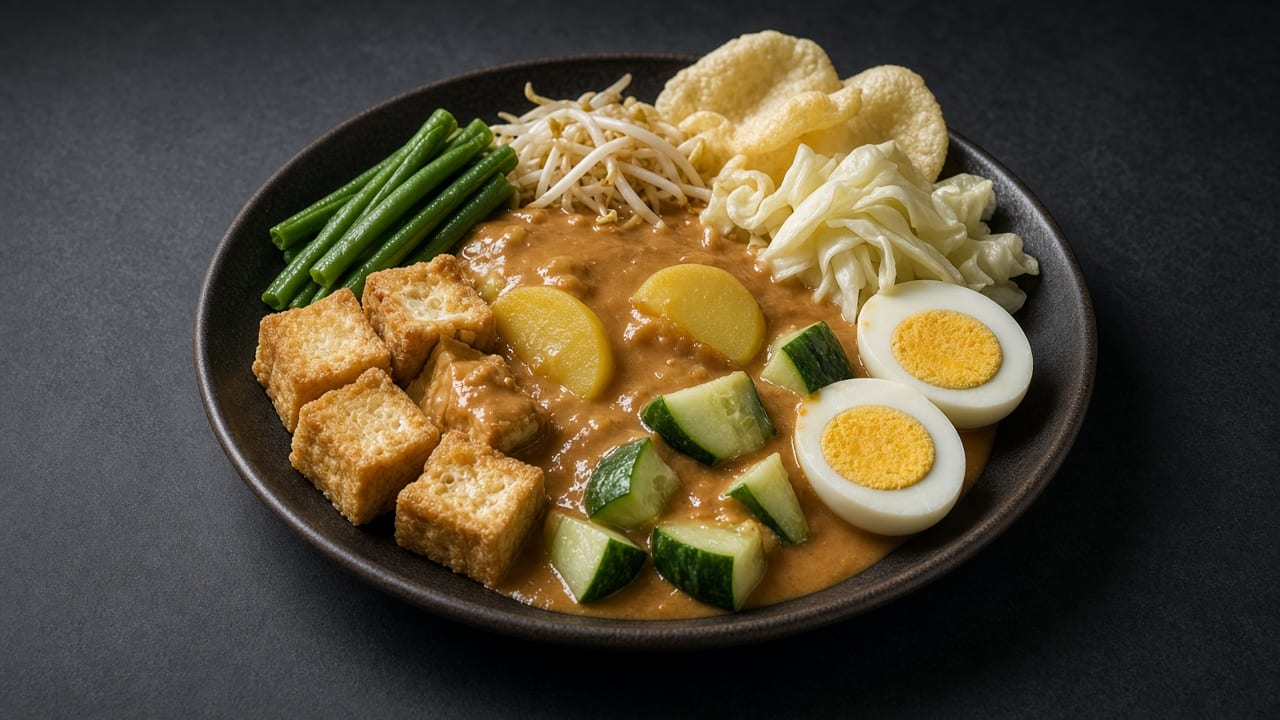
Gado-Gado (Indonesian Vegetable Salad with Peanut Sauce)
Inspired by techniques from Serious Eats and NYT Cooking.
Boiled potatoes, blanched cabbage, green beans and bean sprouts with fried tofu, cucumber, tomato and hard-boiled egg, served with a peanut sauce of shallot, garlic, chilli, palm sugar, tamarind and kecap manis.
Always check the labels of the products you use.
Method
- 1
Make the peanut sauce. Grind the peanuts in the food processor to a coarse, sandy paste and set aside. Blitz the shallots, garlic, chillies, sugar and salt to a rough paste. Simmer the water and tamarind in the small pan for 3 min, then stir in both pastes and the kecap manis and simmer for 5-6 min, stirring often so it does not catch, until thick and creamy. Add the lime juice and loosen with a splash of water if needed.
- 2
Boil the eggs. Lower the eggs into boiling water and cook for 10 min so the yolks are fully set, then chill in iced water, peel and quarter.
- 3
Cook the vegetables. Boil the potatoes in the same pan for 8-10 min until tender and drain. Blanch the cabbage for 1 min, the green beans for 2 min and the bean sprouts for 20 seconds, chilling each in the iced water and draining on paper. Chilling keeps them bright and crisp.
- 4
Assemble. Arrange the vegetables, tofu, cucumber, tomato and eggs on the platter and spoon over the warm peanut sauce, or serve it alongside.
Storage
Store the components separately, refrigerated, up to 2 days. The peanut sauce keeps 5 days; reheat gently with a splash of water, until steaming (74 °C) if serving warm. Cool leftovers in a shallow container and refrigerate within 2 hours (within 1 hour on a day above 32°C).
Why this label?
30.2 g protein for 604 kcal = 5 g per 100 kcal, so protein gives about 20% of the energy. High Protein needs at least 20% (5 g per 100 kcal), the condition in the Annex to EU Regulation (EC) No 1924/2006. How we decide
EU nutrition claims
- Source of fibre: 2 g fibre per 100 kcal (needs ≥ 1.5 g)
Per 100 g of the finished dish, worked out from the nutrition per serving and the lowest likely cooked weight (about 312 g a serving), so the true values are, if anything, lower. Thresholds from the Annex to EU Regulation (EC) No 1924/2006. How we decide
Free sugars
8.7 g per serving
17.4 % of the 50 g daily maximum · 34.8 % of the ideal 25 g
Free sugars under 50 g a day, ideally about 25 g, based on WHO free-sugar guidance (not endorsed by WHO). The share shown is the share of one serving. WHO
Equipment
- food processor
- small saucepan
- large saucepan
- slotted spoon
- large bowl of iced water
- tray lined with kitchen paper
- large platter
Nutrition per serving (estimated values)
| Per serving | Amount |
|---|---|
| Energy | 604 kcal |
| Protein | 30.2 g |
| Carbohydrate | 57.1 g |
| of which sugars | 23.9 g |
| of which free sugars | 8.7 g |
| Fat | 32.8 g |
| of which saturates | 5.9 g |
| Fibre | 11.8 g |
| Salt | 1.08 g |
Protein per 100 kcal
5 g meets High Protein (≥ 5 g, 20% of energy)
Calculated from USDA FoodData Central ingredient values