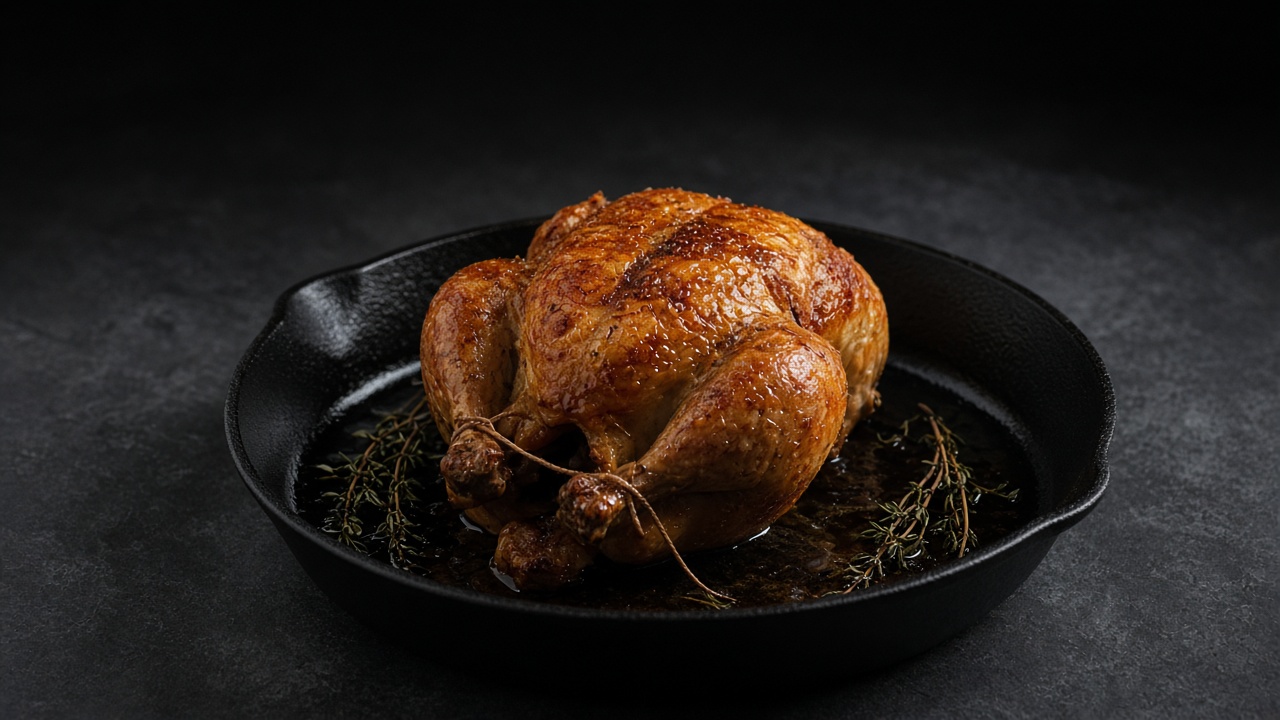
High-Heat Roast Chicken
Inspired by techniques from Serious Eats and NYT Cooking.
A whole chicken dry-brined overnight and blasted in a hot oven for crackling skin and a simple buttery pan sauce. Minimal ingredients, maximum colour and flavour.
Always check the labels of the products you use.
Method
- 1
Dry-brine overnight. Pat the chicken completely dry inside and out, then rub the salt all over the skin and into the cavity. Set it uncovered on a rack over a plate and refrigerate for 12-24 hours (at least 6 hours if time is short). The salt seasons the meat deeply while the fridge air dries out the skin, which is the secret to real crackling later.
- 2
Bring to room temperature. Take the chicken out of the fridge about 30 minutes before roasting, and heat the oven to 230°C (210°C fan) at the same time so it has a full 20-30 minutes to preheat. A bird that isn't fridge-cold in the centre cooks more evenly, so the breast doesn't finish long before the thigh.
- 3
Season and truss. Pepper the chicken all over, tuck the thyme sprigs into the cavity, then tie the legs together with kitchen string so the bird holds a compact shape. A trussed chicken cooks more evenly because the legs and breast sit at a similar distance from the heat.
- 4
Roast at high heat. Once the oven is fully hot - it may smoke a little, so turn on the extractor - set the chicken breast-up in the dry pan with no added oil, since the skin renders its own fat as it cooks. Roast for 50-60 minutes until the skin is deep golden-brown and crackly, checking the thickest part of the breast reads 74°C and the thigh 77-80°C with a thermometer kept clear of the bone. If the skin browns too fast or the oven smokes heavily, drop the heat to 200°C (180°C fan) and add about 10 minutes.
- 5
Rest before carving. Lift the chicken onto a board and let it rest for 15 minutes. The meat finishes cooking gently from its own heat, the juices thicken slightly so less runs out when you carve, and the bird is easier to handle.
- 6
Make the pan sauce. While the chicken rests, pour off most of the fat from the pan, then add the butter and mustard to the remaining juices. Scrape up the browned bits over low heat for 1 minute - those caramelised bits carry plenty of flavour into a quick, glossy sauce.
- 7
Carve and serve. Carve the chicken into portions and spoon the warm pan juices over the top before serving.
Storage
Cool leftovers quickly and keep in the fridge for up to 3 days, or freeze cooked meat for up to 2 months. Reheat gently until piping hot all the way through (74°C) before eating. Cool leftovers in a shallow container and refrigerate within 2 hours (within 1 hour on a day above 32°C).
Why this label?
50.8 g protein for 624 kcal = 8.1 g per 100 kcal, so protein gives about 33% of the energy. High Protein needs at least 20% (5 g per 100 kcal), the condition in the Annex to EU Regulation (EC) No 1924/2006. How we decide
EU nutrition claims
- Sugar-free: 0 g sugars per 100 g (limit ≤ 0.5 g)
Per 100 g of the finished dish, worked out from the nutrition per serving and the lowest likely cooked weight (about 104 g a serving), so the true values are, if anything, lower. Thresholds from the Annex to EU Regulation (EC) No 1924/2006. How we decide
Free sugars
0 g per serving
0 % of the 50 g daily maximum · 0 % of the ideal 25 g
Free sugars under 50 g a day, ideally about 25 g, based on WHO free-sugar guidance (not endorsed by WHO). The share shown is the share of one serving. WHO
Equipment
- heavy ovenproof frying pan or cast-iron skillet (26-30 cm), or a small heavy roasting tin
- kitchen string
- instant-read thermometer
- carving board
Nutrition per serving (estimated values)
| Per serving | Amount |
|---|---|
| Energy | 624 kcal |
| Protein | 50.8 g |
| Carbohydrate | 0.6 g |
| of which sugars | 0 g |
| of which free sugars | 0 g |
| Fat | 45.1 g |
| of which saturates | 14.3 g |
| Fibre | 0.3 g |
| Salt | 2.33 g |
Protein per 100 kcal
8.1 g meets High Protein (≥ 5 g, 20% of energy)
Calculated from USDA FoodData Central ingredient values