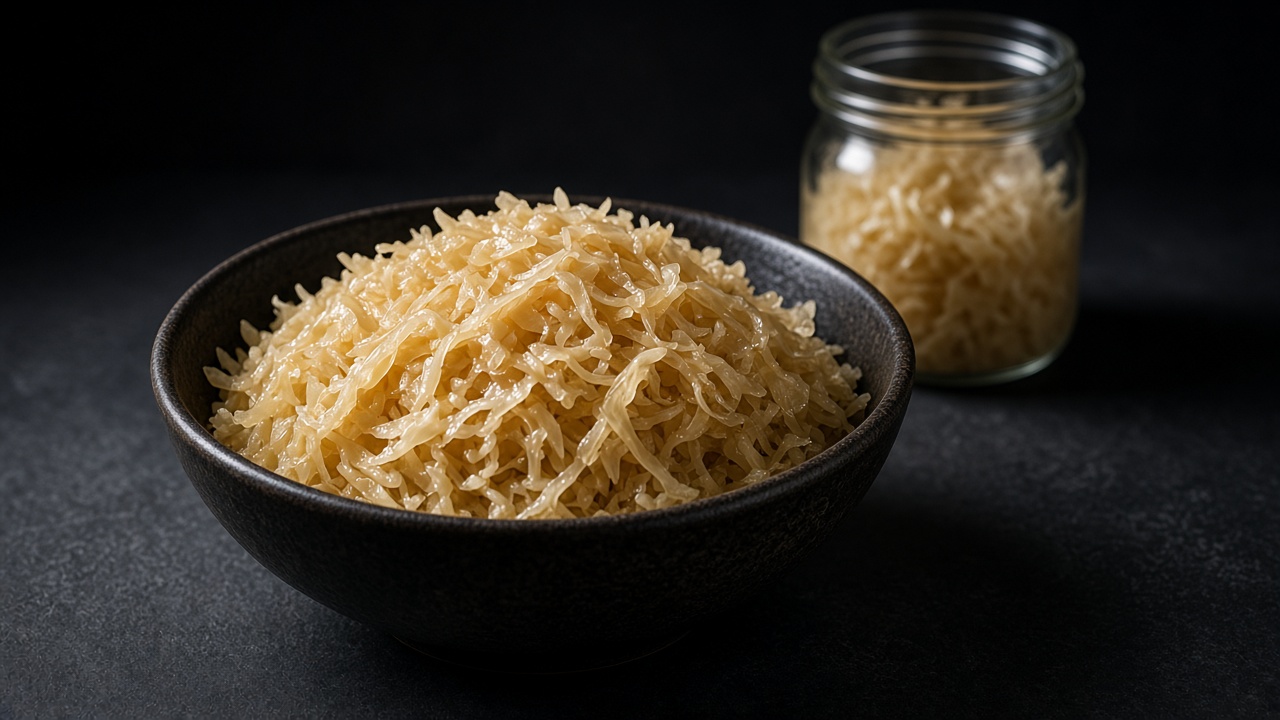
Homemade Sauerkraut
Inspired by techniques from America's Test Kitchen and Serious Eats.
Finely shredded cabbage kneaded with 2% salt and left to ferment in its own brine until pale, translucent and pleasantly sour.
Based on the listed ingredients, none of the 14 major EU allergens. Always check product labels.
Method
- 1
Shred and weigh. Quarter and core the cabbage, setting 2 outer leaves aside, and shred it finely, about 3 mm thick. Weigh the shredded cabbage and use 2% of that weight in salt; 28 g suits 1400 g. Measuring salt by weight keeps the ferment safe and consistent, because too little invites spoilage and too much stalls the bacteria.
- 2
Knead out the brine. Toss the cabbage with the salt and caraway, then squeeze and knead firmly for 5-10 minutes until it is wet and a pool of brine forms in the bowl. If it still looks dry, rest it for 20 minutes and knead again. The salt pulls water from the cabbage, creating the brine it will ferment in.
- 3
Pack it tightly. Press the cabbage and every drop of its juice into the clean jar a handful at a time, pushing down hard until the brine rises above it. Lay the outer leaves and then a round of baking paper on top. Packing out the air keeps oxygen away, which is what spoilage organisms need.
- 4
Add the weight. Dissolve 5 g salt in the 250 ml water, seal it in the bag and set it on top of the paper to hold the cabbage under the brine. Cover the jar with the tea towel, secure it with the rubber band and stand it on the tray. Using brine in the bag means nothing is diluted if it leaks.
- 5
Ferment and check. Leave at 18-21 °C, out of the sun, for 1-3 weeks. Every day or two, press down so everything stays submerged and skim off any film from the surface. Begin tasting on day 7; it is ready when pale, translucent and pleasantly sour.
- 6
Chill to store. Remove the bag, leaves and paper, close the jar and refrigerate. The cold slows fermentation so the sauerkraut holds its flavour and crunch.
Storage
Keep in a closed jar in the fridge for up to 2 months, with the cabbage under its juices. The flavour keeps maturing slowly. Cool leftovers in a shallow container and refrigerate within 2 hours (within 1 hour on a day above 32°C).
Why this label?
0.8 g protein for 15 kcal = 5.3 g per 100 kcal, so protein gives about 21% of the energy. High Protein needs at least 20% (5 g per 100 kcal), the condition in the Annex to EU Regulation (EC) No 1924/2006. How we decide
EU nutrition claims
- Low energy: 25 kcal per 100 g (limit ≤ 40 kcal)
- Low fat: 0.2 g fat per 100 g (limit ≤ 3 g)
- Low saturated fat: 0 g saturated fat per 100 g, 0% of energy (limits ≤ 1.5 g and ≤ 10%)
- Low sugars: 3.2 g sugars per 100 g (limit ≤ 5 g)
- High fibre: 10 g fibre per 100 kcal (needs ≥ 3 g)
Per 100 g of the finished dish, worked out from the nutrition per serving and the lowest likely cooked weight (about 60 g a serving), so the true values are, if anything, lower. Thresholds from the Annex to EU Regulation (EC) No 1924/2006. How we decide
Free sugars
0 g per serving
0 % of the 50 g daily maximum · 0 % of the ideal 25 g
Free sugars under 50 g a day, ideally about 25 g, based on WHO free-sugar guidance (not endorsed by WHO). The share shown is the share of one serving. WHO
Equipment
- kitchen scale
- sharp knife or mandoline
- very large bowl
- 2000 ml wide-mouth glass jar
- baking paper
- 1 litre zip-lock bag
- clean tea towel
- rubber band
- shallow tray
Nutrition per serving (estimated values)
| Per serving | Amount |
|---|---|
| Energy | 15 kcal |
| Protein | 0.8 g |
| Carbohydrate | 3.4 g |
| of which sugars | 1.9 g |
| of which free sugars | 0 g |
| Fat | 0.1 g |
| of which saturates | 0 g |
| Fibre | 1.5 g |
| Salt | 1.16 g |
Protein per 100 kcal
5.3 g meets High Protein (≥ 5 g, 20% of energy)
Calculated from USDA FoodData Central ingredient values