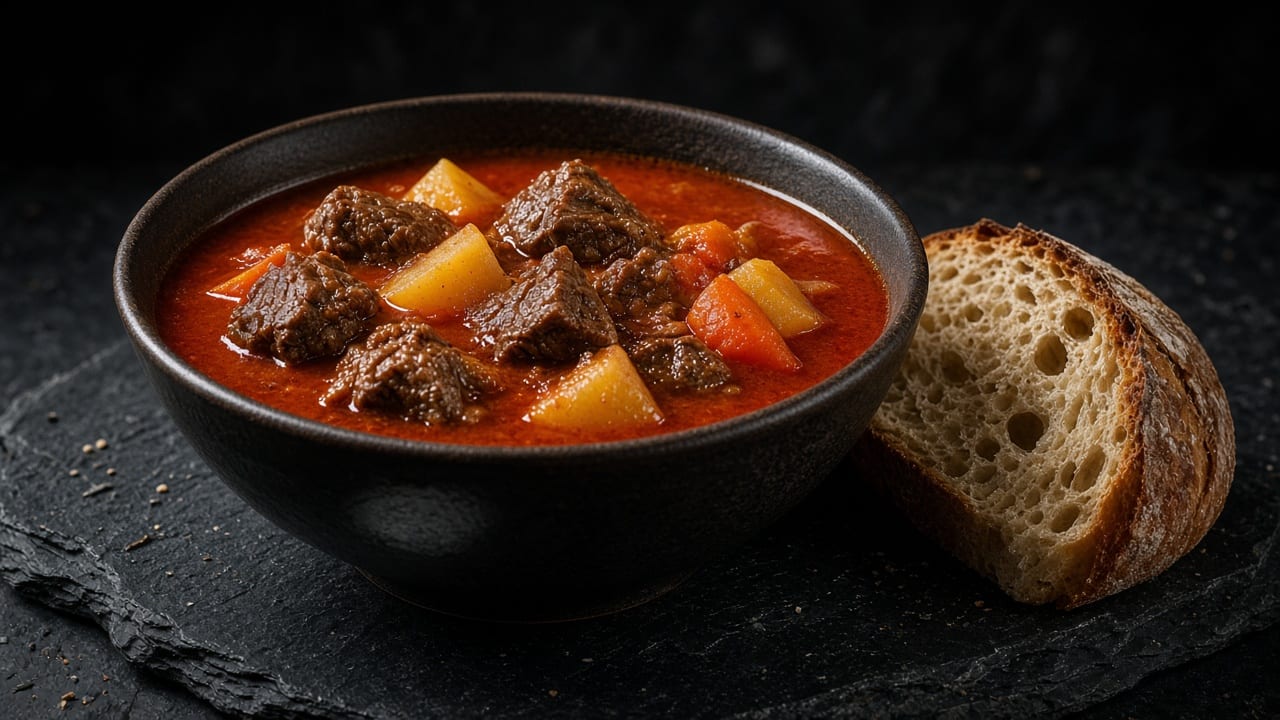
Hungarian Beef Goulash with Potatoes and Peppers
Inspired by techniques from NYT Cooking and America's Test Kitchen.
Chunks of beef chuck are browned, then simmered slowly with onions, paprika and caraway until tender, before potatoes and peppers are added to finish into a thick, warming stew.
Always check the labels of the products you use.
Method
- 1
Brown the beef. Pat the beef dry, then heat the oil in the casserole over medium-high heat and brown the beef in 2-3 batches, without crowding the pan, for 5-6 minutes per batch. Set the browned beef aside; browning in batches keeps the pan hot enough for a proper crust to form, which adds flavour that plain boiling never would.
- 2
Cook the onions. Lower the heat to medium, add the onions to the casserole and cook for 12-15 minutes, stirring and scraping the base often, until soft and golden. Add the garlic and caraway and cook for a further 1 minute. Slow-cooked onions essentially melt into the finished sauce, giving it body and a natural sweetness.
- 3
Add the paprika. Take the casserole off the heat and stir in both paprikas and the tomato purée for 30 seconds, then immediately add the stock, water, bay leaves, salt, pepper and the browned beef with its juices. Paprika scorches and turns bitter if it sits over direct heat for too long, so it needs to go in off the heat and be followed quickly by the liquid.
- 4
Simmer the beef. Bring the pot to the boil, then cover and simmer very gently for 1 hour 30 minutes, stirring occasionally, until the beef is nearly tender. A bare simmer rather than a vigorous boil keeps the tough chuck beef cooking gently enough to break down without the liquid boiling away too fast.
- 5
Add the vegetables. Add the potatoes and peppers and simmer, partly covered, for 30-40 minutes, until the beef is fully tender and the potatoes are cooked through and starting to thicken the broth. The starch released from the potatoes naturally thickens the sauce as it finishes cooking.
- 6
Finish and serve. Stir in the vinegar and remove the bay leaves, then serve the goulash in bowls with crusty bread. The splash of vinegar at the end sharpens all the rich, slow-cooked flavours without needing extra salt.
Storage
Cool leftovers within 2 hours, then refrigerate in a covered container for up to 3 days. Reheat in a pan over medium heat, stirring occasionally, until piping hot throughout (74°C); this goulash also freezes well for up to 3 months.
Why this label?
46.4 g protein for 510 kcal = 9.1 g per 100 kcal, so protein gives about 36% of the energy. High Protein needs at least 20% (5 g per 100 kcal), the condition in the Annex to EU Regulation (EC) No 1924/2006. How we decide
Free sugars
2.3 g per serving
4.6 % of the 50 g daily maximum · 9.2 % of the ideal 25 g
Free sugars under 50 g a day, ideally about 25 g, based on WHO free-sugar guidance (not endorsed by WHO). The share shown is the share of one serving. WHO
Equipment
- large heavy casserole (Dutch oven, 6 litres) with lid
- wooden spoon
- tongs
- ladle
Nutrition per serving (estimated values)
| Per serving | Amount |
|---|---|
| Energy | 510 kcal |
| Protein | 46.4 g |
| Carbohydrate | 51.3 g |
| of which sugars | 10 g |
| of which free sugars | 2.3 g |
| Fat | 14.3 g |
| of which saturates | 3.9 g |
| Fibre | 7.1 g |
| Salt | 2.45 g |
Protein per 100 kcal
9.1 g meets High Protein (≥ 5 g, 20% of energy)
Calculated from USDA FoodData Central ingredient values