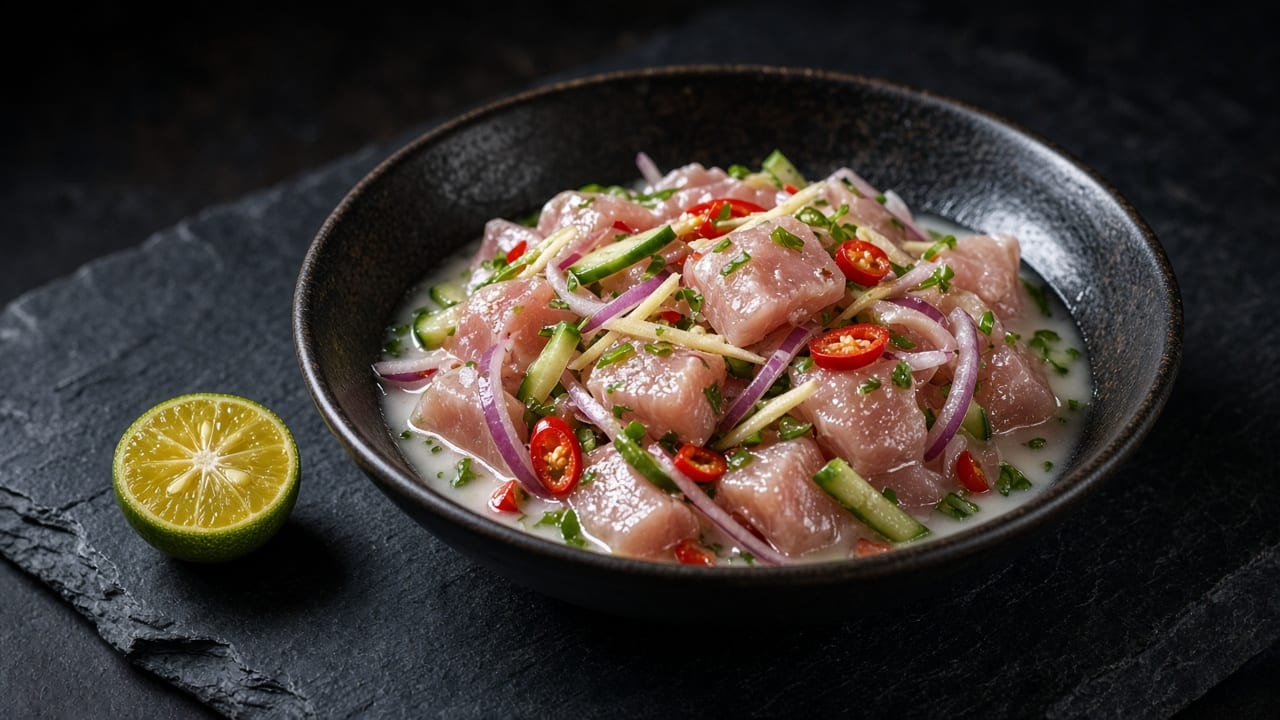
Kinilaw: Filipino Tuna Cured in Coconut Vinegar with Ginger and Cucumber
Inspired by techniques from Serious Eats.
Ruby cubes of tuna cured for a few minutes in coconut vinegar with ginger, red onion and chilli, then drained and tossed with crunchy cucumber.
Always check the labels of the products you use.
Method
- 1
Get everything cold. Dice the onion and cucumber, cut the ginger into fine matchsticks and slice the chillies, then chill. Cube the tuna last and keep it in the fridge so it never warms up.
- 2
Make the cure. Stir the vinegar, lime juice and salt together in the glass bowl until the salt disappears. Dissolving it first means it seasons every piece evenly.
- 3
Cure the tuna. Add the tuna, onion, ginger and chillies and turn them gently. After 5-10 min, with one more fold, the outside of each cube goes pale while the centre stays deep red; that contrast is the texture you want.
- 4
Drain and toss. Pour everything into the sieve to shed most of the vinegar, saving 2-3 tbsp. Return it to the bowl and fold in the cucumber with the saved liquid, which keeps it lively without making it soupy.
- 5
Serve with citrus. Spoon into the serving bowl and eat immediately, with the lime or calamansi halves for squeezing over.
Storage
Eat kinilaw as soon as it is made and discard any leftovers.
Why this label?
21.6 g protein for 125 kcal = 17.3 g per 100 kcal, so protein gives about 69% of the energy. High Protein needs at least 20% (5 g per 100 kcal), the condition in the Annex to EU Regulation (EC) No 1924/2006. How we decide
- Total fat: 4.3 % of energy (limit ≤ 30%)
- Saturated fat: 1.4 % of energy (limit < 10%)
- Free sugars: 0.3 % of energy (limit < 10%)
- Salt: 0.83 g (limit ≤ 1.7 g)
- Fibre or fruit & veg: 1 g fibre / 113 g veg (limit ≥ 1.6 g fibre or 80 g fruit & veg)
Per serving, worked out from the nutrition table against our rule based on the WHO healthy diet guidance. Not endorsed by WHO.
EU nutrition claims
- Low fat: 0.3 g fat per 100 g (limit ≤ 3 g)
- Low saturated fat: 0.1 g saturated fat per 100 g, 1.4% of energy (limits ≤ 1.5 g and ≤ 10%)
- Low sugars: 1.3 g sugars per 100 g (limit ≤ 5 g)
Per 100 g of the finished dish, worked out from the nutrition per serving and the lowest likely cooked weight (about 196 g a serving), so the true values are, if anything, lower. Thresholds from the Annex to EU Regulation (EC) No 1924/2006. How we decide
Free sugars
0.1 g per serving
0.2 % of the 50 g daily maximum · 0.4 % of the ideal 25 g
Free sugars under 50 g a day, ideally about 25 g, based on WHO free-sugar guidance (not endorsed by WHO). The share shown is the share of one serving. WHO
Equipment
- sharp knife
- large glass or ceramic bowl
- fine sieve
- serving bowl
Nutrition per serving (estimated values)
| Per serving | Amount |
|---|---|
| Energy | 125 kcal |
| Protein | 21.6 g |
| Carbohydrate | 6.4 g |
| of which sugars | 2.5 g |
| of which free sugars | 0.1 g |
| Fat | 0.6 g |
| of which saturates | 0.2 g |
| Fibre | 1 g |
| Salt | 0.83 g |
Protein per 100 kcal
17.3 g meets High Protein (≥ 5 g, 20% of energy)
Calculated from USDA FoodData Central ingredient values