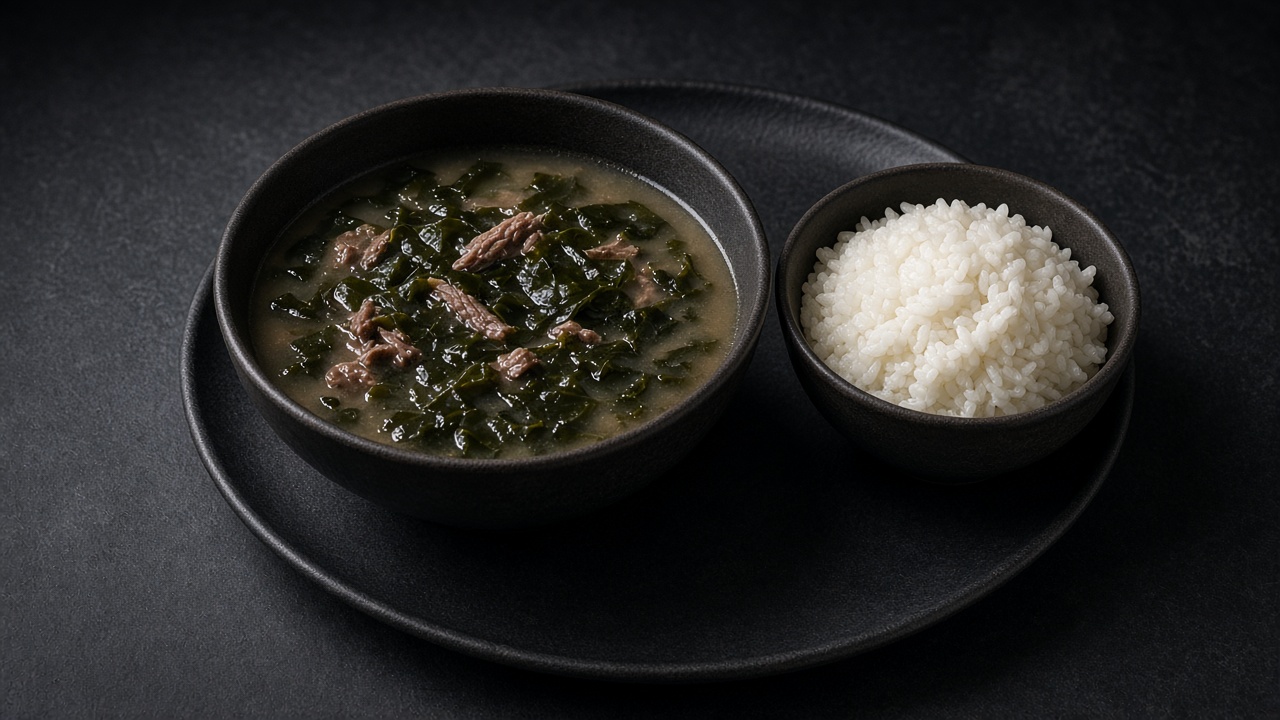
Miyeok-Guk: Korean Seaweed and Beef Brisket Soup
Inspired by techniques from Serious Eats and NYT Cooking.
Brisket simmered slowly into a clear broth, shredded and seasoned, then cooked with soaked seaweed until silky; served with short-grain rice.
Always check the labels of the products you use.
Method
- 1
Soak the seaweed. Cover the dried seaweed with plenty of cold water and leave it for about 2 h until completely soft. Expect it to grow many times its dry size.
- 2
Simmer the brisket. Meanwhile, place the brisket, cold water, whole garlic, ginger and onion in the large pan and bring to the boil. Skim off the foam, cover and simmer gently for 2 h until the beef is very tender. Remove and discard the garlic, ginger and onion. Starting in cold water draws more flavour from the meat into the broth.
- 3
Shred and season. Lift the brisket onto the board and let it cool for 10 min. Slice across the grain, then pull into bite-size shreds and toss in the small bowl with the chopped garlic, half the soy sauce and the sesame oil.
- 4
Cook the rice. Half an hour before serving, rinse the rice until the water is almost clear. Put it in the small pan with 300 ml water, bring to the boil, cover and cook on the lowest heat for 15 min. Rest off the heat, still covered, for 10 min.
- 5
Prepare the seaweed. Drain the seaweed, squeeze out as much water as you can and chop it into bite-size pieces.
- 6
Simmer together. Bring the broth back to a simmer and add the seaweed, seasoned beef and the remaining soy sauce. Cook for 30 min until the seaweed is silky and tender; add a little water if it looks crowded, then taste.
- 7
Serve. Ladle into bowls and put the rice alongside.
Storage
Keep covered in the fridge for up to 3 days or freeze the soup (without rice) for up to 2 months. Reheat until piping hot (74 °C). Cool leftover rice quickly and use within 24 h, reheating until piping hot. Cool leftovers in a shallow container and refrigerate within 2 hours (within 1 hour on a day above 32°C).
Why this label?
25.9 g protein for 397 kcal = 6.5 g per 100 kcal, so protein gives about 26% of the energy. High Protein needs at least 20% (5 g per 100 kcal), the condition in the Annex to EU Regulation (EC) No 1924/2006. How we decide
EU nutrition claims
- Low sugars: 1 g sugars per 100 ml (limit ≤ 2.5 g)
Per 100 ml of the finished dish, worked out from the nutrition per serving and the lowest likely cooked weight (about 145 ml a serving), so the true values are, if anything, lower. Thresholds from the Annex to EU Regulation (EC) No 1924/2006. How we decide
Free sugars
0 g per serving
0 % of the 50 g daily maximum · 0 % of the ideal 25 g
Free sugars under 50 g a day, ideally about 25 g, based on WHO free-sugar guidance (not endorsed by WHO). The share shown is the share of one serving. WHO
Equipment
- large bowl
- large saucepan or casserole with a lid
- slotted spoon
- chopping board
- small bowl
- small saucepan with a tight lid
- sieve
Nutrition per serving (estimated values)
| Per serving | Amount |
|---|---|
| Energy | 397 kcal |
| Protein | 25.9 g |
| Carbohydrate | 58.8 g |
| of which sugars | 1.4 g |
| of which free sugars | 0 g |
| Fat | 6.4 g |
| of which saturates | 2 g |
| Fibre | 1.6 g |
| Salt | 2.26 g |
Protein per 100 kcal
6.5 g meets High Protein (≥ 5 g, 20% of energy)
Calculated from USDA FoodData Central ingredient values