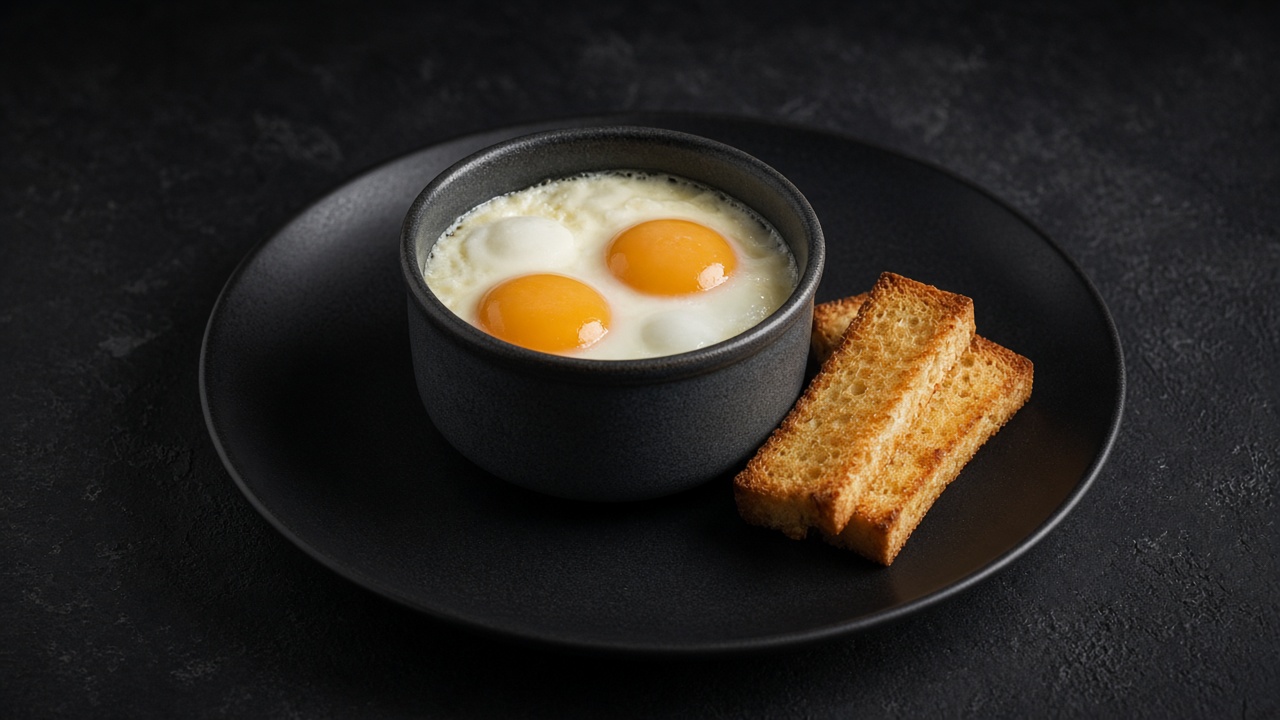
Oven-Baked Eggs in Ramekins with Cream and Toast
Inspired by techniques from NYT Cooking and America's Test Kitchen.
Eggs baked in buttered ramekins over a spoonful of cream in a gentle water bath until the whites are firm and the yolks fully set. Simple and elegant, served with toast fingers for scooping.
Always check the labels of the products you use.
Method
- 1
Heat oven and kettle. Heat the oven to 190 °C (170 °C fan) and boil a kettle of water. Brush the inside of the ramekins with the softened butter and stand them in the deep roasting tin. The butter lets the eggs release cleanly and adds richness.
- 2
Fill the ramekins. Spoon 1 tbsp of the cream into each ramekin, crack 2 eggs into each one and season with the salt. The cream sits beneath the eggs as a cushion, protecting them from the hot base so they cook evenly.
- 3
Add the water bath. Carefully pour hot water from the kettle into the tin until it comes halfway up the sides of the ramekins. Water cannot rise above 100 °C, so it surrounds the eggs with steady, gentle heat and stops the whites turning rubbery before the yolks have set.
- 4
Bake until set. Bake for 16-20 minutes, checking from 14 minutes, until the whites are firm and the yolks are fully set with no liquid yolk, 71 °C in the centre of the yolk. Deeper ramekins need the longer time, so trust the thermometer and the look of the yolk rather than the clock alone.
- 5
Serve hot. Wearing oven gloves, lift the ramekins out of the tin onto plates, taking care as they are very hot. Sprinkle with the pepper and serve with the toast cut into fingers.
Storage
Best eaten straight from the oven. Refrigerate any leftovers within 1 hour, use within 1 day and reheat until piping hot (74 °C).
Why this label?
16.6 g protein for 319 kcal = 5.2 g per 100 kcal, so protein gives about 21% of the energy. High Protein needs at least 20% (5 g per 100 kcal), the condition in the Annex to EU Regulation (EC) No 1924/2006. How we decide
EU nutrition claims
- Low sugars: 2.7 g sugars per 100 g (limit ≤ 5 g)
Per 100 g of the finished dish, worked out from the nutrition per serving and the lowest likely cooked weight (about 116 g a serving), so the true values are, if anything, lower. Thresholds from the Annex to EU Regulation (EC) No 1924/2006. How we decide
Free sugars
2.3 g per serving
4.6 % of the 50 g daily maximum · 9.2 % of the ideal 25 g
Free sugars under 50 g a day, ideally about 25 g, based on WHO free-sugar guidance (not endorsed by WHO). The share shown is the share of one serving. WHO
Equipment
- 4 ramekins (about 180 ml each)
- deep roasting tin
- kettle
- pastry brush
- instant-read thermometer
- oven gloves
- toaster
Nutrition per serving (estimated values)
| Per serving | Amount |
|---|---|
| Energy | 319 kcal |
| Protein | 16.6 g |
| Carbohydrate | 21 g |
| of which sugars | 3.1 g |
| of which free sugars | 2.3 g |
| Fat | 18.3 g |
| of which saturates | 8.2 g |
| Fibre | 1.1 g |
| Salt | 1.22 g |
Protein per 100 kcal
5.2 g meets High Protein (≥ 5 g, 20% of energy)
Calculated from USDA FoodData Central ingredient values