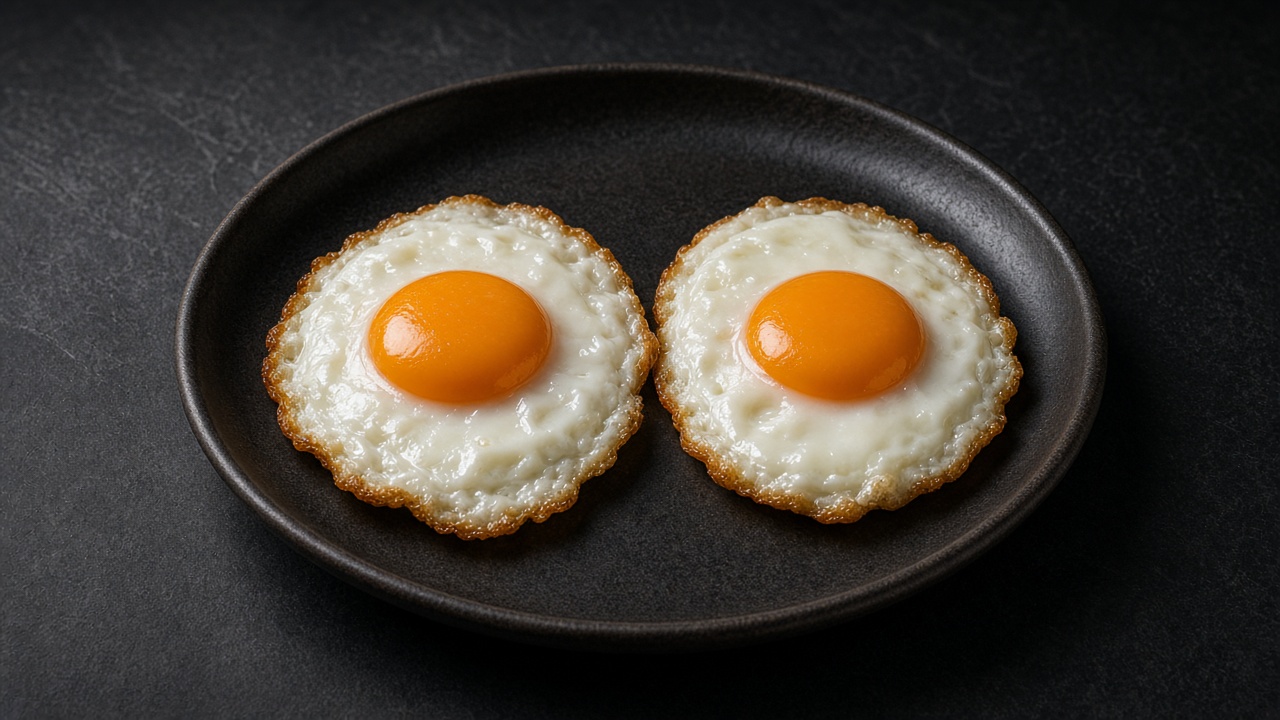
Pan-Fried Eggs with Lacy Edges and Set Yolks
Inspired by techniques from America's Test Kitchen and Serious Eats.
Fried eggs with crisp, golden, lacy edges and tender whites, finished under a lid until the yolks are fully set. A quick, satisfying breakfast staple.
Always check the labels of the products you use.
Method
- 1
Crack into bowls. Crack 2 eggs into each small bowl, checking carefully for any pieces of shell. Pre-cracking means the eggs go into the pan together and cook evenly, and you can fish out shell before it reaches the hot fat.
- 2
Heat the fat. Warm the oil in the frying pan over medium-high heat until it shimmers, then add the butter and swirl to coat the base. The oil can take the high heat needed for crisp edges, while the butter adds flavour and a golden colour.
- 3
Fry for lacy edges. Tip both bowls of eggs into the pan at once, holding them close to the surface so the yolks stay whole, side by side. Season with the salt and pepper. Cook uncovered for 1-2 minutes until the edges are golden and lacy and the base of the whites has set; the hot fat bubbles up through the thin outer white, which is what creates those crisp, frilly edges.
- 4
Cover to set. Turn the heat to low, cover and cook for 3-4 minutes more until the whites are completely set and the yolks are firm with no runny centre (71°C). A gentle press on a yolk should feel springy rather than liquid. Steam trapped under the lid cooks the tops of the eggs through without burning the bases.
- 5
Serve straight away. Slide the eggs onto the warm plates with the thin spatula, cutting between them as you go. Warm plates keep the eggs hot and stop the crisp edges going soft, so eat them at once.
Storage
Fried eggs are best eaten fresh. Refrigerate any leftovers within 1 hour, use within 1 day and reheat until piping hot (74°C).
Why this label?
12.6 g protein for 239 kcal = 5.3 g per 100 kcal, so protein gives about 21% of the energy. High Protein needs at least 20% (5 g per 100 kcal), the condition in the Annex to EU Regulation (EC) No 1924/2006. How we decide
EU nutrition claims
- Low sugars: 0.5 g sugars per 100 g (limit ≤ 5 g)
Per 100 g of the finished dish, worked out from the nutrition per serving and the lowest likely cooked weight (about 80 g a serving), so the true values are, if anything, lower. Thresholds from the Annex to EU Regulation (EC) No 1924/2006. How we decide
Free sugars
0 g per serving
0 % of the 50 g daily maximum · 0 % of the ideal 25 g
Free sugars under 50 g a day, ideally about 25 g, based on WHO free-sugar guidance (not endorsed by WHO). The share shown is the share of one serving. WHO
Equipment
- 28-30 cm non-stick frying pan with a lid
- 2 small bowls
- thin spatula
- instant-read thermometer
- 2 warm plates
Nutrition per serving (estimated values)
| Per serving | Amount |
|---|---|
| Energy | 239 kcal |
| Protein | 12.6 g |
| Carbohydrate | 0.8 g |
| of which sugars | 0.4 g |
| of which free sugars | 0 g |
| Fat | 20.3 g |
| of which saturates | 6.2 g |
| Fibre | 0 g |
| Salt | 0.72 g |
Protein per 100 kcal
5.3 g meets High Protein (≥ 5 g, 20% of energy)
Calculated from USDA FoodData Central ingredient values