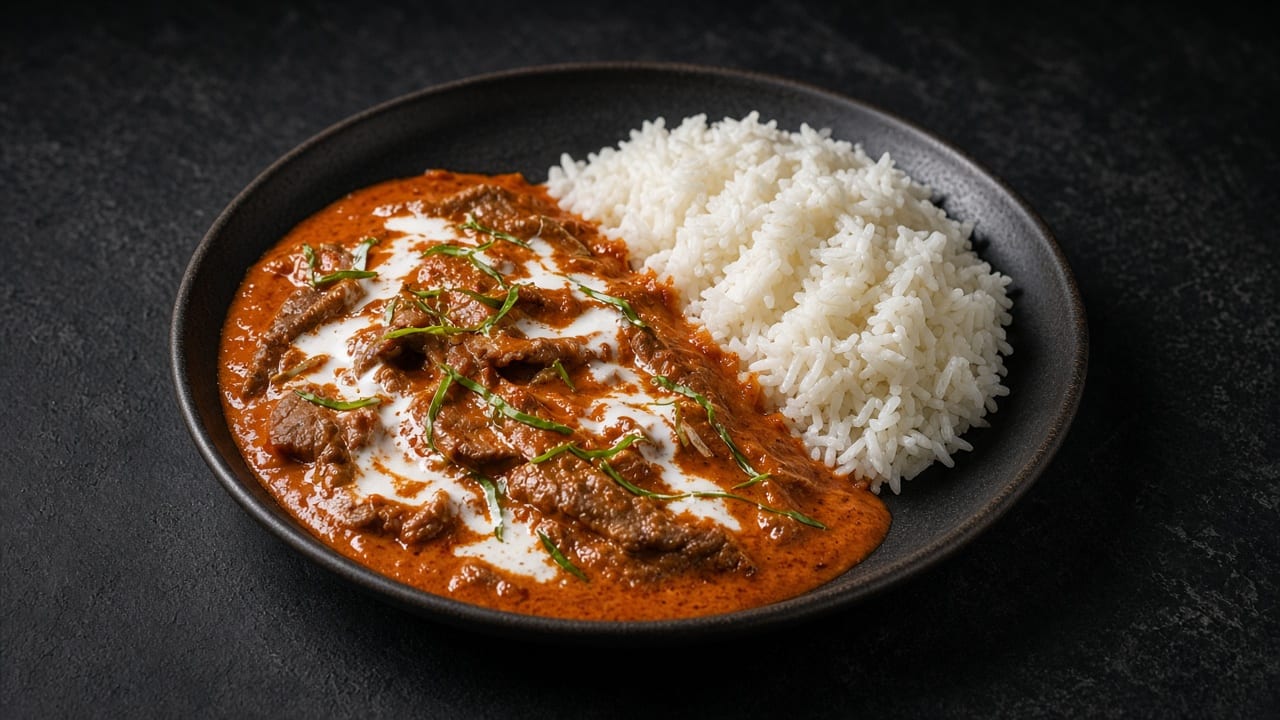
Panang Chicken Curry with Makrut Lime Leaves and Peanuts
Inspired by techniques from NYT Cooking and America's Test Kitchen.
A store-bought paste is boosted with toasted coriander, cumin and ground peanuts, fried in cracked coconut cream and simmered with sliced chicken thighs and red pepper until thick and glossy.
Always check the labels of the products you use.
Method
- 1
Boost the paste. Toast the coriander and cumin seeds in the dry pan over medium heat for about 1 minute, until fragrant. Grind them finely, add the 30 g peanuts and grind to a coarse paste, then mix with the curry paste in the small bowl. Fresh-toasted spices and peanuts give a shop paste a much rounder flavour.
- 2
Season the chicken. Toss the chicken with the fish sauce in the medium bowl. Thin slices take on the seasoning quickly and cook in minutes.
- 3
Crack the cream. Spoon 4 tbsp of the thick cream from the top of the coconut milk into the large pan with the oil and cook over medium-high heat for 1 minute, until bubbling. Add the paste and fry for 3-5 minutes, stirring constantly, until brick red and the oil separates, adding a splash of coconut milk if it sticks. Frying the paste in fat is what develops the curry's depth.
- 4
Build the sauce. Add the torn lime leaves and sugar and stir for 1 minute. Set aside 2 tbsp coconut milk for serving, pour in the rest, bring to the boil and cook for 5 minutes, stirring, until slightly thickened.
- 5
Simmer the chicken. Add the chicken and red pepper and simmer for 6-8 minutes, stirring, until the chicken is cooked through (74 °C) and the sauce is thick enough to coat it. Panang should cling rather than pool.
- 6
Finish and serve. Drizzle with the reserved coconut milk and scatter with the sliced lime leaves, chopped peanuts and basil. Serve with jasmine rice.
Storage
Cool quickly, refrigerate within 1 hour and use within 3 days. Reheat once until piping hot (74 °C).
Why this label?
30.6 g protein for 490 kcal = 6.2 g per 100 kcal, so protein gives about 25% of the energy. High Protein needs at least 20% (5 g per 100 kcal), the condition in the Annex to EU Regulation (EC) No 1924/2006. How we decide
EU nutrition claims
- Low sugars: 2.3 g sugars per 100 g (limit ≤ 5 g)
Per 100 g of the finished dish, worked out from the nutrition per serving and the lowest likely cooked weight (about 233 g a serving), so the true values are, if anything, lower. Thresholds from the Annex to EU Regulation (EC) No 1924/2006. How we decide
Free sugars
2.5 g per serving
5 % of the 50 g daily maximum · 10 % of the ideal 25 g
Free sugars under 50 g a day, ideally about 25 g, based on WHO free-sugar guidance (not endorsed by WHO). The share shown is the share of one serving. WHO
Equipment
- small dry frying pan
- spice grinder or mortar and pestle
- small bowl
- medium bowl
- 30 cm frying pan or wok
- silicone spatula
- instant-read probe thermometer
Nutrition per serving (estimated values)
| Per serving | Amount |
|---|---|
| Energy | 490 kcal |
| Protein | 30.6 g |
| Carbohydrate | 12 g |
| of which sugars | 5.3 g |
| of which free sugars | 2.5 g |
| Fat | 37.1 g |
| of which saturates | 21.6 g |
| Fibre | 2.5 g |
| Salt | 1.68 g |
Protein per 100 kcal
6.2 g meets High Protein (≥ 5 g, 20% of energy)
Calculated from USDA FoodData Central ingredient values