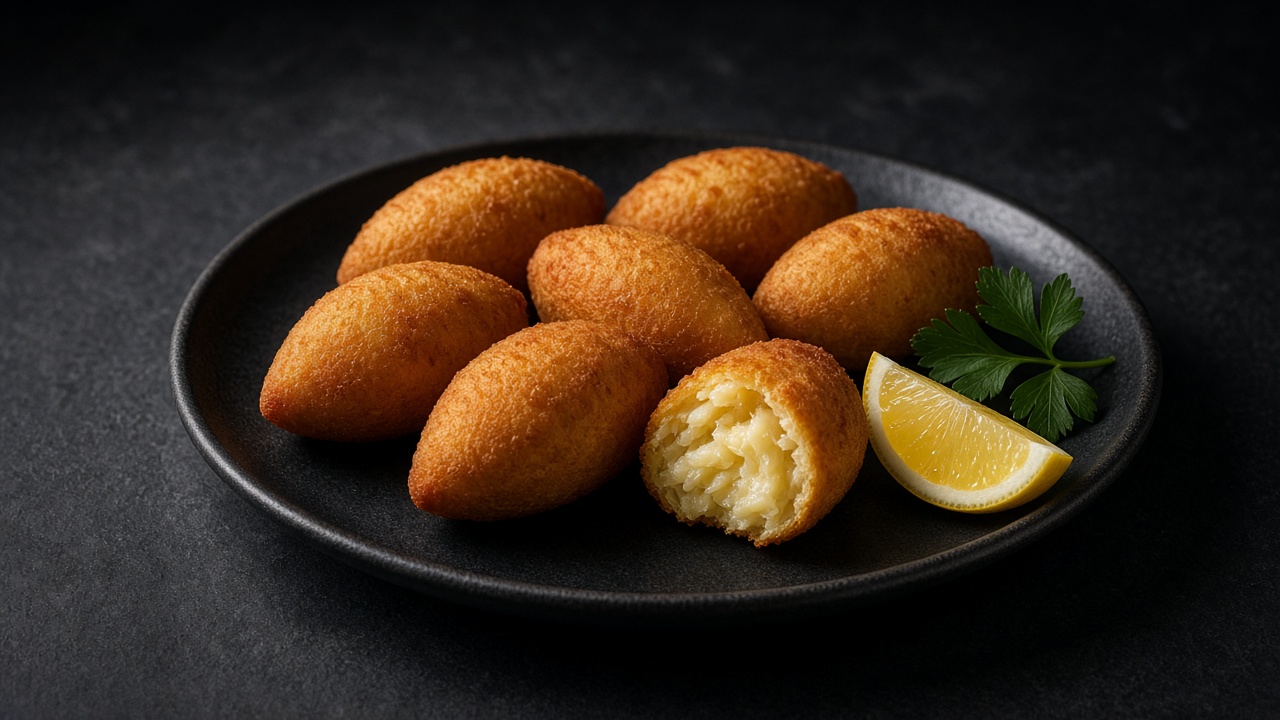
Pastéis de Bacalhau (Salt Cod and Potato Fritters)
Inspired by techniques from America's Test Kitchen and NYT Cooking.
Light, crisp-shelled Portuguese fritters of flaked salt cod, fluffy potato, onion and parsley, shaped between two spoons and fried golden. Serve with lemon.
Always check the labels of the products you use.
Method
- 1
Soak. Rinse the cod, then soak it in plenty of cold water in the fridge for 24-36 hours, changing the water 3-4 times. This draws out most of the salt and rehydrates the fish.
- 2
Potatoes. Boil the potatoes in unsalted water for 15-20 minutes, until a knife slides in easily. Drain, leave to steam dry for 5 minutes, then rice or mash until smooth; dry potato gives lighter fritters.
- 3
Cod. Put the drained cod in a pan of fresh water, bring to a bare simmer and cook for 8-10 minutes, until it flakes. Drain and cool.
- 4
Flake. Remove all skin and bones, then wrap the cod in a tea towel and rub it between your hands until it becomes fine, fluffy threads. Fine threads give the classic airy texture.
- 5
Beat. Mix the potato, cod, onion, garlic, parsley and pepper with a wooden spoon, then beat in the eggs one at a time for 2-3 minutes, until the mixture is light and holds its shape.
- 6
Shape. Scoop a heaped dessert spoon of mixture and pass it between 2 spoons 3-4 times to make a smooth, three-sided oval. Set it on a plate and repeat to make about 24.
- 7
Fry. Heat the oil to 180 °C. Fry 6 at a time for 4-5 minutes, turning, until deep golden and the centre reads 74 °C. Drain on paper towels and serve warm with lemon.
Storage
Best on the day. Cooked fritters keep in the fridge for 2 days; reheat at 200 °C for 8-10 minutes, until piping hot (74 °C). The mixture keeps for 1 day in the fridge before frying. Cool leftovers in a shallow container and refrigerate within 2 hours (within 1 hour on a day above 32°C).
Why this label?
14 g protein for 161 kcal = 8.7 g per 100 kcal, so protein gives about 35% of the energy. High Protein needs at least 20% (5 g per 100 kcal), the condition in the Annex to EU Regulation (EC) No 1924/2006. How we decide
EU nutrition claims
- Low saturated fat: 1 g saturated fat per 100 g, 5% of energy (limits ≤ 1.5 g and ≤ 10%)
- Low sugars: 0.7 g sugars per 100 g (limit ≤ 5 g)
Per 100 g of the finished dish, worked out from the nutrition per serving and the lowest likely cooked weight (about 90 g a serving), so the true values are, if anything, lower. Thresholds from the Annex to EU Regulation (EC) No 1924/2006. How we decide
Free sugars
0 g per serving
0 % of the 50 g daily maximum · 0 % of the ideal 25 g
Free sugars under 50 g a day, ideally about 25 g, based on WHO free-sugar guidance (not endorsed by WHO). The share shown is the share of one serving. WHO
Equipment
- large bowl
- 2 saucepans
- colander
- potato ricer or masher
- clean tea towel
- wooden spoon
- 2 dessert spoons
- large heavy pot or deep fryer
- instant-read thermometer
- slotted spoon
- paper towels
Nutrition per serving (estimated values)
| Per serving | Amount |
|---|---|
| Energy | 161 kcal |
| Protein | 14 g |
| Carbohydrate | 11 g |
| of which sugars | 0.6 g |
| of which free sugars | 0 g |
| Fat | 6.7 g |
| of which saturates | 0.9 g |
| Fibre | 0.9 g |
| Salt | 0.79 g |
Protein per 100 kcal
8.7 g meets High Protein (≥ 5 g, 20% of energy)
Calculated from USDA FoodData Central ingredient values