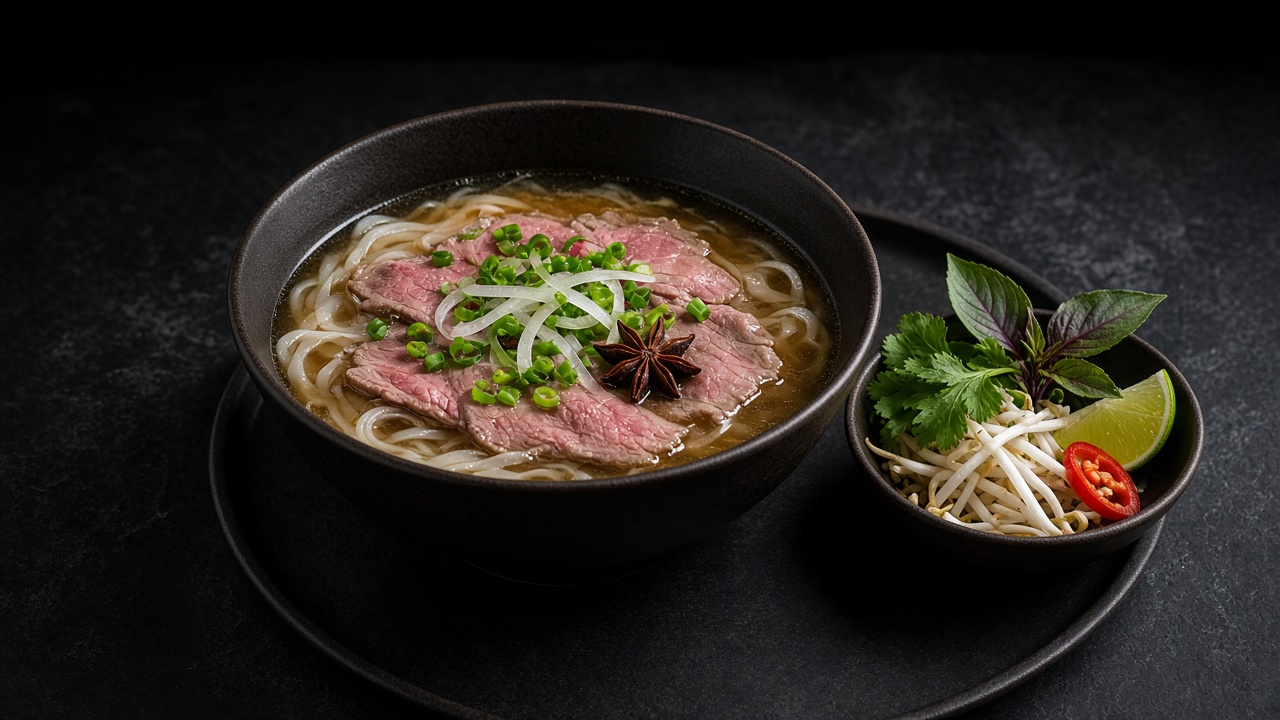
Pho Bo: Vietnamese Beef and Rice Noodle Soup
Inspired by techniques from America's Test Kitchen and Serious Eats.
A deeply fragrant beef broth simmered with charred onion, ginger and warm spices, ladled over silky rice noodles with tender shredded shank and thin slices of beef. Fresh herbs, sprouts and lime let everyone finish their own bowl.
Always check the labels of the products you use.
Method
- 1
Char the aromatics. Heat the grill to high and grill the onion and ginger halves on the foil-lined tray for about 20 minutes, turning, until blackened in patches. Charring adds a sweet, smoky depth that is characteristic of a good pho broth.
- 2
Blanch the shank. Put the shank in the stockpot, cover with cold water, bring to the boil and boil for 10 minutes. Tip into the colander, rinse the meat and bones well and wash out the pot. Blanching removes the blood and impurities that would otherwise cloud the broth.
- 3
Simmer the broth. Return the shank to the pot with the charred onion and ginger, garlic, star anise, peppercorns, coriander seeds, cinnamon, cloves and 4500 ml water. Bring to the boil, then lower the heat so it barely bubbles and simmer for 3 hours, skimming now and then. A slow, gentle simmer extracts flavour and body while keeping the broth clear.
- 4
Freeze and slice beef. Meanwhile, freeze the eye of round on a plate for 35-45 minutes until very firm, then slice it across the grain as thinly as you can, about 3 mm. Cover and refrigerate. Partly freezing the meat makes it firm enough to slice paper-thin, so it cooks in seconds.
- 5
Strain and season. Lift out the shank and shred the meat, discarding the bones and gristle. Let the broth settle for 5 minutes, skim off the fat, then strain it through the muslin-lined sieve into the saucepan; you should have about 3 litres, so top up with water if needed. Stir in the fish sauce, sugar and salt, then taste.
- 6
Prepare the noodles. Soak or cook the rice noodles following the packet instructions until just tender, then drain and divide them among the bowls. Slightly firm noodles are best, as the hot broth will soften them further.
- 7
Cook the sliced beef. Bring the broth to a rolling boil. Lower the sliced beef into it in the small sieve, a few slices at a time, for 30-60 seconds until no pink remains, then lay it over the noodles with the shredded shank. Cooking the slices in batches keeps the broth boiling so every piece cooks through quickly.
- 8
Assemble and serve. Ladle about 500 ml boiling broth into each bowl and top with coriander, spring onions and sliced onion. Serve with the bean sprouts, basil, lime wedges and sriracha for everyone to add at the table.
Storage
Cool the strained broth and refrigerate for up to 4 days or freeze for up to 3 months; keep the meat, noodles and herbs separately. Bring the broth to a rolling boil before serving and cook fresh slices of beef in it as above. Cool leftovers in a shallow container and refrigerate within 2 hours (within 1 hour on a day above 32°C).
Why this label?
39.9 g protein for 611 kcal = 6.5 g per 100 kcal, so protein gives about 26% of the energy. High Protein needs at least 20% (5 g per 100 kcal), the condition in the Annex to EU Regulation (EC) No 1924/2006. How we decide
EU nutrition claims
- Low sugars: 1.9 g sugars per 100 ml (limit ≤ 2.5 g)
Per 100 ml of the finished dish, worked out from the nutrition per serving and the lowest likely cooked weight (about 277 ml a serving), so the true values are, if anything, lower. Thresholds from the Annex to EU Regulation (EC) No 1924/2006. How we decide
Free sugars
2.4 g per serving
4.8 % of the 50 g daily maximum · 9.6 % of the ideal 25 g
Free sugars under 50 g a day, ideally about 25 g, based on WHO free-sugar guidance (not endorsed by WHO). The share shown is the share of one serving. WHO
Equipment
- large stockpot (at least 8 litres)
- overhead grill (broiler) and foil-lined tray
- large pot for the noodles
- colander
- fine sieve lined with muslin
- large saucepan (at least 4 litres)
- spider or large slotted spoon
- small sieve or wire skimmer
- sharp knife
- 6 deep soup bowls
Nutrition per serving (estimated values)
| Per serving | Amount |
|---|---|
| Energy | 611 kcal |
| Protein | 39.9 g |
| Carbohydrate | 89.3 g |
| of which sugars | 5.3 g |
| of which free sugars | 2.4 g |
| Fat | 8.4 g |
| of which saturates | 3 g |
| Fibre | 3.2 g |
| Salt | 2.44 g |
Protein per 100 kcal
6.5 g meets High Protein (≥ 5 g, 20% of energy)
Calculated from USDA FoodData Central ingredient values