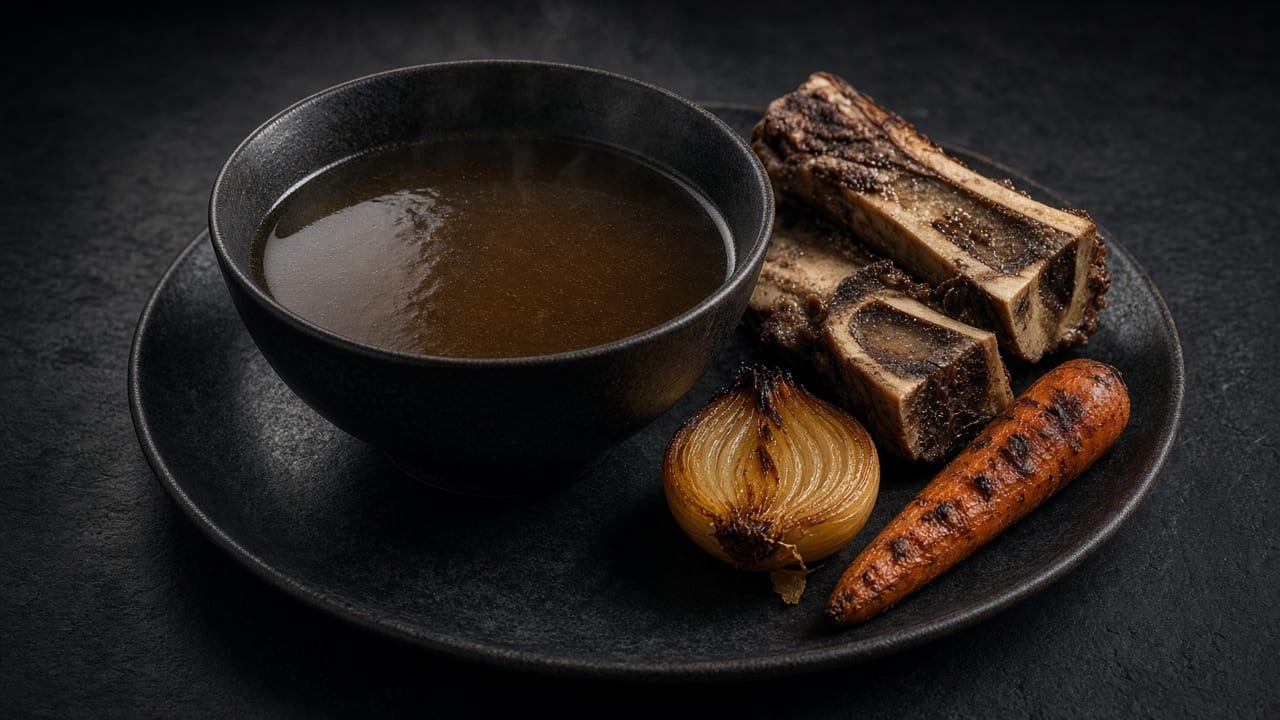
Roasted Brown Beef Stock
Inspired by techniques from America's Test Kitchen and NYT Cooking.
A deep brown, unsalted beef stock made from well-roasted bones, onion, carrot and a little tomato paste, simmered slowly so it stays clear.
Always check the labels of the products you use.
Method
- 1
Roast the bones. Heat the oven to 220 °C (200 °C fan). Spread the bones in the roasting tin and roast 30 min. Turn them, brush the meaty sides with the tomato paste, add the onions (cut side down) and carrots and roast 20-30 min more, until deep brown but not burnt.
- 2
Fill the pot. Move everything into the stockpot. Pour 500 ml of the water into the hot tin, scrape up the brown bits and add them to the pot with the rest of the water, the garlic, bay, thyme, peppercorns and vinegar.
- 3
Bring up slowly. Heat over medium-low heat to just below a simmer, about 45 min, skimming off the grey foam as it rises.
- 4
Simmer. Keep it at the barest simmer, uncovered, for 5-6 h. Do not boil or stir, which makes it cloudy. Top up with hot water if the bones poke out.
- 5
Strain. Ladle the stock through the sieve, lined with damp muslin if you have it, into the heatproof bowl. Discard the solids. You should have about 3 litres.
- 6
Cool fast. Stand the bowl in iced water and stir now and then until it is below 21 °C within 2 h, then refrigerate overnight. Lift off the set fat the next day.
- 7
Use. The stock is unsalted: season whatever soup or sauce you make with it. Reduce it by half for a richer base.
Storage
Refrigerate up to 4 days or freeze up to 3 months. Bring to the boil before using. Cool leftovers in a shallow container and refrigerate within 2 hours (within 1 hour on a day above 32°C).
Why this label?
4.9 g protein for 32 kcal = 15.3 g per 100 kcal, so protein gives about 61% of the energy. High Protein needs at least 20% (5 g per 100 kcal), the condition in the Annex to EU Regulation (EC) No 1924/2006. How we decide
EU nutrition claims
- Low fat: 0.2 g fat per 100 ml (limit ≤ 1.5 g)
- Low saturated fat: 0.1 g saturated fat per 100 ml, 2.8% of energy (limits ≤ 0.75 g and ≤ 10%)
- Low sugars: 1.4 g sugars per 100 ml (limit ≤ 2.5 g)
Per 100 ml of the finished dish, worked out from the nutrition per serving and the lowest likely cooked weight (about 98 ml a serving), so the true values are, if anything, lower. Thresholds from the Annex to EU Regulation (EC) No 1924/2006. How we decide
Free sugars
0 g per serving
0 % of the 50 g daily maximum · 0 % of the ideal 25 g
Free sugars under 50 g a day, ideally about 25 g, based on WHO free-sugar guidance (not endorsed by WHO). The share shown is the share of one serving. WHO
Equipment
- large roasting tin
- stockpot (at least 8 litres)
- tongs
- ladle or skimmer
- fine sieve
- muslin (optional)
- large heatproof bowl
- sink or larger bowl of iced water
- lidded containers
Nutrition per serving (estimated values)
| Per serving | Amount |
|---|---|
| Energy | 32 kcal |
| Protein | 4.9 g |
| Carbohydrate | 3 g |
| of which sugars | 1.4 g |
| of which free sugars | 0 g |
| Fat | 0.2 g |
| of which saturates | 0.1 g |
| Fibre | 0 g |
| Salt | 1.24 g |
Protein per 100 kcal
15.3 g meets High Protein (≥ 5 g, 20% of energy)
Calculated from USDA FoodData Central ingredient values