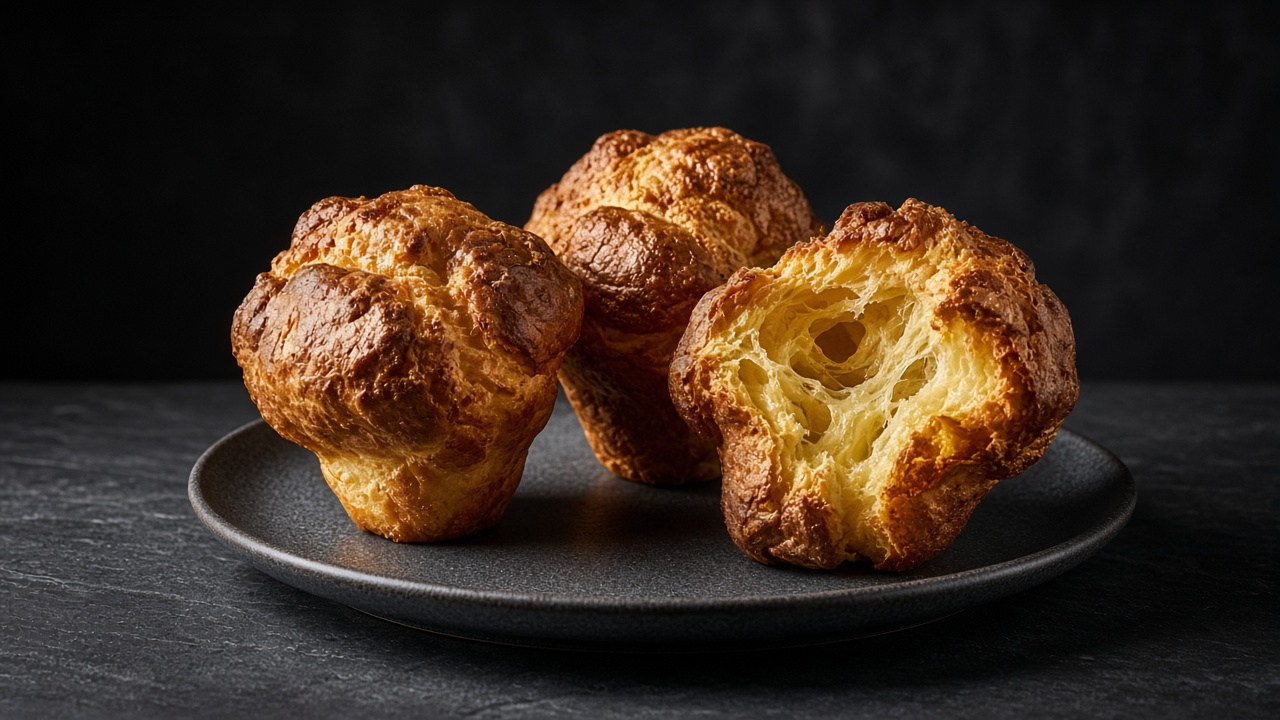
Tall Crisp Popovers
Inspired by techniques from America's Test Kitchen and King Arthur Baking.
Dramatically tall popovers with crisp, deep golden walls and a tender, hollow inside, baked hot then low.
Always check the labels of the products you use.
Method
- 1
Oil the tin. Brush every popover mould generously with oil, rims included. A well-oiled tin lets the batter climb freely and release cleanly.
- 2
Make and rest the batter. Whisk the eggs until frothy, then slowly whisk in the warm milk and melted butter. Whisk the flour, salt and sugar together, add them to the eggs and whisk until mostly smooth; a few tiny lumps are fine. Pour into the jug and leave for 1 h at room temperature so the flour hydrates fully and the batter rises evenly.
- 3
Heat thoroughly. Heat the oven to 230 °C (210 °C fan) for at least 20 min, with a shelf in the lower-middle position. Strong, steady heat turns the liquid in the batter to steam fast, and that steam is what inflates the popovers.
- 4
Fill the moulds. Give the batter a stir and pour it into the 6 moulds, filling each about three-quarters full. If you are using a muffin tin, spread it over 12 holes instead.
- 5
Bake hot. Bake for 20 min and keep the door closed the whole time. By then they will have risen tall and started to colour; opening the door early lets the steam escape and they sink.
- 6
Bake low. Turn the oven down to 150 °C (130 °C fan) and bake for 35-40 min more, or 15-20 min for muffin-tin popovers. They are ready when deep golden brown, crisp and firm when tapped, which means the egg walls have fully set.
- 7
Let the steam out. Working quickly, poke a skewer into the top of each popover to release the steam. Return them to the oven for 10 min more so the inside dries and the walls stay crisp rather than collapsing.
- 8
Serve straight away. Turn the popovers out onto the rack and serve right away while they are hollow, crisp and steaming.
Storage
Popovers are best eaten within an hour. Leftovers keep airtight at room temperature for 1 day; re-crisp in a 180 °C oven for 5 min.
EU nutrition claims
- Source of protein: 3.7 g protein per 100 kcal, about 15% of energy (needs ≥ 12%)
Per serving, from the nutrition table. Condition from the Annex to EU Regulation (EC) No 1924/2006. How we decide
Free sugars
0.7 g per serving
1.4 % of the 50 g daily maximum · 2.8 % of the ideal 25 g
Free sugars under 50 g a day, ideally about 25 g, based on WHO free-sugar guidance (not endorsed by WHO). The share shown is the share of one serving. WHO
Equipment
- 6-hole popover tin or deep 12-hole muffin tin
- large bowl
- balloon whisk
- jug
- pastry brush
- skewer
- wire rack
Nutrition per serving (estimated values)
| Per serving | Amount |
|---|---|
| Energy | 319 kcal |
| Protein | 11.9 g |
| Carbohydrate | 41 g |
| of which sugars | 4.8 g |
| of which free sugars | 0.7 g |
| Fat | 11.6 g |
| of which saturates | 5.5 g |
| Fibre | 1.2 g |
| Salt | 0.92 g |
Protein per 100 kcal
3.7 g High Protein needs ≥ 5 g (20% of energy)
Calculated from USDA FoodData Central ingredient values