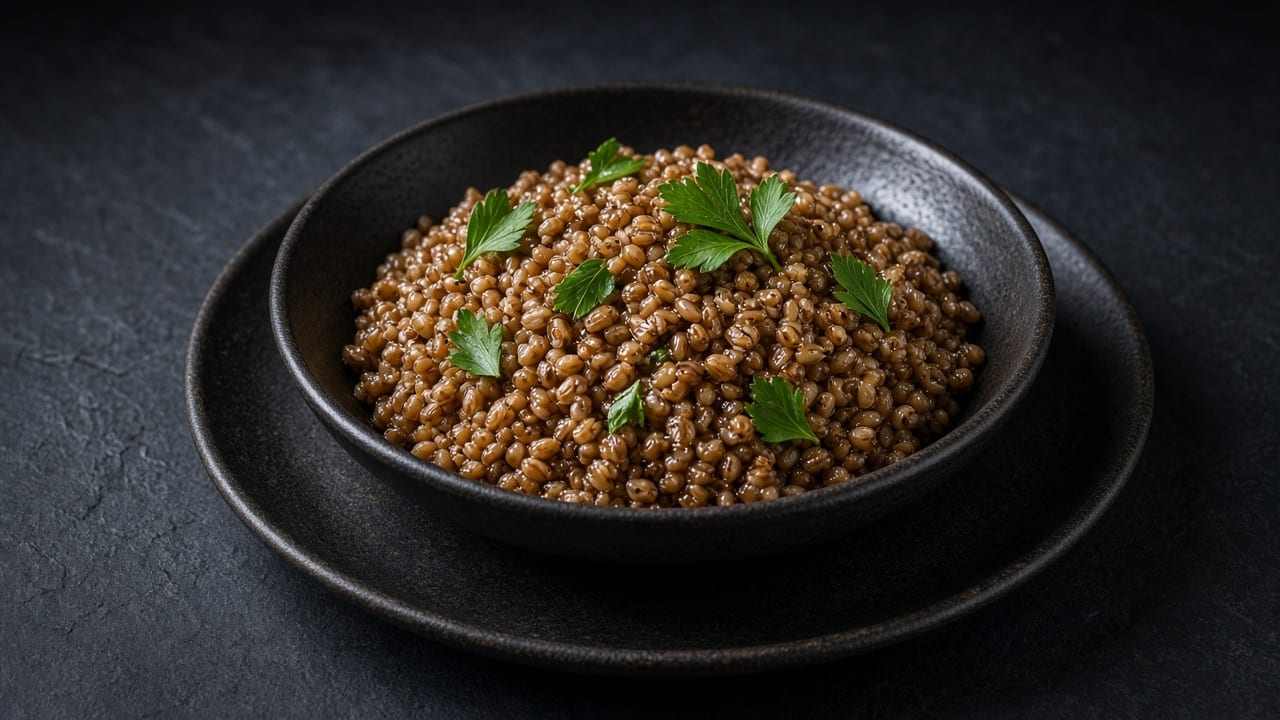
Toasted Farro with Olive Oil and Parsley
Inspired by techniques from America's Test Kitchen and Food Network Kitchen.
Dry-toasted farro boiled in plenty of salted water with bay leaves, drained and dressed with olive oil and parsley.
Always check the labels of the products you use.
Method
- 1
Heat the water. Bring the 2000 ml water to the boil in the large saucepan with the salt and bay leaves. Lots of water means the grains cook evenly and you can drain off any surplus starch.
- 2
Toast the farro. While the water heats, stir the dry farro in the frying pan over medium heat for about 6 min. When it has turned a shade darker and smells like toasted nuts, it is ready.
- 3
Boil until chewy. Tip the farro into the boiling water and simmer uncovered, stirring now and then. Semi-pearled farro needs 15-20 min and whole farro 30-40 min, so start tasting at 15 min; it should be tender with a definite chew.
- 4
Drain. Drain the farro well in the colander and fish out the bay leaves. Most of the cooking salt goes down the sink with the water.
- 5
Dress and serve. Toss the hot farro with the oil and pepper so it soaks up the flavour as it steams. Fold in most of the parsley and scatter the rest on top.
Storage
Refrigerate covered up to 5 days, or freeze up to 3 months. Serve cold in salads, or reheat with a splash of water until piping hot (74 °C). Cool leftovers in a shallow container and refrigerate within 2 hours (within 1 hour on a day above 32°C).
Why this label?
- Total fat: 26.1 % of energy (limit ≤ 30%)
- Saturated fat: 3.7 % of energy (limit < 10%)
- Free sugars: 0 % of energy (limit < 10%)
- Salt: 1.11 g (limit ≤ 1.7 g)
- Fibre or fruit & veg: 7.4 g fibre / 0 g veg (limit ≥ 3.6 g fibre or 80 g fruit & veg)
Per serving, worked out from the nutrition table against our rule based on the WHO healthy diet guidance. Not endorsed by WHO.
EU nutrition claims
- Source of protein: 3.4 g protein per 100 kcal, about 14% of energy (needs ≥ 12%)
- Source of fibre: 2.6 g fibre per 100 kcal (needs ≥ 1.5 g)
Per 100 g of the finished dish, worked out from the nutrition per serving and the lowest likely cooked weight (about 53 g a serving), so the true values are, if anything, lower. Thresholds from the Annex to EU Regulation (EC) No 1924/2006. How we decide
Free sugars
0 g per serving
0 % of the 50 g daily maximum · 0 % of the ideal 25 g
Free sugars under 50 g a day, ideally about 25 g, based on WHO free-sugar guidance (not endorsed by WHO). The share shown is the share of one serving. WHO
Equipment
- large saucepan
- medium frying pan
- wooden spoon
- colander
Nutrition per serving (estimated values)
| Per serving | Amount |
|---|---|
| Energy | 290 kcal |
| Protein | 10 g |
| Carbohydrate | 47.8 g |
| of which sugars | 4.6 g |
| of which free sugars | 0 g |
| Fat | 8.4 g |
| of which saturates | 1.2 g |
| Fibre | 7.4 g |
| Salt | 1.11 g |
Protein per 100 kcal
3.4 g High Protein needs ≥ 5 g (20% of energy)
Calculated from USDA FoodData Central ingredient values